
This 3 days in Seoul itinerary is for first-time visitors who want a full trip without a march-till-you-drop schedule. The bottom line: split the city by geography, not by attraction wishlist. Spend Day 1 in old downtown Seoul (palace, hanok alleys, market food), Day 2 on views and modern districts, and Day 3 across the Han River in Gangnam. Below is a paced, subway-linked plan built around real 2026 opening figures, with room to swap stops for weather or energy.
The 3 days in Seoul itinerary at a glance
Each day is built around one neighborhood cluster so you spend minutes, not hours, moving between stops. Seoul’s subway is the backbone of all of it — fast, air-conditioned, and signposted in English.
| Day | Theme | Key stops | Area |
|---|---|---|---|
| Day 1 | Old Seoul & palace history | Gyeongbokgung, Bukchon, Insadong, Cheonggyecheon, Gwangjang Market, Myeongdong (evening) | Jongno / downtown |
| Day 2 | Views & modern Seoul | N Seoul Tower, Myeongdong shopping, DDP, Hongdae nightlife | Namsan / Jung-gu / Mapo |
| Day 3 | River & Gangnam | Bongeunsa, Starfield COEX, Lotte World Tower, Banpo or Yeouido riverside | Gangnam / Jamsil / Han River |
What this 3 days in Seoul itinerary actually costs
Most of Seoul’s best days out are cheap or free; only a couple of stops on this route need a real ticket. Fares and admission below are compiled from official operator sites as of mid-2026, and converted at roughly ₩1,380 to US$1 — the exchange rate drifts, so treat dollar figures as ballpark.
| Stop | Adult price (₩) | Rough US$ | Notes |
|---|---|---|---|
| Subway base fare | 1,550 (T-money) / 1,650 single | ~$1.15 | Distance-based; most trips stay near the base fare |
| Gyeongbokgung Palace | 3,000 | ~$2.20 | Free if you arrive in rented hanbok |
| N Seoul Tower observatory | 29,000 | ~$21 | Cable car up is a separate fare |
| Seoul Sky (Lotte World Tower) | 33,000 | ~$24 | Online/third-party often a little cheaper |
| Banpo Rainbow Fountain | Free | — | Evening shows, mid-March to 31 October (2026 season) |
| Bongeunsa, Starfield COEX Library | Free | — | Temple and book plaza both free to enter |
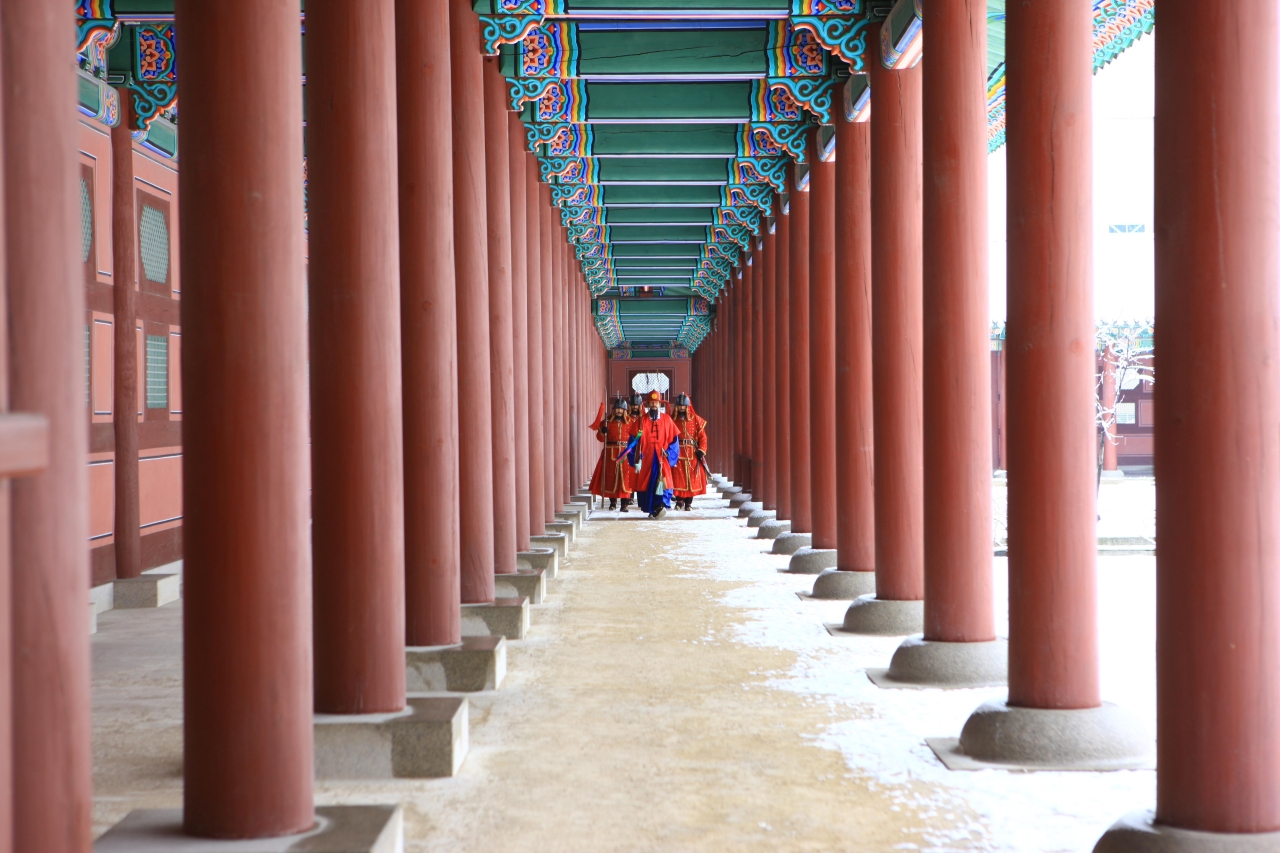
Day 1 starts at Gyeongbokgung, where the guard ceremony runs several times daily — Source: Korea Tourism Organization 관광사진갤러리 (KOGL Type 1)
Day 1 of the 3 days in Seoul itinerary: Palaces, hanok alleys, and market food
Start early at Gyeongbokgung, Seoul’s grandest palace, and aim to catch the changing-of-the-guard ceremony that runs near the main gate in the morning. From the palace’s east side it’s a short uphill walk to Bukchon Hanok Village, a lived-in neighborhood of traditional tiled-roof houses — keep your voice down, as residents actually live here. If you have the appetite for a second palace, Changdeokgung and its Secret Garden sit just east of Bukchon and reward a slower pace.
By early afternoon, drift south into Insadong for tea houses, galleries, and craft shops, then detour to the nearby Ikseon-dong hanok alley if you want cafes over souvenirs. Walk off lunch along Cheonggyecheon Stream, a restored waterway that cuts a quiet green line through downtown. For dinner, head to Gwangjang Market, Seoul’s oldest food market — the move here is bindaetteok (mung-bean pancake) and mayak gimbap eaten standing at a stall. Cap the night in Myeongdong for street snacks and neon.
Getting around: everything above is walkable within old Jongno. To reach Myeongdong, take Line 1 or 2 a couple of stops, or simply walk 20 minutes south. Food pick: a bindaetteok-and-tteokbokki graze across Gwangjang Market stalls.
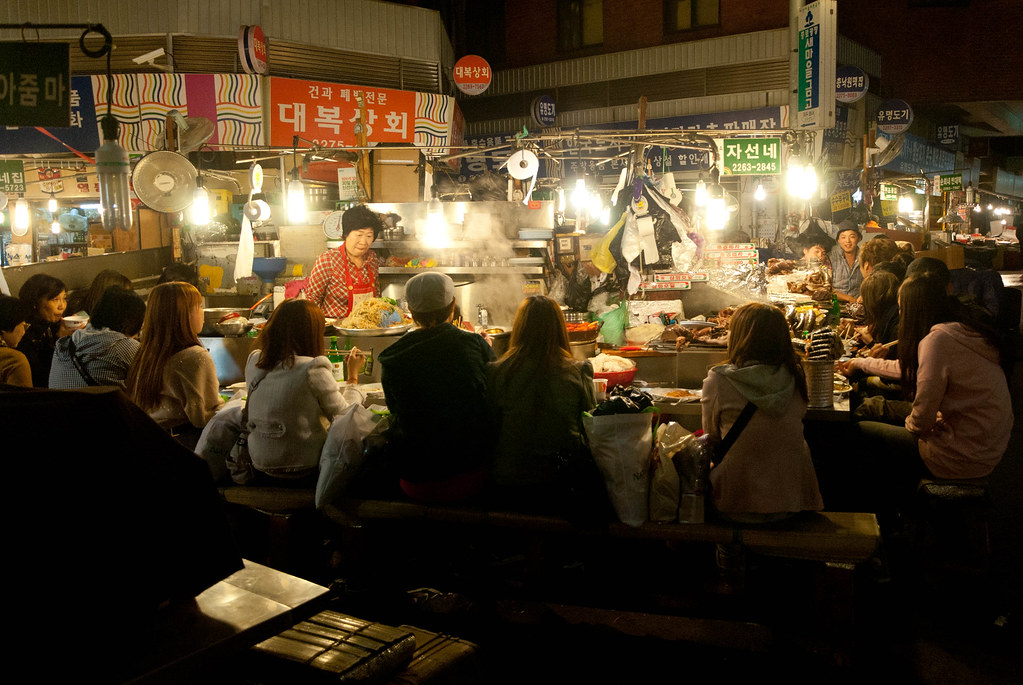
Gwangjang Market closes out Day 1 — stools, steam and a plate of bindaetteok — theaucitron, CC BY-SA 2.0 via openverse (Source: https://www.flickr.com/photos/9190330@N06/6319273831)
Day 2 of the 3 days in Seoul itinerary: The best city view, then modern Seoul after dark
Open the day at N Seoul Tower on Namsan mountain for the wide-angle orientation view that helps the rest of the trip make sense. You can hike up through Namsan Park, ride the cable car, or take the local Namsan circular bus. Come back down for a proper afternoon of shopping and street food in Myeongdong. Cosmetics, mid-range fashion, and skewers. Or swap it for the older, cheaper stalls of Namdaemun Market next door.
In the late afternoon, ride east to Dongdaemun Design Plaza (DDP), Zaha Hadid’s silver spaceship of a building, which photographs best once the LED-rose light-up begins after dark. Then it’s across town to Hongdae, the university district where buskers, bars, and late-night eateries run past midnight — the natural place to end a modern-Seoul day.
Getting around: from Myeongdong (Line 4) ride to Dongdaemun History & Culture Park (Line 4 to Line 2/5) for DDP; from there Line 2 runs directly west to Hongik University station for Hongdae. Food pick: Korean fried chicken and a cold beer at a Hongdae side-street joint.
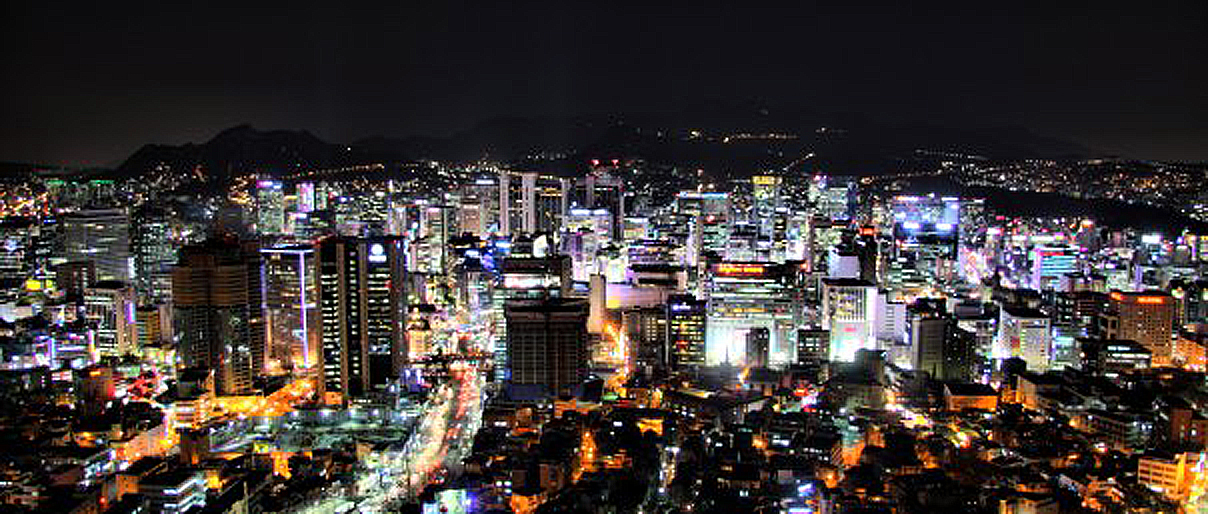
Day 2’s payoff: the city from N Seoul Tower after dark — Evilbish, CC BY-SA 3.0 via openverse (Source: https://commons.wikimedia.org/w/index.php?curid=17392881)
Day 3: Temple calm, sky-high views, and the river at night
Cross the Han River into Gangnam and begin somewhere unexpectedly peaceful: Bongeunsa Temple, a working Buddhist temple sitting improbably among glass towers. Directly across the road is Starfield Library at COEX Mall, the free two-story book atrium that has become one of Seoul’s most photographed indoor spaces — and a good rain fallback.
In the afternoon, take Line 2 three stops from Samseong to Jamsil for Lotte World Tower’s Seoul Sky, Korea’s tallest observation deck. Whether it’s worth the ₩33,000 over N Seoul Tower’s ₩29,000 is a genuine toss-up: go up here for the higher, glass-floor thrill, or skip it if you already did Namsan on Day 2. Save the evening for the river. From roughly mid-March through the end of October, the Banpo Hangang Park Rainbow Fountain runs free 20-minute shows in the evenings — the 20:00 and 20:30 slots catch the best light. Outside fountain season, or if you just want space to breathe, Yeouido Hangang Park is the classic riverside picnic spot with fried-chicken delivery and convenience-store ramyeon.
Getting around: Bongeunsa and COEX share Bongeunsa station (Line 9) and Samseong station (Line 2); Line 2 runs on to Jamsil for Lotte World Tower. For Banpo, ride to Express Bus Terminal (Line 3/7/9) and walk to the river. Food pick: the Korean picnic ritual — fried chicken plus a riverside beer at Banpo or Yeouido.
Stretching the 3 days in Seoul itinerary: a spare half-day
Got extra time? Our Places guides cover every stop in this 3 days in Seoul itinerary in full detail, plus the ones that did not fit.
Two free museums make excellent rain or jet-lag days and slot neatly into this route: the War Memorial of Korea in Yongsan, and the sprawling National Museum of Korea nearby. If you prefer a gentler second palace to Gyeongbokgung, Deoksugung blends Korean halls with Western-style stone buildings and sits right by City Hall.
Honest caveats: what can go wrong
This plan looks tidy on paper and tighter in practice. A few things to watch:
- Don’t over-stack Day 1. Two full palaces plus Bukchon, Insadong, and a market is a lot of walking. Pick either Gyeongbokgung or Changdeokgung as your main palace unless you love history.
- Palace closing days. Gyeongbokgung closes Tuesdays and Changdeokgung closes Mondays, so check before you commit a morning to one.
- The fountain is weather-dependent. Banpo’s show is cancelled in rain or strong wind, and it doesn’t run in winter — always have Yeouido or a river walk as a backup.
- Two observation decks is redundant. N Seoul Tower and Seoul Sky give similar payoffs. Doing both is fine but not necessary; most travelers pick one.
- Weather swings. Summer (July–August) is humid with sudden downpours, while late autumn and winter are cold and windy. Build in indoor stops (COEX, DDP, museums) and don’t schedule back-to-back outdoor blocks.
- Jet lag is real. If you land late, treat Day 1 as flexible and let the itinerary slide a day rather than forcing a 7 a.m. palace start.
This itinerary pairs with our companion guides on getting from the airport into the city, buying and topping up a T-money card, and picking a tourist SIM or eSIM. Sort those three out first. Everything above then becomes a tap-and-go affair.
Verified as of September 2026. Fares, admission prices, and show schedules change without much notice; double-check the official operator pages before you go.