
If a Seoul food day has one open slot, Gwangjang Market is the easiest, highest-variety way to fill it. It is Korea’s oldest permanent market. Expect a maze of narrow lanes where vendors cook in the open, ladling out mung-bean pancakes and sliding bowls of noodles across shared counters. You can graze five or six iconic Korean street foods in about 90 minutes. Then walk straight out to a riverside path. This guide lays out what the market is, what to eat, and the drawbacks worth weighing before you commit a slot to it.
- Address: 88 Changgyeonggung-ro, Jongno-gu, Seoul
- Hours: food alley roughly 09:00–23:00, open daily year-round; the general market runs ~09:00–18:00 and the vintage-clothing arcade ~10:00–19:00, both closed Sundays (individual stalls vary)
- Prices: ~₩3,000–8,000 per dish (approximate, in flux — see below)
- Getting there: Jongno 5-ga Station (Line 1), Exits 7–9; or Euljiro 4-ga (Lines 2/5), Exit 4
- ⏱ Time needed: ~1.5–2 hours
- 🔗 Pairs well with: Cheonggyecheon stream (5-min walk), Ikseon-dong hanok cafés (~10 min), Dongdaemun/DDP, Jongmyo Shrine
- ✅ Verified as of August 2026
A working market that predates the country’s modern era
Gwangjang Market opened in 1905 as Korea’s first permanent everyday market. It fed Seoul through colonial rule, war, and a frantic modernization, and it is still going. The site sprawls across roughly 42,000 square meters — far bigger than the food alley most visitors picture. Upstairs and around the edges sit textile, hanbok, and vintage-clothing sellers, and locals genuinely shop here. This is not a tourist set piece.
Most first-timers, though, come for the food alley at the center. Cooks fry, grind, steam, and plate everything in the open, and stools jam shoulder-to-shoulder around shared counters. The market drew a global audience after Netflix’s “Street Food: Asia,” and the crowds grew to match. The appeal is simple: the live, cook-in-front-of-you energy of old Seoul, packed into a few walkable lanes.
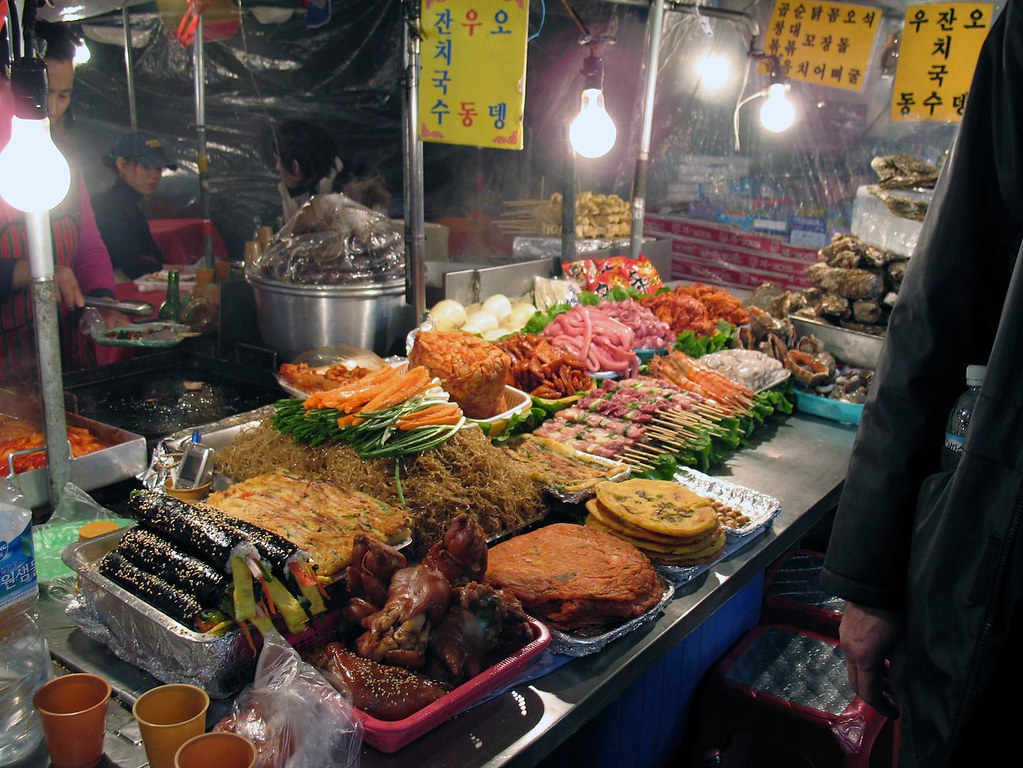
Photo: A food-alley stall piled high at Gwangjang — CC BY 2.0 via Flickr.
One detail many guides skip: wander a few aisles from the cooking smoke and the crowds thin quickly. The fabric-and-tailor maze doubles as an escape valve when the central lanes get overwhelming. There is more here than one famous alley — but for a tight 90-minute slot, the food is the point.
Building a meal in bites, stall by stall
Two dishes come up first: bindaetteok and mayak gimbap. Bindaetteok is the crisp mung-bean pancake, ground fresh and fried to order (about ₩5,000). Mayak gimbap — literally “drug” gimbap — are bite-sized seaweed rice rolls (about ₩3,000), and the nickname is more warning than joke.
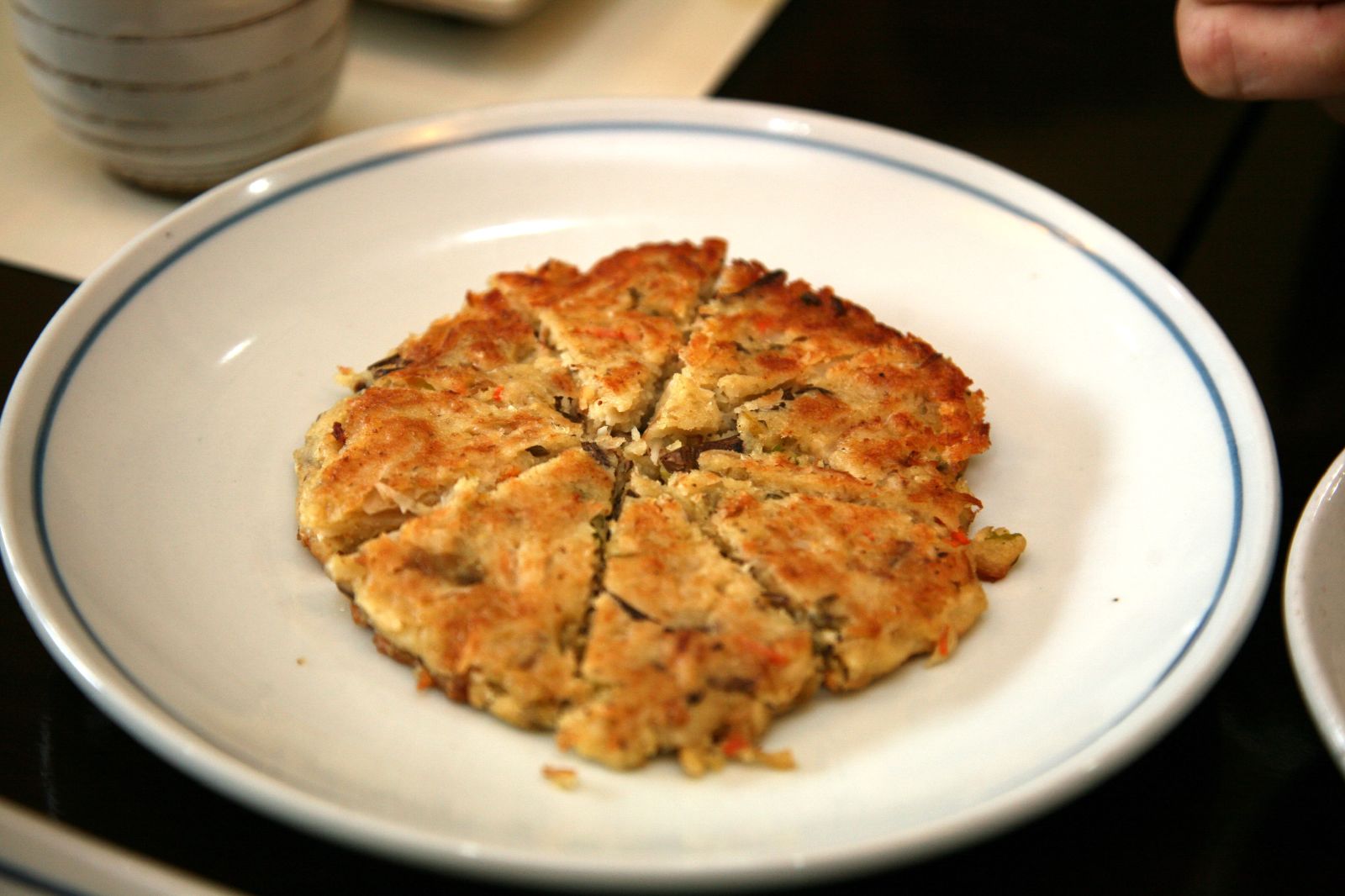
Photo: Bindaetteok, the fresh-ground mung-bean pancake — CC BY-SA 3.0 via Wikimedia Commons.
Beyond those, visitors gravitate to yukhoe (seasoned raw beef, roughly ₩15,000–20,000) and steaming kalguksu (knife-cut noodle soup, about ₩6,000). Tteokbokki, sundae, jeon, and bibimbap turn up everywhere. Prices drift, so treat all of these as ballpark. As a rough budget guide, two people can graze well on around ₩20,000–30,000 total if they split a pancake, a plate of gimbap, and a shared bowl of noodles. A yukhoe order alone can nearly match that, so decide up front whether raw beef is a priority. If the Gwangjang Market alley feels overwhelming when you arrive, walk one full loop before choosing anything. Seeing the whole run first makes the second pass much easier, and you spot which counters have free stools. Then build the meal in bites. A pancake at one stall, a few gimbap rolls at the next, a bowl of noodles to finish. No need to commit to a single menu.
One caveat on that stool, because it does not exist everywhere. The counters serving bindaetteok, kalguksu and yukhoe have seats. Several of the most photographed snack stalls do not. At those you eat standing in the middle of a narrow aisle, skewer in one hand, while a steady stream of people brushes past your back. It is memorable, and it is also genuinely awkward with a dripping cup of tteokbokki. If sitting down matters to you, choose the stall for that first and the dish second.
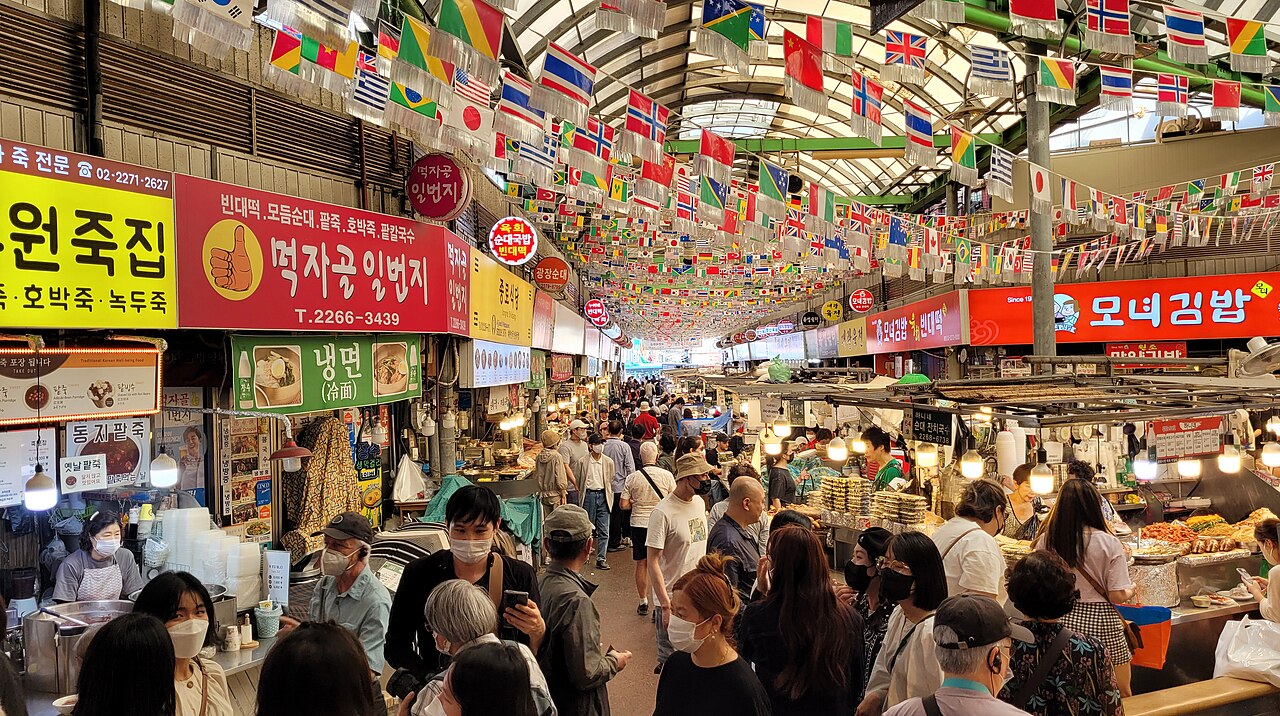
Photo: Food stalls inside Gwangjang Market — Wikimedia Commons (CC0).
Gwangjang Market’s drawbacks, and how to plan around them
Gwangjang is a fast-changing place with real drawbacks. The most consistent is over-tourism and heavy crowding. Lunch (roughly 12:00–14:00) and weekends are the worst — packed aisles and long waits for a seat. Some Seoul locals now skip it entirely.
It helps to separate two kinds of line, because they behave nothing alike. At the sit-down counters the crowd looks alarming but turns over fast, and ten minutes is a common wait even when a stall looks mobbed. The famous snack stalls are the opposite. The glutinous-rice doughnut counter has drawn thirty people deep at two in the afternoon on an ordinary weekday, and that line does not move quickly. Check whether a stall hands out numbered tickets instead of running a physical queue, too. Joining the wrong one costs you the wait twice.
The price-gouging story is a real one. Through mid-2026, travelers and Korean media flagged inflated tourist pricing, vendors pushing customers to over-order, and stingy portions. One case went viral. A ₩7,000 sundae plate arrived with about nine slices, plus a surprise ₩2,000 charge for a bottle of water. The city pushed back hard. Undercover “mystery shoppers” and a vendor real-name penalty system launched in mid-2026 to hold individual stalls accountable. Conditions are improving rather than fixed, and plenty of stalls were always fair, but it pays to stay sharp on prices.
The version that actually works is a little more than that. Say the dish’s name back to the vendor, point at the posted price, and confirm how many portions you are getting, all at the moment of ordering. Korean visitors who do this consistently report the problem simply does not arise. It also heads off the other complaint, which is less about inflated prices than about bundling. At some snack stalls the rice cakes and fritters are sold only in fixed ₩6,000 sets rather than by the piece, so a small-looking plate is the minimum order rather than a short-change. Ask first if the quantity matters to you.
A few more practical notes. Some stalls are cash-preferred or refuse cards outright, so carry small bills. A convenience store or bank ATM near Jongno 5-ga Exit 7 is the safest place to stock up before you dive in. Hygiene at certain stalls has drawn complaints and is part of the city’s current inspection push. And at peak times Gwangjang Market puts genuine pressure on seats. Vendors need tables turning, so lingering is not always welcome when it is slammed.
A weekday-morning game plan
The single most useful lever is timing. Arrive on a weekday around 10:00, after the market opens but before the lunch surge from roughly 11:30. That means free seats and a manageable crush. Carry small-bill cash so a card-refusing stall never strands you, and don’t let the language barrier stop you, since pointing works perfectly.
Come a little hungry, but not starving, so you can pace across several stalls instead of filling up on the first big plate. Share everything. Portions are built for two or more, and splitting is how you get through five stalls instead of two. Groups can split dishes so everyone tastes more without over-ordering, which also sidesteps the upsell. Vegetarians have limited but real options. Some bindaetteok, bibimbap, and veg kalguksu can work if you ask. Strict vegans should be careful, as broths and sauces cross over. For more on eating across the country, see our other Korean market guides.
Is Gwangjang your kind of stop?
Gwangjang Market suits food-curious travelers who want maximum variety and atmosphere in one short slot and don’t mind a shoulder-to-shoulder scrum. For anyone who loves grazing, trying a little of everything, and soaking up the noise of a working market, it delivers.
The quieter option — or a hard skip — makes more sense if you dislike crowds or want a calm sit-down meal. Same if you are strictly vegetarian or vegan, or price-sensitive and unwilling to confirm prices as you order. None of those are dealbreakers for everyone; they are honest mismatches. And where one applies but the experience still appeals, an early weekday-morning visit softens almost all of it.
The efficient food slot in central Seoul
The recommendation is to go in the morning and confirm prices before ordering. Treat Gwangjang Market as a roughly 90-minute grazing slot rather than a destination dinner. Pair it with a short walk along Cheonggyecheon stream next door. It makes one of the most efficient, full-of-character food stops in Seoul.
Pingback: 3 Days in Seoul: First-Timer's Itinerary (2026)