
This guide is for foreign travelers landing at Incheon International Airport (ICN) who just want to know the fastest, cheapest, or easiest way into central Seoul — without overpaying or missing the last train. Here is the bottom line on getting from Incheon Airport to Seoul. For most visitors the AREX airport train is the best-value ride into the city, an airport limousine bus wins if you have heavy bags and a hotel near a stop, and a taxi or Kakao T makes sense for groups, very late arrivals, or door-to-door convenience. Fares below are compiled from official operator sites and Incheon Airport notices as of mid-2026; currency conversions use a rough ₩1,380 = US$1.
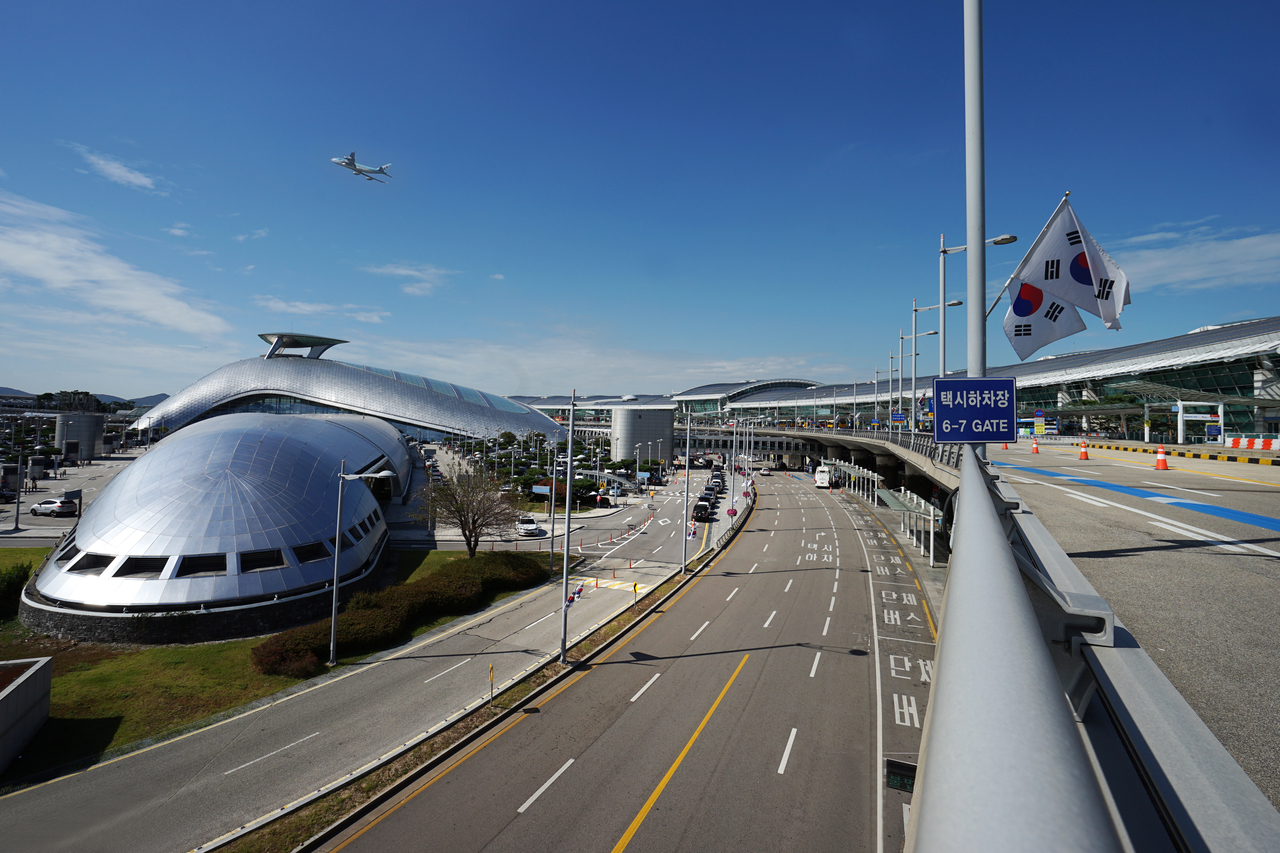
The ground-transport curb at Incheon: taxi stands, bus bays and the signed gates you walk out to — Source: Korea Tourism Organization 관광사진갤러리 (KOGL Type 1)
Incheon Airport to Seoul: the fast answer, side by side
Central Seoul is about 50 km east of the airport. Every Incheon Airport to Seoul option ends somewhere different. The train drops you at Seoul Station, buses stop near specific hotels and neighborhoods, and a taxi goes to your exact door. So “best” depends on where you are sleeping and how much luggage you are dragging.
| Option | Time to central Seoul | Approx cost | Best for |
|---|---|---|---|
| AREX Express Train (nonstop to Seoul Station) | 43 min from T1 · 51 min from T2 | ₩13,000 on-site (~US$9.50); ~₩11,500 pre-booked online | Fastest fixed-time trip to Seoul Station |
| AREX All-Stop Train (commuter) | ~59–66 min to Seoul Station | about ₩4,750 from T1 / ₩5,350 from T2 (~US$3.50–3.90) | Budget travelers; direct subway transfers |
| Airport Limousine / KAL bus | ~60–90 min (traffic-dependent) | ₩17,000 standard · ₩18,000 KAL premium (~US$12–13) | Heavy luggage; hotel near a stop |
| Regular taxi / Kakao T | ~50–70 min | ₩60,000–80,000 (~US$43–58); +20% late night | Groups, late arrivals, door-to-door |
| Deluxe (black) / International taxi | ~50–70 min | ₩90,000–120,000+ (~US$65–87) | Comfort, English-quoted fixed fare |
AREX: the train most travelers take
The Airport Railroad (AREX) is the workhorse link between ICN and Seoul Station, and in 2026 it still runs in two flavors, both operating normally.
The Express Train is a nonstop, reserved-seat service straight to Seoul Station. It takes about 43 minutes from Terminal 1 and 51 minutes from Terminal 2 (T2 is the first stop on the line, so it is a few minutes longer). Trains leave roughly every 30–40 minutes, and the last Express leaves Terminal 1 at around 22:48 (Terminal 2 around 22:40). The walk-up fare is ₩13,000, but booking online through resellers typically shaves it to around ₩11,500. At Seoul Station you can transfer to Metro Lines 1 and 4, or walk to the KTX high-speed platforms.
The All-Stop (commuter) Train is the budget hero. It looks and works like a normal subway, stops at every station along the way, and costs only about ₩4,750 from Terminal 1 or ₩5,350 from Terminal 2 to Seoul Station — payable by simply tapping a T-money card. It takes roughly 59–66 minutes and departs every 5–10 minutes. Its hidden advantage: because it plugs straight into the Seoul Metro, if your hotel sits near a subway line (say, Hongik University, Gongdeok, or Digital Media City) you may skip a transfer entirely. Trains run from about 05:25 until roughly midnight.
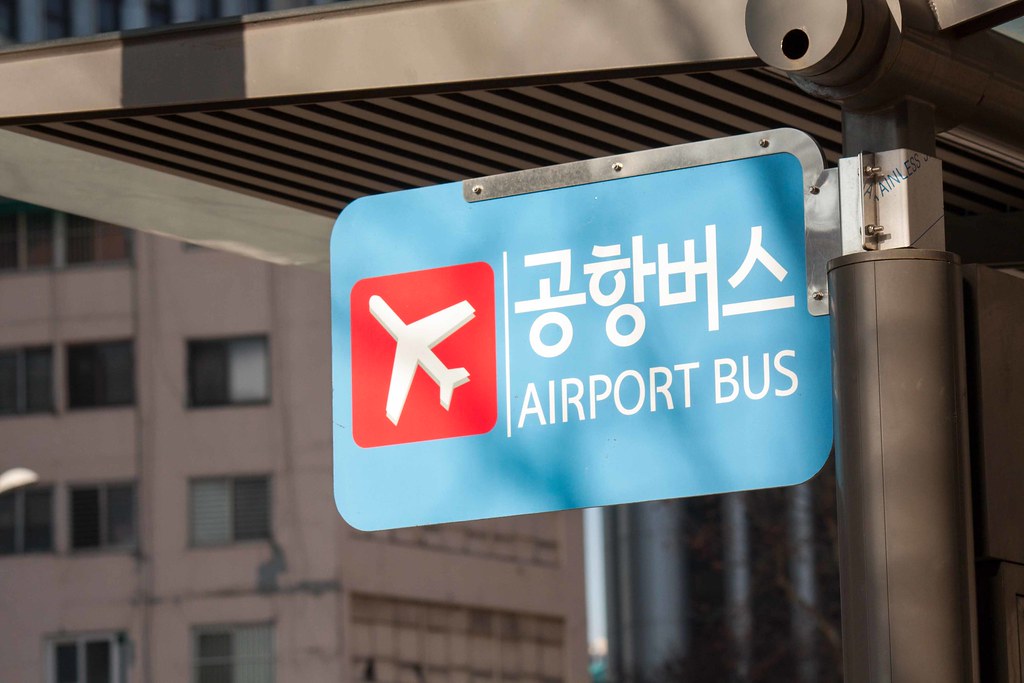
Airport bus stops are signed in Korean and English — look for 공항버스 — CC0photo, CC CC0 1.0 via openverse (Source: https://www.flickr.com/photos/137346712@N07/24151517839)
Airport limousine and KAL buses: closest to your hotel
Airport buses are the go-to for travelers with big suitcases, because you hand your bags to the driver and sit down — no stairs, no dragging. Standard airport limousine routes (numbered in the 6000s, such as 6001, 6002, 6015 and others) cost around ₩17,000 per adult as of April 2026. The premium KAL Limousine buses, in the 6700s, run direct to clusters of major hotels for about ₩18,000. Each passenger generally gets two bags free.
The catch is that every Incheon Airport to Seoul bus route serves a fixed list of stops. The buses shine only if one of them is near where you are staying. Check the route map at the airport bus ticket counter, or on the operator’s site, before you commit. Journey time is typically 60–90 minutes and swings hard with traffic. For late arrivals there are dedicated night routes (N6000, N6001, N6002) that keep running after the trains stop.
Taxis and Kakao T: door to door, for a price
A regular taxi from Incheon to central Seoul runs roughly ₩60,000–80,000 by the meter — call it around ₩65,000–75,000 to Myeongdong and ₩55,000–65,000 to Hongdae — including the Incheon Bridge toll. Download the Kakao T app before you land: it has an English interface, shows a fare estimate, and spares you any language friction at the rank. For extra comfort, “Deluxe” (black) taxis and dedicated International Taxis offer fixed, English-quoted fares but cost meaningfully more — often ₩90,000–120,000 or higher.
Two warnings. First, Seoul-licensed taxis add a late-night surcharge: 20% from 10–11 p.m., 40% from 11 p.m. to 2 a.m., and 20% from 2–4 a.m. (Incheon-licensed cars add about 20% from midnight to 4 a.m.). That can push a normal ₩80,000 fare well past ₩100,000. Second, ignore any driver who approaches you inside the terminal offering a “flat rate” — walk to the official taxi rank outside and take a metered car or a Kakao T booking.
Is there a KTX or SRT from the airport?
No — and this trips up a lot of visitors. The direct KTX high-speed service to Incheon Airport was discontinued back in 2018. There is no direct KTX from Incheon Airport to Seoul’s high-speed network. In 2026 you reach it by connecting. Ride the AREX to Seoul Station and board KTX there, or take an airport bus to Gwangmyeong Station (some 6000-series routes serve it) where KTX trains also call. There is no high-speed train departing from the airport itself.
Terminal 1 vs Terminal 2: check yours before you travel
One detail decides your whole Incheon Airport to Seoul plan: which terminal you land at.
Incheon has two passenger terminals about 15 minutes apart, and getting off at the wrong one is a classic scramble. Terminal 2 serves Korean Air, Asiana (which moved here in January 2026), Delta, Air France, KLM and their partners. Terminal 1 handles almost everyone else — most other Star Alliance and Oneworld carriers, plus most low-cost airlines. Check your boarding pass, not just the alliance.
For transport, the difference is small: both terminals have their own AREX station, bus stops and taxi ranks. The Express Train simply takes a few minutes longer from T2. If you land at the wrong terminal, a free inter-terminal shuttle runs every 5–10 minutes (about a 15–20 minute ride), or you can hop the AREX between terminals for about ₩1,200.
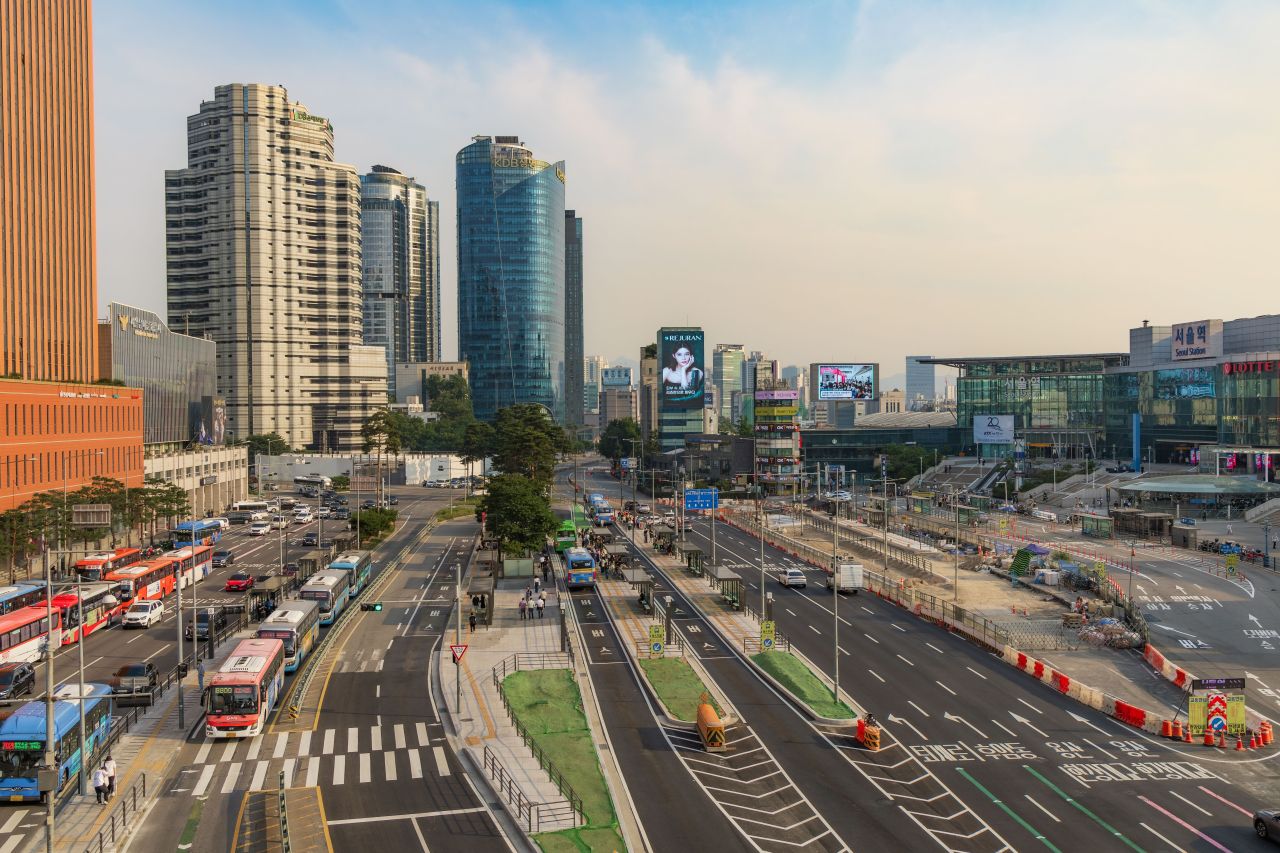
Seoul Station, where the AREX line ends and the city bus network takes over — Source: Korea Tourism Organization 관광사진갤러리 (KOGL Type 1)
Before you leave arrivals: T-money, SIM, and luggage
Do three quick things in the arrival hall and the rest of your trip gets easier. T-money card. Buy one at any airport convenience store (CU, GS25, 7-Eleven) or ticket machine for a few thousand won, then load cash. It works on every subway, bus, the AREX all-stop train, and most taxis. SIM / eSIM. The telecom (roaming) counters in the arrivals hall sell tourist SIMs and activate eSIMs on the spot. All three carriers run 24-hour arrivals counters in both Terminal 1 and Terminal 2, which matters for late landings. Some tourist SIMs double as a T-money card once you swap the chip out. Luggage delivery: services will carry your bags from the airport to your Seoul hotel, or the reverse, so you can sightsee unburdened. Expect roughly ₩17,000–45,000 per bag depending on size and area, with most operators running about 7 a.m. to 10 p.m., so it suits a daytime arrival better than a midnight one.
Once the Incheon Airport to Seoul leg is behind you, most first-timers head straight for the historic core. Our Places guides cover what follows. That means the palace district around Gyeongbokgung and the lanes of Insadong — while the shopping-and-street-food crowd makes for Myeongdong and the nightlife set aims at Hongdae. Where you are sleeping among these is what should decide your route in from the airport.
Honest caveats — what can go wrong
A few things regularly catch travelers out. Rush hour (roughly 7–9 a.m. and 5–8 p.m.) can add 30–60 minutes to any road option — bus or taxi — while the train is unaffected, so if you land in those windows, lean toward AREX. Last train and last bus. This is where the Incheon Airport to Seoul trip catches people out. The AREX stops running around midnight. Arrive after that and your realistic choices are a night bus (N6000/N6001/N6002) or a taxi with the late-night surcharge. Factor the extra cost into a red-eye budget. Buses depend on your stop: a limousine is only convenient if a route actually serves your hotel — otherwise you finish the journey by taxi or subway anyway. Terminal mix-ups cost time; confirm T1 vs T2 before you book any airport pickup. And never accept an unmetered “flat fare” from someone soliciting inside the terminal — use the official rank or Kakao T.
Verified as of September 2026. Fares, timetables and last-train times change — always double-check the current figures on the official AREX, airport bus, and Incheon Airport websites before you travel.