
If you only have time for one palace in Seoul, make it Gyeongbokgung. It is the largest of the city’s five Joseon-era palaces, and the original royal seat. Gyeongbokgung sits at the head of Seoul’s old ceremonial axis, with the ridge of Bugaksan rising behind it. Most visitors need two to three hours here. The old neighbourhoods next door sit within a ten-minute walk, so one stop tends to shape a whole first day. Treat the prices and hours below as a working guide rather than a guarantee — both change with the season.
- Address: 161 Sajik-ro, Jongno-gu, Seoul
- Hours: ~09:00–18:00 (to 18:30 mid-summer, to 17:00 in winter); last entry ~1 hour before close. Closed Tuesdays
- Admission: around ₩3,000 (free for ages 18 and under, 65+, and when wearing hanbok); Integrated Palace Ticket ~₩10,000 covers five sites
- Getting there: Gyeongbokgung Station (Line 3), Exit 5; or Gwanghwamun (Line 5)
- ⏱ Time needed: ~2–3 hours
- 🔗 Pairs well with: Bukchon Hanok Village (~10-min walk), Insadong, Tongin Market/Seochon (~10 min), Cheonggyecheon
- ✅ Verified as of May 2026
What you are actually looking at
One detail worth knowing before you arrive: much of what you walk through is not the 14th-century original. King Taejo founded the palace in 1395. Fire destroyed it during the Imjin War in 1592. It then stood in ruins for some 270 years, until a rebuild in the 1860s under the Heungseon Daewongun. What you see today is a careful reconstruction. The Japanese colonial period tore much of it down again, and restoration has continued steadily since. Once visitors set aside the expectation of ancient timber, the scale of the compound tends to take over.
The main sights line up along one straightforward loop, which is part of why Gyeongbokgung works so well as a single visit. You enter through Gwanghwamun, the main gate where the guard ceremony takes place. Beyond it stands Geunjeongjeon, the throne hall, raised on a stone terrace with rank stones set across the courtyard. That is the classic photograph, especially with Bugaksan behind it.
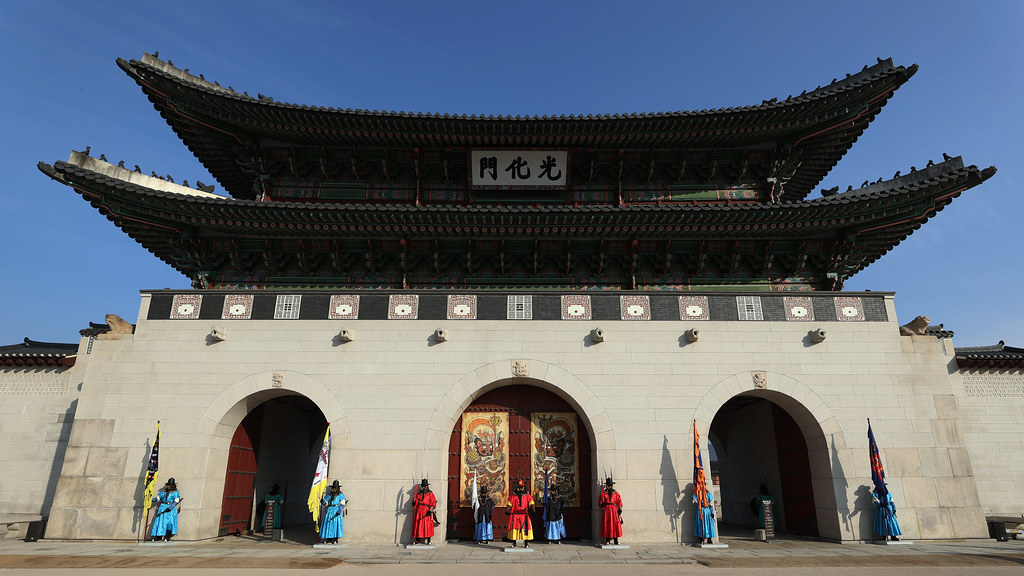
Photo: Gwanghwamun, the main gate, with the royal guard out front — CC BY 2.0 via Flickr.
Further in sits Gyeonghoeru, an open banquet pavilion on its own pond. When its columns reflect in still water, it is among the most photographed buildings in the country. Behind it, the small Hyangwonjeong pavilion sits on an islet reached by a slender bridge. Head there when the gate-side crowds build. Two free museums sit within the grounds: the National Palace Museum and the National Folk Museum. Both are worth the extra time if you have it.
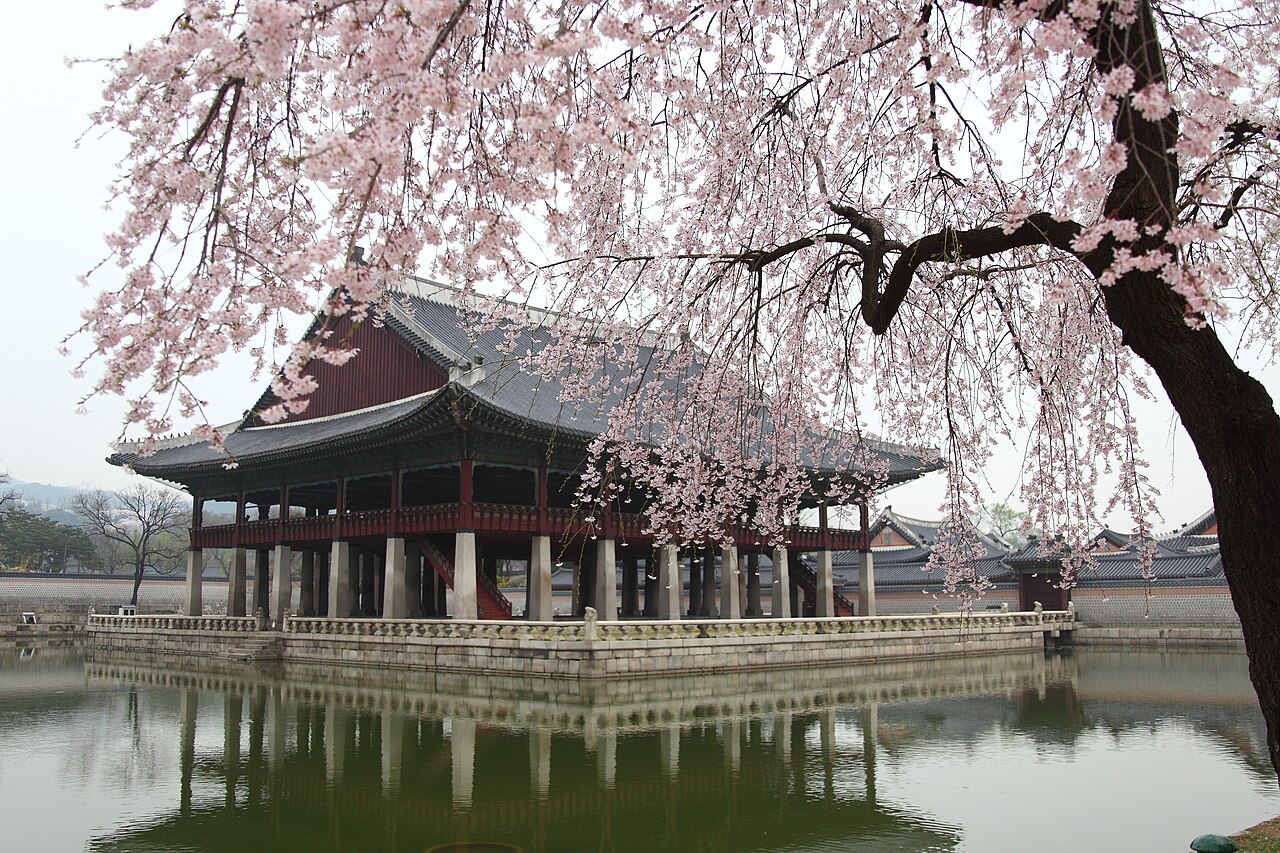
Photo: Gyeonghoeru pavilion on its pond — Wikimedia Commons.
Walking the palace front to back traces a Joseon king’s daily geography. Public audience halls give way to private living quarters, then to garden pavilions built for rest. That progression makes the compound read as a sequence, not a row of old buildings. The side courtyards and back gardens feel most atmospheric of all. Don’t rush them.
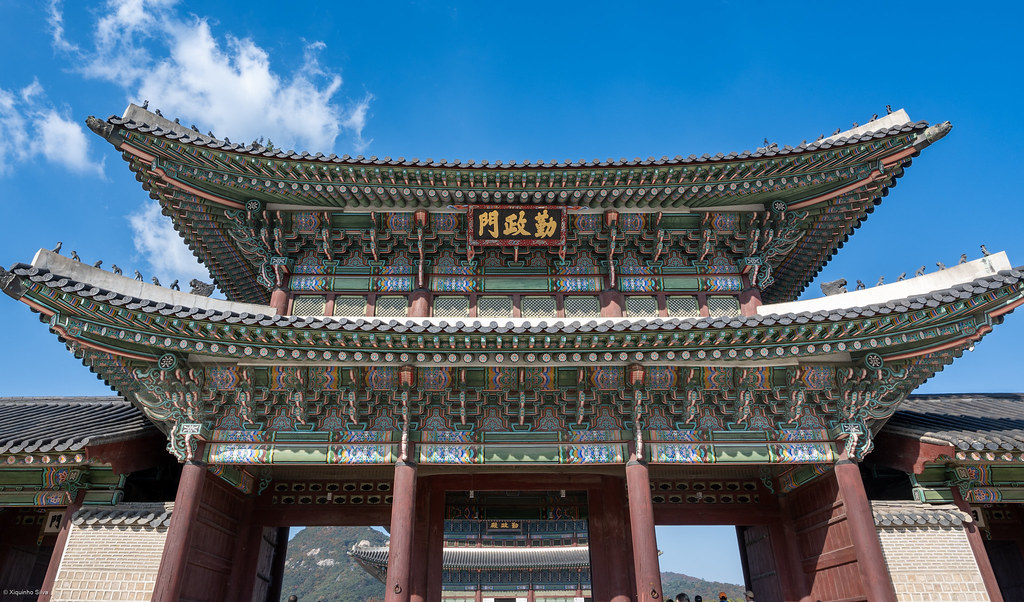
Photo: Painted eaves and signage of Geunjeongmun gate — xiquinhosilva, CC BY 2.0 via Flickr.
The Changing of the Guard — and the other things that cost nothing
The single event most visitors build their timing around is the Changing of the Royal Guard. It is free, held at the main gate, and typically runs around 10:00 and 14:00 (not on Tuesdays). The costumed guards, drums and banners are what most people remember from the visit. Front-row spots fill early, so arriving a few minutes ahead makes the difference between a clear view and the back of a crowd.
Several other things here are free and easy to miss. Wearing hanbok gets you in at no charge. A full set, top and bottom, is the condition, and rental shops cluster around the palace. Free English-language guided tours run several times a day from the information point near the entrance. The halls carry little signage, so a tour adds most of the context you would otherwise miss. And the two on-site museums are free as well. For a compound of this size, the roughly ₩3,000 ticket is unusually good value.
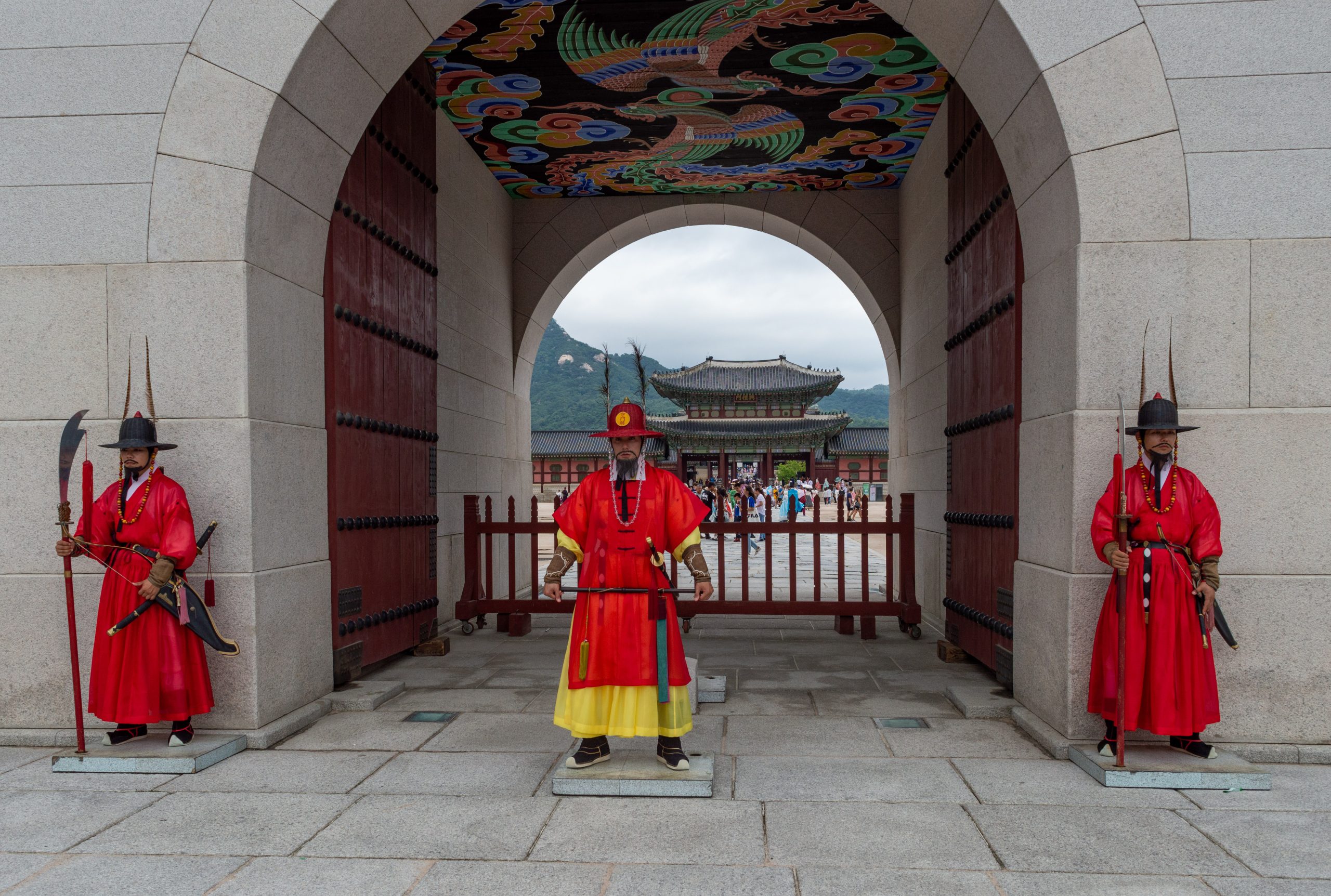
Photo: Royal guards at the Gwanghwamun gate — Tristan Surtel, CC BY-SA 4.0 via Wikimedia Commons.
Is the Integrated Palace Ticket worth it?
The ~₩10,000 Integrated Palace Ticket covers Gyeongbokgung, Changdeokgung (including its Secret Garden), Changgyeonggung, Deoksugung and Jongmyo Shrine, and stays valid for three months. Bought separately, the four palaces run roughly ₩3,000 + ₩3,000 + ₩1,000 + ₩1,000. Changdeokgung’s Secret Garden needs its own ~₩5,000 timed ticket on top. So the pass pays for itself the moment you plan to see Gyeongbokgung, Changdeokgung and the Secret Garden. If you only intend to visit one or two palaces, the single ₩3,000 ticket is the better buy. As a rough rule: three or more of these sites, get the pass; one or two, pay per site.
Before you go: the honest downsides of Gyeongbokgung
It is a strong stop, but a few things are worth knowing in advance rather than discovering on the day:
- Crowds are real. Weekends and the guard ceremony draw tour groups and hanbok photographers in large numbers.
- It is big, which means walking. Comfortable shoes matter more than visitors expect for a two-hour circuit.
- Most halls are roped off. Interiors are closed to protect them, which surprises first-timers expecting to step inside royal rooms.
- It is a reconstruction. Visitors set on all-original heritage sometimes find that a letdown.
- The Tuesday closure. The palace is closed on Tuesdays — simple to plan around, easy to forget.
- Exposed grounds. The open courtyards are hot in summer and wind-exposed in winter, and the Gwanghwamun frontage can feel touristy.
Two of those deserve more than a line. The scale genuinely defeats people. On a humid summer day the combination of heat, open courtyards and crowds wears visitors down, and plenty admit they ran out of energy and skipped the halls beyond Geunjeongjeon entirely. Children flag faster still. Treat it as a two-hour walk in full sun rather than a stroll between buildings, and plan a shaded pause.
The crush lands immediately. Everyone entering funnels straight to Geunjeongjeon, so the throne hall is at its worst in the first few minutes after you walk in. Turn left or right and work the quieter side courtyards first, then come back once the wave has moved on. Note too that the throne itself is viewed from the doorway rather than inside, and a line forms for that one spot.
If you want the night opening, plan like a local
The seasonal after-dark sessions are the hardest ticket at Gyeongbokgung, and they do not work like normal admission. Slots release online by session on the official ticketing partners, first-come, and popular months sell out. Korean visitors open a server-clock page and click the instant the release hour hits, purely to land a low queue number. If that sounds excessive, it is the difference between getting in and not. One thing that works in your favour on the night: ticket collection runs a separate queue for foreign visitors, which is usually far shorter than the main line.
Be honest with yourself about the payoff, too. The lit courtyards photograph beautifully, but the grounds are genuinely dark between the highlights. Anyone who sees poorly at night will spend the visit squinting, and several visitors come away feeling they experienced less of the palace than they would have by day.
The best way to plan your Gyeongbokgung visit
Two windows work best. Arriving right at 09:00, or in the late afternoon, avoids the calm-breaking gap between the morning rush and the early-afternoon tour groups. If the ceremony is the priority instead, plan around the 10:00 performance and claim a spot a few minutes early. Either way, joining a free English tour when the timing lines up is the easiest way to get more out of the visit.
Pack for the weather, since the courtyards are fully open: water and sun cover in summer, real layers against the funnelled wind in winter. If photographs are the point, a full hanbok gets you in free and fits the setting. And if your plan includes more than one palace, the ~₩10,000 Integrated Ticket is usually better value. See our other Seoul palace guides to map out the rest.
Who is it best for? Most first-time visitors who want one grand, photogenic history stop and do not mind crowds or walking. Who might prefer somewhere else? Anyone who cannot walk far, dislikes crowds, or only has a Tuesday free is better served by a quieter site. The more intimate Changdeokgung and its Secret Garden are the natural alternative.
In short
Aim for opening time or the 10:00 ceremony. Treat Gyeongbokgung as a two-to-three-hour grand-history stop, not a full day. Then walk on to Bukchon Hanok Village, ten minutes away. Avoid the Tuesday closure and the busiest hours, and it remains what it should be: the best single palace stop in Seoul.