
Tucked into the hills between two royal palaces, Bukchon Hanok Village is one of Seoul’s most photographed corners. It is also one of its most misunderstood. It is a real, lived-in neighborhood of curved tiled roofs and narrow stone lanes. Centuries-old hanok (traditional Korean houses) here are still actual homes. Not a museum. Not a theme park. That is exactly what makes it special — and what makes it tricky. For a Seoul day, the village works best as one easy slot. Walk 1 to 1.5 hours uphill and back, chained to the palaces on either side.
- Address: Bukchon-ro 11-gil, Jongno-gu, Seoul (the famous viewpoint lane)
- Hours: open public streets, but the famous lane (Bukchon-ro 11-gil “Red Zone”) is open to tourists only 10:00–17:00 — visiting 17:00–10:00 risks a ₩100,000 fine (enforced since Mar 2025). The rest of the village has no time limit.
- Admission: free (it’s a residential neighborhood; only museums/workshops charge)
- Getting there: Anguk Station (Line 3), Exit 2, then ~5-min uphill walk
- ⏱ Time needed: ~1–1.5 hours
- 🔗 Pairs well with: Gyeongbokgung (~10-min walk), Changdeokgung (adjacent), Samcheong-dong cafés (~10 min), Insadong
- ✅ Verified as of August 2026
One famous lane, and the seven views nobody photographs
Back in the Joseon dynasty, this hillside was prime real estate — a yangban (aristocrat) quarter wedged between Gyeongbokgung and Changdeokgung, handy for court officials. The name simply means “northern village,” for its position north of the old Cheonggyecheon stream. Today it holds around 900 hanok and roughly 6,100 residents, and most of what visitors see was built or restored in the 1920s.
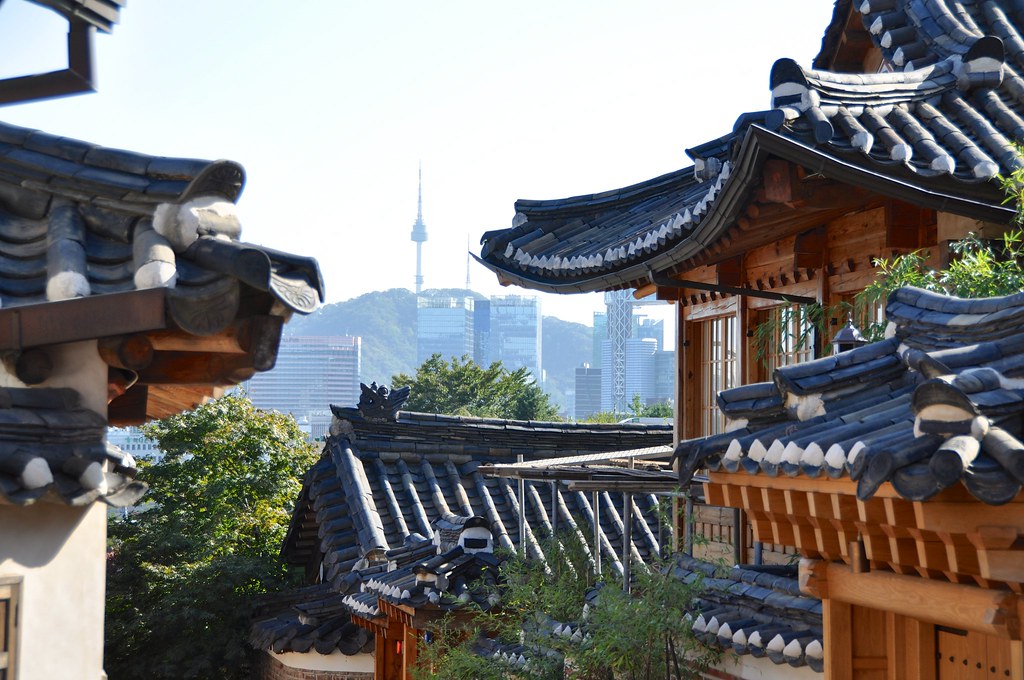
Photo: Hanok roofs cascading toward N Seoul Tower — CC BY-SA 2.0 via Flickr.
The signature Bukchon Hanok Village frame is the steep downhill stretch of Bukchon-ro 11-gil. Dark-tiled roofs tumble toward the city, with Namsan and N Seoul Tower floating in the distance. That clash of Joseon craftsmanship against a modern skyline is the shot everyone comes for. But the neighborhood is organized around the “Bukchon Eight Views,” and almost every visitor photographs only that one lane. The other seven are quieter and just as rewarding. They include the Changdeokgung panorama, the Gahoe-dong alleys, the craft-workshop street of Wonseo-dong, and the stone steps toward Samcheong-dong. Walking between them turns a hurried photo stop into an actual route.
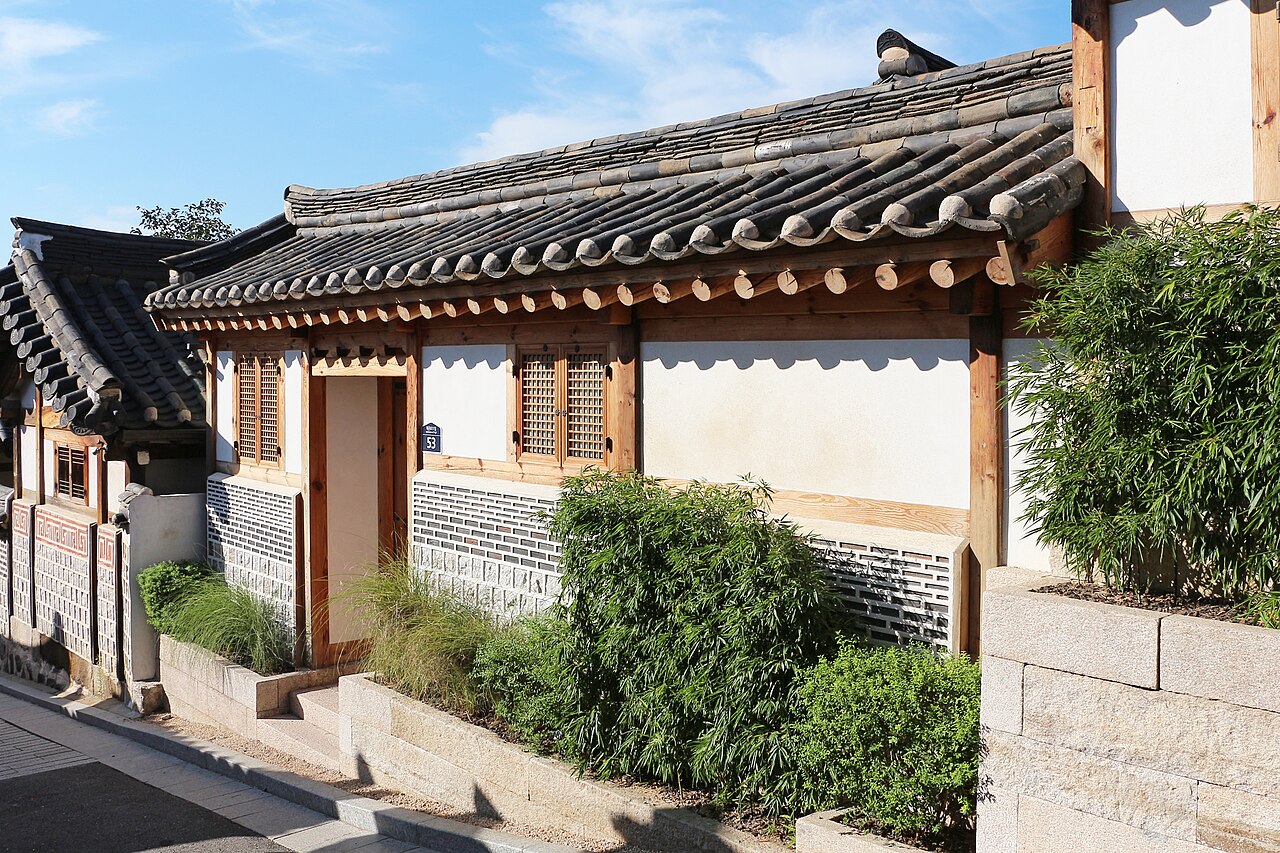
Photo: Hanok lanes in Bukchon — Wikimedia Commons.
Beyond the photo: what the lanes hold
Visitors most often praise the architecture itself — the wooden lattice doors, the graceful upturned eaves, the rhythm of grey roofs stepping down the hill. The signature view delivers when light and crowds cooperate. But the village rewards those who slow down. Duck into a small craft museum, an artisan workshop, or a hanok teahouse on a side street. Several are housed inside hanok themselves, covering crafts like knot-tying and embroidery. That turns a photo walk into something more memorable.
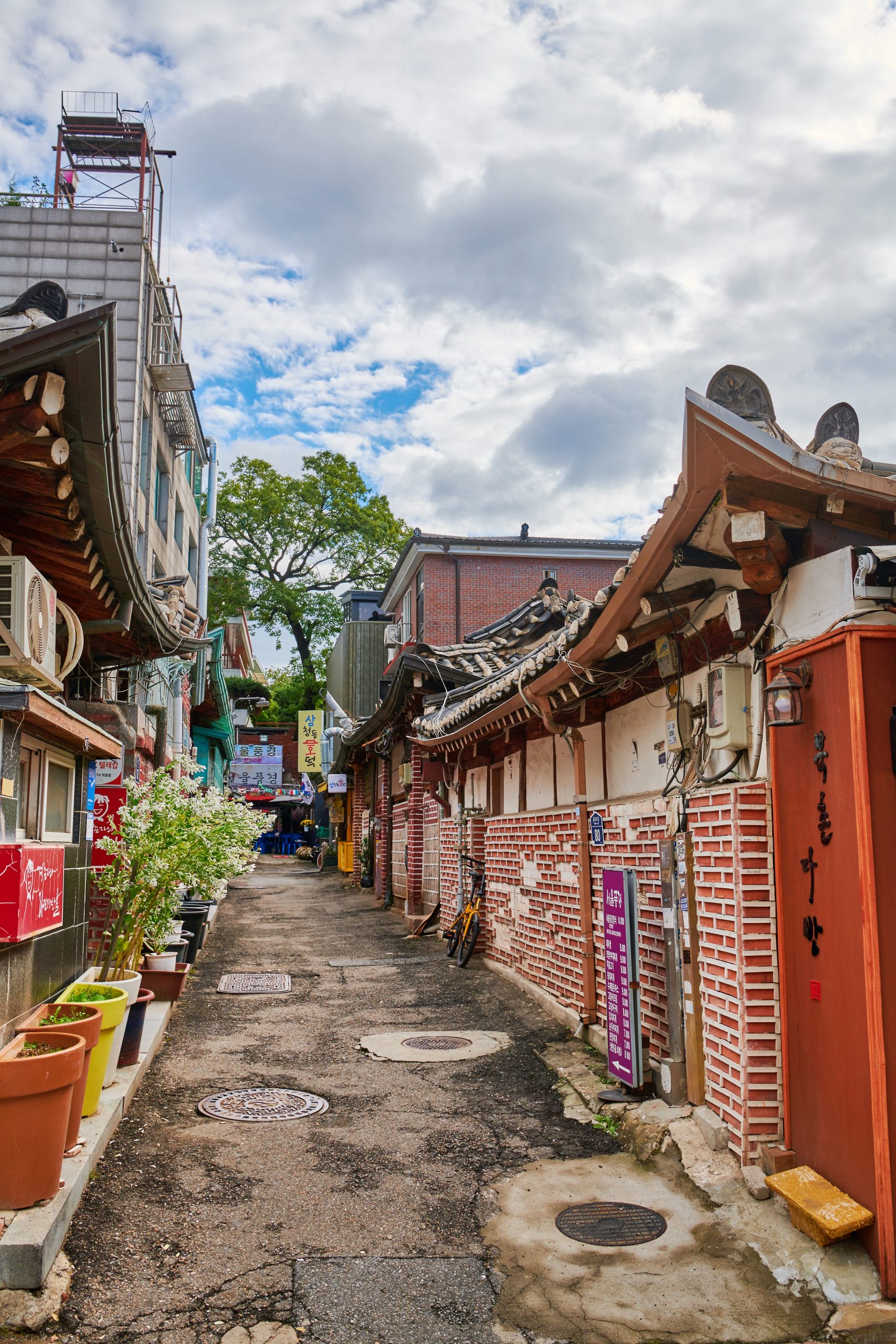
Photo: A quieter hanok lane on Gamgodang Street — Source: Korea Tourism Organization (KOGL Type 1).
The lasting payoff is the contrast: genuine Joseon architecture sitting in the middle of a hyper-modern capital. No other Seoul neighborhood pulls that off quite like this one.
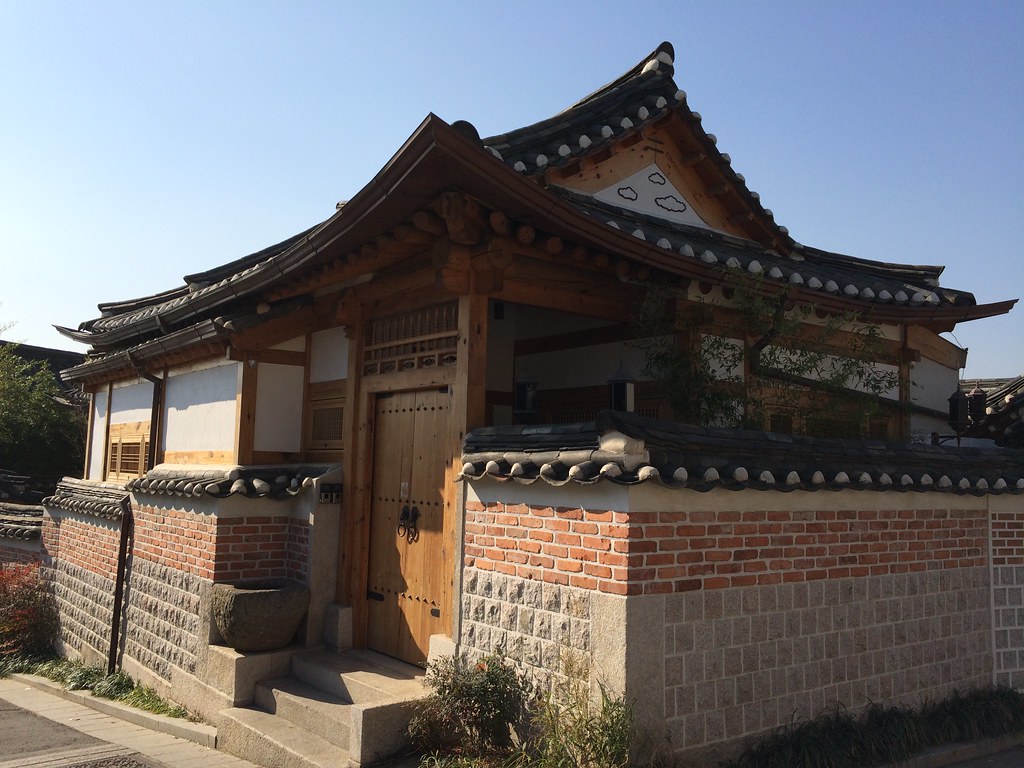
Photo: A hanok house in Bukchon — Kaeru, CC BY 2.0 via Flickr.
Before you go: the honest downsides of Bukchon Hanok Village
Bukchon is a victim of its own fame. It helps to arrive knowing this:
- Severe over-tourism. Roughly 6.4 million visitors a year descend on about 6,100 residents. At peak times, a peaceful stroll is basically impossible — the photo spots clog with crowds and tripods.
- Real access restrictions. The famous lane is open to tourists only 10:00–17:00. Arriving outside that window risks a ₩100,000 fine (enforced since March 2025), so sunrise and sunset shots of that lane are no longer possible.
- Residents under pressure. People genuinely live here, and they have pushed back over years of noise, litter, and tourists peering into homes. “Quiet please” signs are everywhere, and monitors patrol the lanes. Respect is not optional. The threshold is lower than visitors expect, too: residents say two or three people chatting normally already carries in these lanes. The upside is that the pressure has worked, and long-term residents report the late-night noise is much better than it was.
- Can feel underwhelming. Some arrive expecting attractions and leave grumbling it is “just houses.” There is little to do — the value is the streetscape, not a checklist. The same goes for the small paid rooftop viewpoints that a few houses at the top of the lanes now run. Visitors describe them as more modest than the photos suggest, so treat one as a cheap rest stop rather than a highlight.
- Steep and tiring. Hills and stone steps run throughout. Add summer heat or a rented hanbok and it becomes a workout; strollers and limited-mobility visitors struggle here.
- Do not drive up here. The Bukchon Hanok Village lanes are narrow, steep and often lined with parked cars, and the local public lots are small. The move is to leave the car in a central downtown lot and come in on foot or by subway. An all-day space booked through a parking app runs around ₩9,000.
- It is a view, so the weather decides. The signature shot depends on Namsan being visible behind the roofs. On a hazy or foggy day that backdrop is simply not there, and the lane is just a lane.
Two things about that time restriction are worth getting right, because travelers routinely over-read it. First, it does not cover the whole of Bukchon Hanok Village. Jongno-gu designated Bukchon a special management area in July 2024 and graded it into red, orange and yellow zones by how badly residents are affected. Only the red zone carries the 10:00 to 17:00 window, covering the famous lane and parts of Gahoe-dong behind Jeongdok Library. The rest of the neighborhood has no time limit at all.
Second, the rule targets sightseeing rather than presence. Residents and their guests are exempt. So are customers of shops and teahouses inside the zone, guests staying at a hanok there, and anyone simply walking through without stopping to tour. If you have booked a hanok stay or a table in the red zone, arriving after five breaks nothing. What gets fined is standing in the lane taking photos outside the window.
Timing and the walking route that works
A common approach is to go early on a weekday. The famous lane only opens to tourists at 10:00. So arrive right at opening and beat the densest crowds. The lane stays manageable between 10:00 and about 11:00. After that, tour groups build steadily until the late-afternoon closure. Comfortable shoes matter, as the hills and steps are unforgiving in flat sandals or a rented hanbok. Treat Bukchon Hanok Village as one link in a chain rather than a destination in itself. Wear shoes you can climb in, because the lanes are steep and the stone gets slick in rain. Keep your voice down as you go, and skip the doorways entirely. People are asleep behind them, and the residents of Bukchon Hanok Village did not sign up to live inside a photo set. Pairing it with the palaces on either side makes a tight, walkable half-day. A hanok teahouse gives a breather mid-walk, and our other hanok-village guides cover what lies beyond the photo spots.
A quick note on cost
Because Bukchon is a residential neighborhood, the walk itself costs nothing — a rarity among Seoul’s headline sights. Budgets add up on the extras. A hanbok rental typically runs about ₩15,000–30,000 for a few hours. Small hanok museums or craft workshops usually charge modest single-digit-thousand-won fees. Many of the smaller workshops and teahouses are cash-friendly, so carrying a little cash alongside a card smooths the visit. Set against the paid palaces next door, this makes Bukchon the cheapest anchor in a Jongno-gu morning.
Is Bukchon the right stop for your trip?
Bukchon Hanok Village suits travelers who want an atmospheric traditional streetscape and standout photos. It suits those who will arrive early and behave like guests in a real neighborhood. For that visitor, it clearly rewards the effort.
Skip it if you expect museums and activities, or cannot manage hills and steps. Skip it too if only evenings are free and the photographs are the point. The red-zone lane closes to sightseers at 17:00, so the after-dinner version of that walk is off the table, though a booked teahouse or an overnight hanok stay inside the zone still works. And anyone averse to crowds should come at opening or not at all.
Bukchon in one line
Come early, keep it short, and tread lightly. Bukchon Hanok Village is best treated as exactly what it is: a respectful, roughly one-hour photogenic walk through a living historic neighborhood. Chained to Gyeongbokgung on one side or Changdeokgung on the other, it slots cleanly into a Seoul morning. Visitors get the iconic tiled-roof view — and leave before they have overstayed their welcome.
Pingback: Hahoe Folk Village, Andong: Honest Day-Trip Guide