
Once the palaces are done, many travellers want a stop that stays distinctly Korean but runs slower. More about browsing, tea, and crafts than throne halls and ticket gates. Insadong fills that slot. It is a 700-metre arts street in the middle of Jongno, It remains the most easily reached cultured afternoon in central Seoul. Antique dealers, calligraphy brushes, hanji paper, name-stamp carvers, a well-known spiral mall, and teahouses where you can sit down and slow the pace.
It comes with a caveat that regulars will confirm: parts of Insadong have drifted touristy over the years. The value of a guide here is in knowing what still rewards your time and what to walk past. That is what this one sets out to do.
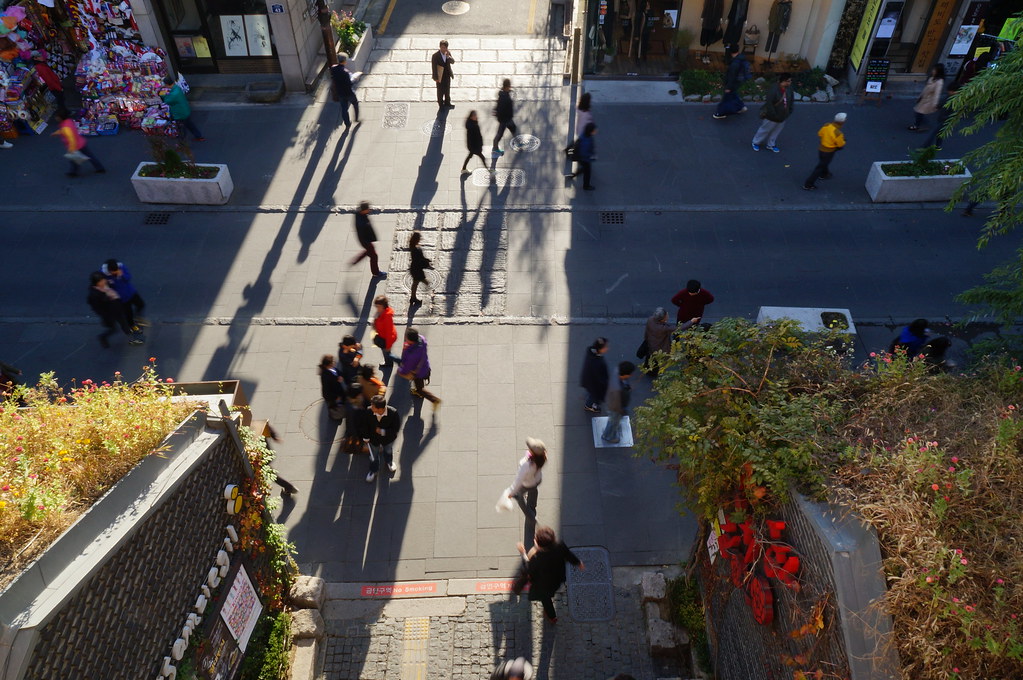
Insadong-gil, the main pedestrian lane, on a busy afternoon. Photo: CC BY-SA 2.0 via Flickr (flickr.com/photos/96578052@N02/10924462593).
- 📍 Address: Insadong-gil, Jongno-gu, Seoul
- 🕒 Hours: The street is public and open 24/7. Shops & teahouses run roughly 10:30–20:00; Ssamziegil 10:30–20:30. Best on weekends, when the street goes car-free (Sat 14:00–22:00, Sun 10:00–22:00).
- 💵 Cost: Free to walk. Traditional tea ₩8,000–12,000 (~$6–9); street snacks ₩1,000–2,000; crafts from a few thousand won up.
- 🚇 Getting there: Anguk Station (Line 3), Exit 6 — walk ~100 m and you’re at the top of the street. Jonggak (Line 1, Exit 3) reaches the south end in ~6 min.
- ⏱ Time needed: 1–3 hours (1 for a quick walk + snack, 2–3 to browse, sip tea, and dip into the alleys).
- 🔗 Nearby: Jogyesa Temple (5 min), Bukchon Hanok Village (15 min), Changdeokgung (10 min), Cheonggyecheon (8 min).
- ✅ Verified as of June 2026.
A street built on brushes, paper and stone seals
Insadong is really one main lane, Insadong-gil, with a tangle of side alleys branching off it. For generations it has been the heart of Korea’s traditional art and antique trade. This is where Seoul has long bought its calligraphy brushes, its handmade mulberry paper, its ceramics, and its carved stone seals.
Roughly a hundred small galleries sit along the street, alongside craft boutiques, hanbok shops, and teahouses tucked up narrow staircases. The atmosphere is calmer and more grown-up than Myeongdong or Dongdaemun. Visitors come to browse rather than power-shop, and that is much of the appeal.
It helps to know what the street does well before wandering in. Insadong is strongest on traditional crafts. Calligraphy brushes and ink, hand-pressed hanji paper, celadon and white porcelain, folding fans, and carved dojang name seals. Several shops will cut a personal stamp with your name in Hangul while you wait. Expect roughly ₩15,000–40,000 depending on whether the body is wood or stone. The carving takes about 15–20 minutes. For a souvenir that feels Korean rather than generic, this is the place.
The layout rewards one simple habit: walk the main street for the energy, then turn into the alleys for the substance. The franchises cluster on the main drag; the more interesting shops sit one turn off it.
Ssamziegil: the spiral that defines the street
If Insadong has a single landmark, it is Ssamziegil — a four-storey mall built as one continuous spiral ramp. You climb gently past dozens of independent craft studios and design shops without ever taking a stair. That is genuinely good news for a pushchair or a tired group. It is still a climb to the top, though, an unbroken one, so anyone with a bad knee or back should know they are walking up four storeys of slope with nowhere to pause between flights. Entry is free, and the rooftop offers a quiet little view over the tiled roofs.
Just inside the entrance is the stall most people photograph: ttongppang, literally “poop bread” — a red-bean pastry shaped exactly as the name suggests. It runs about ₩1,000, it is unashamedly a gag, and it makes an easy, cheap first bite. The shops winding up the spiral are a genuinely good place to find a handmade gift that is not a fridge magnet.
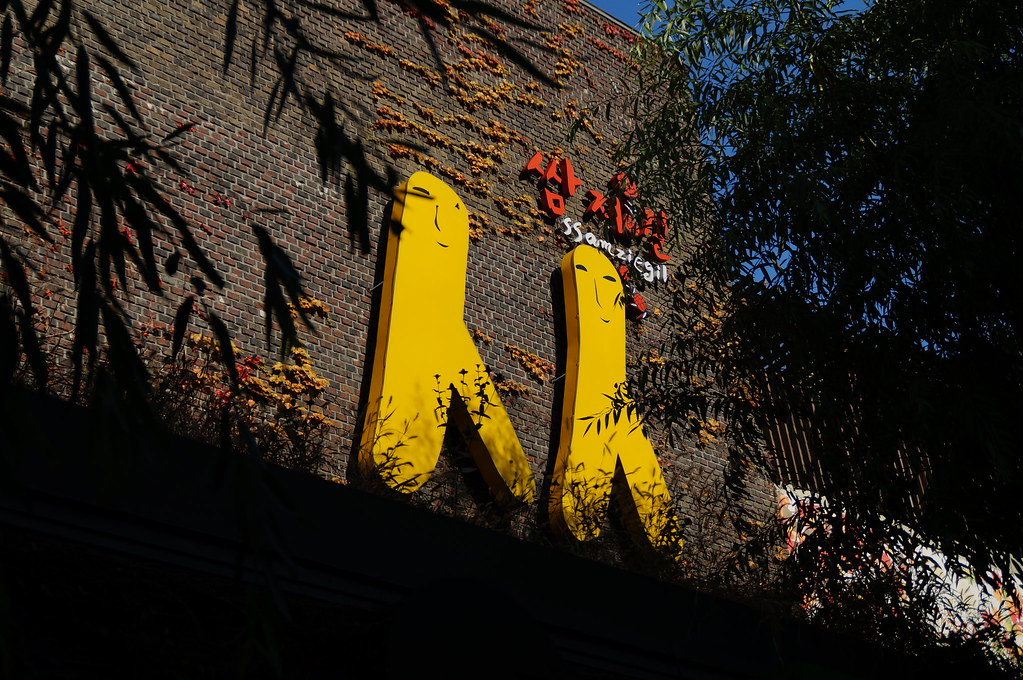
Ssamziegil, the spiral mall that anchors the street. Photo: CC BY-SA 2.0 via Flickr (flickr.com/photos/96578052@N02/10924148045).
The teahouse ritual most visitors rush past
The step hurried visitors most often skip is sitting down for tea. Insadong holds some of Seoul’s most atmospheric traditional teahouses. Old wooden rooms, low tables, and a pot of something like jujube or citron tea, usually served with a small rice cake. A pot runs ₩8,000–12,000, and what you are really buying is a half-hour of calm in the middle of a busy city. Most teahouses take cards. But a few older ones off the alleys are cash-only, so carry a small note.
One thing to plan around: these rooms are small. Most teahouses seat a couple of dozen people at most, and on a rainy or blazing day the whole street tries to get indoors at once, which is exactly when the good ones fill up. If the tea is the part of Insadong you actually want, take it early in the visit rather than saving it for the end.
As you walk, watch too for the dragon-beard candy vendors. They stretch a block of hardened honey into roughly 16,000 silk-fine threads, then wrap it around crushed nuts. The whole process is performed for a gathered crowd. It is part snack, part street theatre.
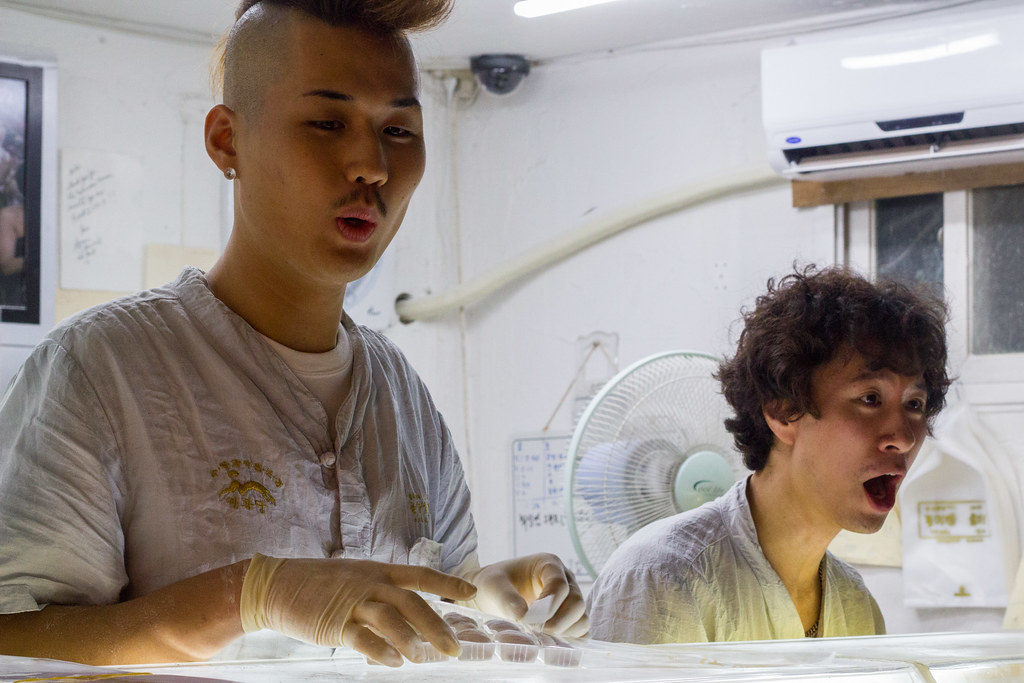
Vendors stretching honey into thousands of fine threads — dragon-beard candy. Photo: Gecko Art, CC BY 2.0 via Flickr.
Weekends turn it into a street fair
Timing changes Insadong considerably. On Saturday afternoons and Sundays the main street closes to cars and fills with buskers, craft demos, calligraphers, and pop-up stalls. The energy is excellent and it is the best window for people-watching. The trade-off is crowds: you move slowly and queue for the popular snacks.
For a calmer visit, a weekday morning is the quieter option. The galleries have space and the antique shops can be browsed without a crowd at your back. Calmer is the honest word rather than quiet, though. Korean visitors will tell you Insadong carries a crowd at more or less every hour it is open, weekday mornings included, so the realistic goal is room to move rather than solitude. As a rule of thumb, take a weekday morning for shopping and tea. Take a weekend afternoon for atmosphere and street performers. If you can only come at a weekend, arrive close to 14:00 as the street first goes car-free. That buys you the fair with the thinnest crowds.
Insadong: the drawbacks nobody mentions
Insadong has lost some of its character, and longtime visitors will say so plainly. Coffee chains, cosmetics shops, and convenience stores have moved into spaces that once held antique dealers and galleries. One older survey found barely a third of shops still sold the traditional goods the street is known for. The historic Pimatgol alley pubs nearby came down years ago.
It also gets crowded, especially on weekend afternoons when the street goes car-free. The lane is narrow, so peak times mean shuffling shoulder-to-shoulder. Some snacks and souvenirs are also priced for tourists — the same mass-made trinkets appear in shop after shop along the main drag. That has one practical upside worth using. Because the stock repeats, so do the prices, with a few hundred won of difference between shops selling an identical item, so walk the street once before buying anything.
Two arrival notes catch people out. Do not drive. Jongno parking is among the priciest in the city, the lanes around Insadong-gil are tight, and leaving a car on the street here reliably earns a ticket. And if you are moving between hotels, drop the luggage first. The lane is too crowded and too narrow for a suitcase to be anything but a fight, and taxis cannot get close to the middle of the street.
So is it a tourist trap? On the main lane, partly. But that verdict is too blunt for the whole street. The galleries, the calligraphy shops, the teahouses, and the side alleys remain the real thing. Set expectations, skip the franchises, and Insadong holds up.
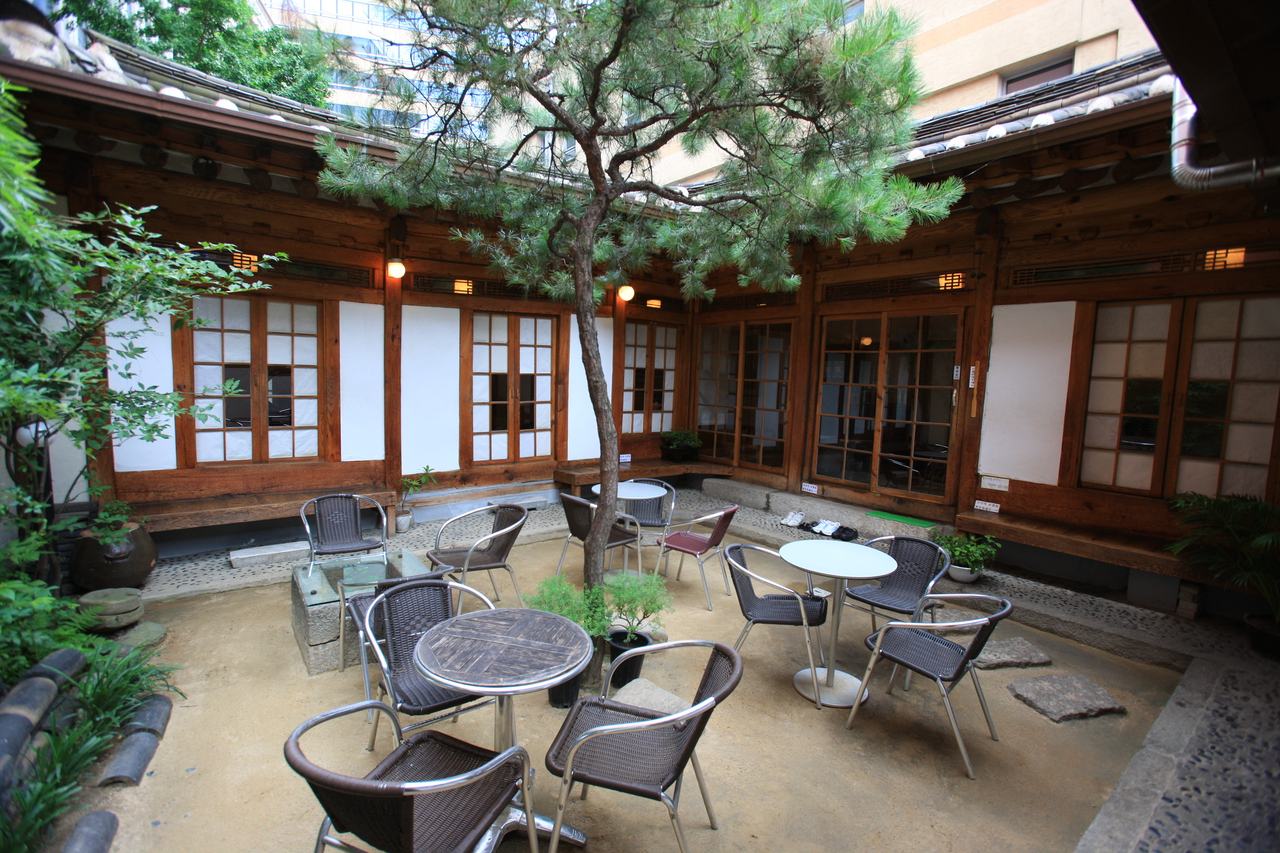
A traditional hanok teahouse courtyard, the kind tucked off Insadong-gil. Photo: Korea Tourism Organization 관광사진갤러리 (KOGL Type 1).
Is Insadong the right stop for you?
It suits travellers who like browsing crafts or want a genuine teahouse experience. It also suits anyone collecting ceramics and paper goods, or wanting a slower slot between the palaces. It works well for families, couples, and anyone who finds Myeongdong exhausting.
It is a weaker fit for shoppers chasing fashion and cosmetics, since Myeongdong or Hongdae serve that better. Same if you have already seen plenty of “old town” tourist streets and tire of crowds. In that case, a 30-minute weekday-morning pass covers it before moving on.
For most first-time visitors, though, Insadong earns its place in a Seoul itinerary. The key is treating the main street as the trailer and the alleys as the actual film.
Chaining Insadong into a half-day walk
Insadong’s real strength is location. It sits dead-centre in old Seoul, which makes it easy to fold into a longer walking day. A classic loop runs Gyeongbokgung → Bukchon Hanok Village → Anguk → Insadong → Jogyesa Temple → Cheonggyecheon → Gwangjang Market for dinner. Each leg is a short walk, and one day covers palaces, hanok lanes, crafts, a temple, a stream, and a food market.
For more central Seoul icons in the same neighbourhood, browse our Seoul markets & shopping — several sit within a 15-minute walk of Insadong-gil.