
Right across from Seoul City Hall, tucked behind a long stone wall in the thick of downtown, sits the city’s quiet surprise: Deoksugung Palace. It is the smallest of Seoul’s five grand palaces — and arguably the most unusual. Few places anywhere let traditional Korean throne halls stand a few steps from neoclassical European stone buildings, all in one compact courtyard. So does Deoksugung Palace earn a slot on a packed Seoul itinerary? For most visitors the answer is yes. It especially suits anyone wanting a calm, quick palace visit without the Gyeongbokgung scrum.
- Address: 99, Sejong-daero, Jung-gu, Seoul (서울 중구 세종대로 99)
- Hours: 09:00–21:00, last entry 20:00. Closed Mondays.
- Price: Adults 1,000 KRW · free for ages 18 and under, seniors 65+, and hanbok wearers
- Getting there: City Hall Station (Line 1 & 2), Exit 2 — a 2-minute walk to Daehanmun gate
- ⏱ Time needed: about 1 to 1.5 hours (add an hour if you book the Seokjojeon tour)
- 🔗 Nearby: the Deoksugung stonewall walkway (adjacent), Seoul Museum of Art (5-min walk), Seoul Plaza (across the road)
- ✅ Verified as of June 2026
A palace where Korean throne halls meet European stone
Deoksugung Palace began as a royal residence and only later became a full palace. Its defining chapter came in the early 1900s under Emperor Gojong, who pushed hard to modernize Korea. The grounds still carry that ambition. Classic wooden throne halls sit a few steps from neoclassical stone buildings, and that deliberate contrast is the reason to come.
The traditional side anchors on Junghwajeon, the throne hall. It once hosted royal ceremonies, and its bracketed roof and stone courtyard look every bit the part. Downtown skyscrapers rise directly behind it — a juxtaposition that has become its own kind of Seoul photo. For more royal sites around the city, see our other Seoul palace guides.
Then comes the twist. The standout is Seokjojeon, a grand neoclassical stone hall finished in 1910. A British architect designed it, and it reads more like a European mansion than a Korean palace. Today it houses the Daehan Empire History Museum, tracing Korea’s brief turn-of-the-century empire. Nearby, Jeonggwanheon is a brick pavilion with Romanesque columns under a Korean-style roof. This is where Emperor Gojong is said to have taken his coffee. Nowhere else in Seoul blends the two worlds quite like this corner.
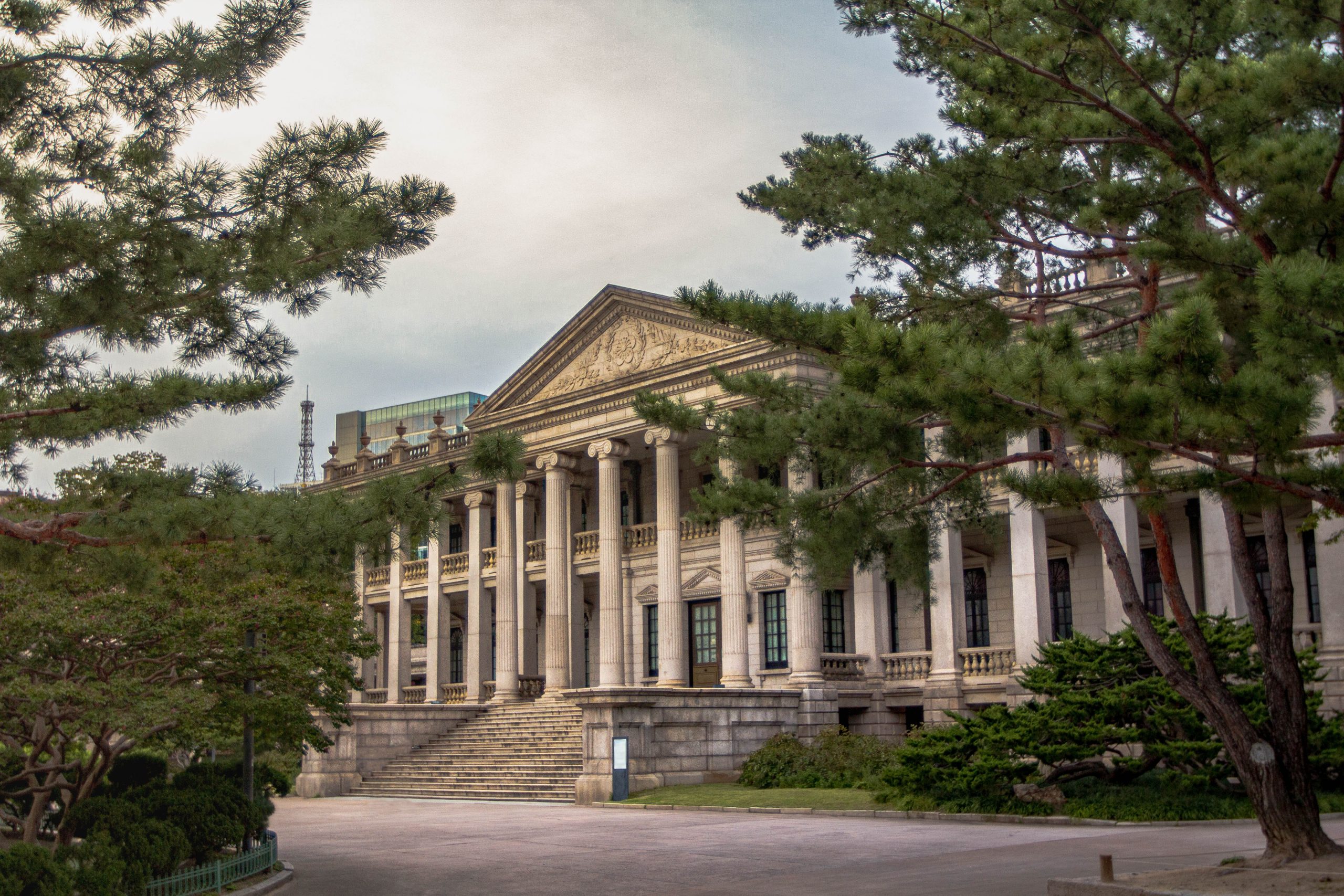
Photo: Seokjojeon, the Western-style stone hall at Deoksugung — Pip1024, CC BY-SA 4.0 via Wikimedia Commons.
The guard ceremony and the stonewall walk
Many visitors time their trip around the changing of the royal guard. It runs in front of Daehanmun gate three times a day — 11:00, 14:00, and 15:30 — with around 78 costumed guards marching in behind a commander. Bright robes, steady drums, strong photos. Mind the gaps, though. There is no ceremony on Mondays, and organizers cancel it in rain or extreme heat and cold. If only one window fits your schedule, take the 11:00 slot. It draws the smallest crowd and carries the best morning light.
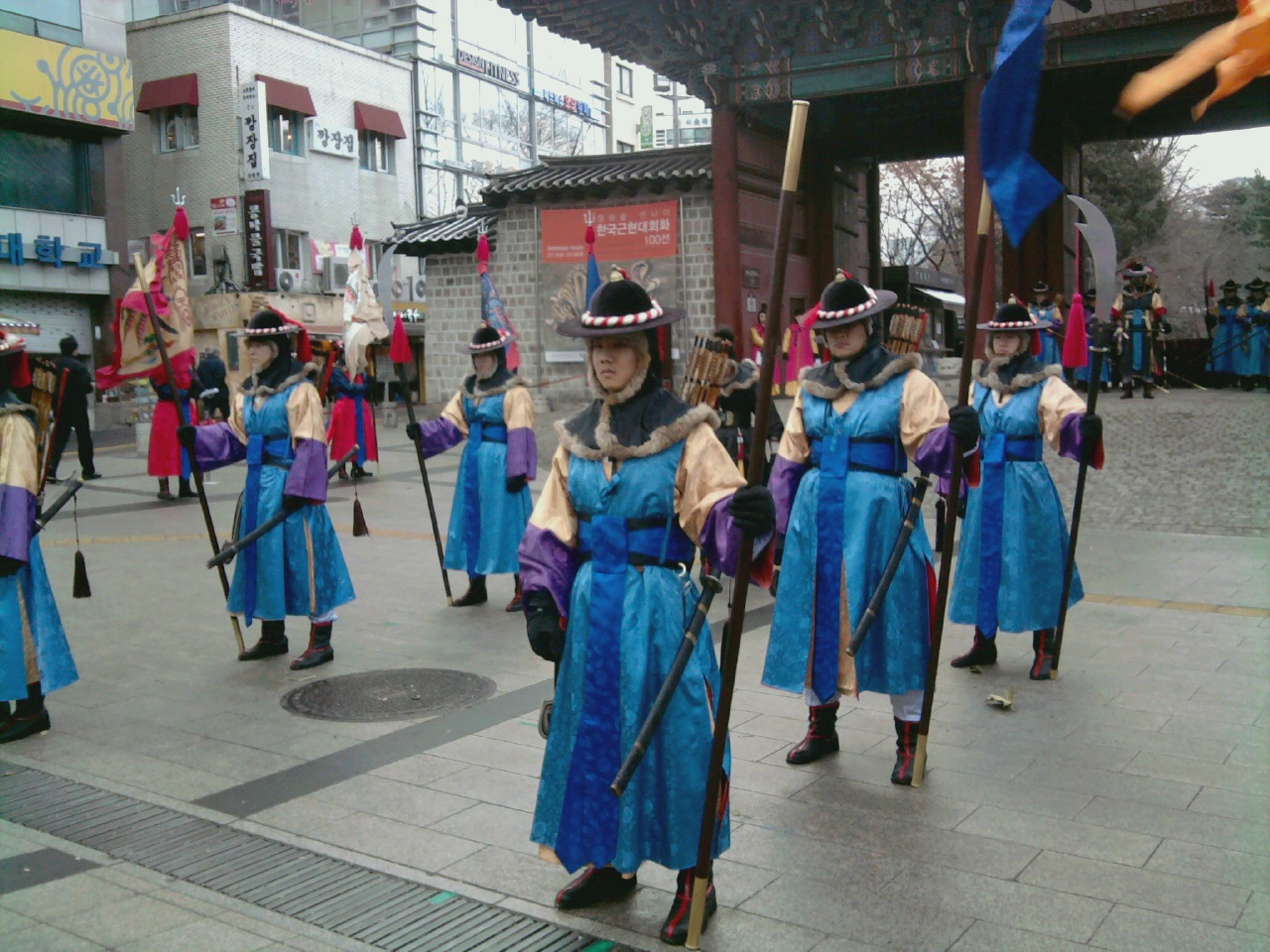
Photo: Changing-of-the-guard reenactment at Deoksugung — Salamander724, public domain via Wikimedia Commons.
The wall on the way out deserves time of its own. Just outside runs the famous Deoksugung-gil stonewall road, a tree-lined cobblestone path looping about 900 meters around the palace. It is one of Seoul’s most-loved strolls, it turns gold in autumn, and it is completely free — ticket or no ticket. It also links to the Seoul Museum of Art five minutes along the wall, whose permanent collection is free too. So you can stack a short palace visit, a gallery, and a scenic walk into a single slot.
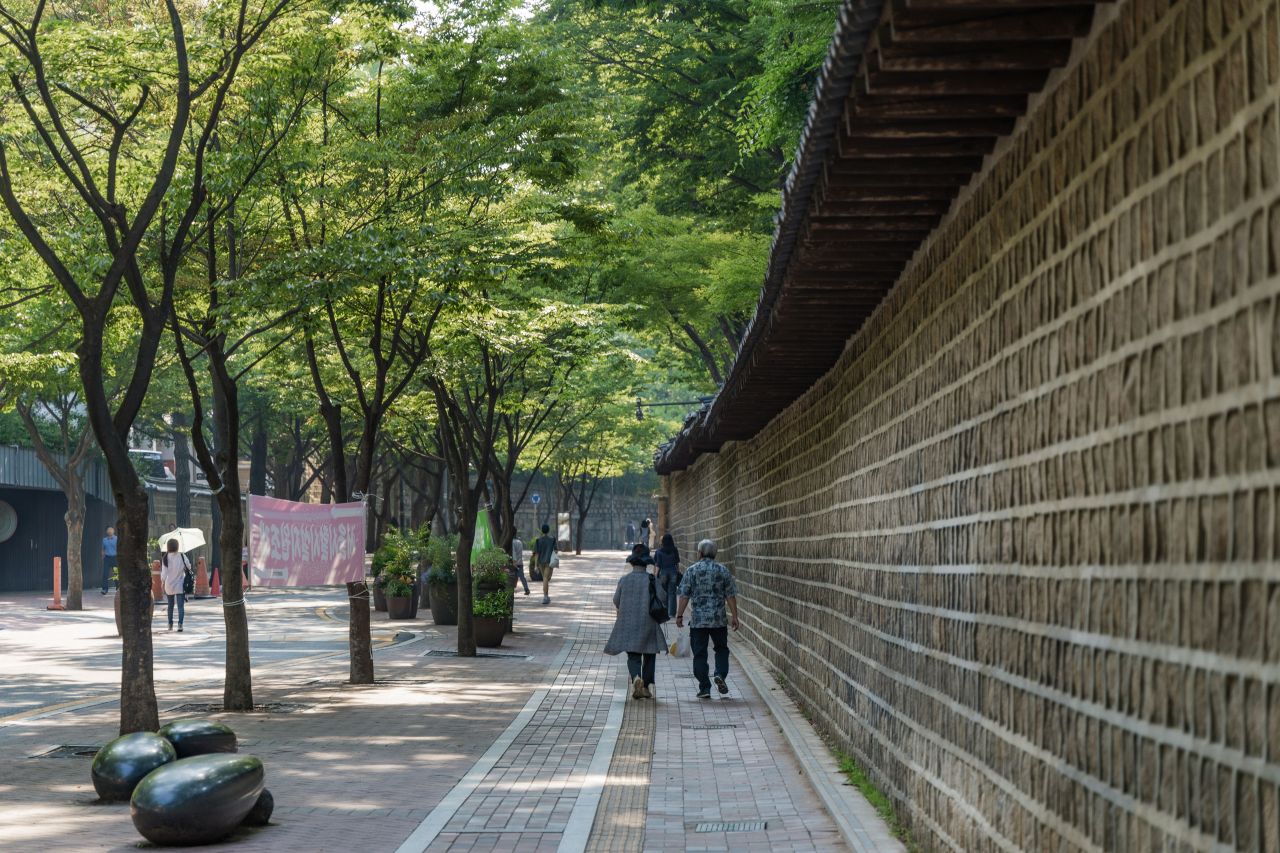
Photo: The tree-lined Deoksugung-gil stonewall road — Source: Korea Tourism Organization (KOGL Type 1).
A few caveats worth knowing at Deoksugung Palace
It is a rewarding stop, but a handful of limitations are worth weighing.
The Seokjojeon tour is the whole trip for some people — and it’s easy to miss. Rounds are numbered and start on a fixed clock, so a few minutes’ lateness costs you the slot. Expect a short wait of five to ten minutes before your group goes in. The deep-dive commentary sessions rotate their theme through the year, which is worth checking if you have a specific interest.
Not all of Seokjojeon is open. The second-floor corridor is off-limits, and several furnished rooms cannot be entered. Some visitors leave wishing they had seen the bedrooms and original furniture properly. The interiors are also dim, so photos come out harder than you expect.
It is small, and the tour can feel rushed. Only about six main buildings. After the larger palaces some visitors find it modest or over too quickly. A few come out of the guided round feeling hurried through.
Timing, access, and getting there
Weekends and holiday afternoons are the wrong window. That is when the walk-up queues build and the rounds fill. A weekday, or early morning, transforms the visit.
The Monday trap — and the holiday one. The palace closes Mondays, and so does the ceremony. Public holidays can close parts of the site too, which catches out unprepared travelers repeatedly. Confirm the day before committing.
Don’t drive. Parking around Deoksugung Palace is both expensive and genuinely hard to find. City Hall Station sits two minutes from the gate, so take the subway and skip the problem entirely.
Limited English signage. Many information boards remain Korean-only. The free English tour or a little reading beforehand fills the gap.
Patchy accessibility. It is listed as accessible, but ramps can be hard to reach and are not consistently wheelchair-friendly.
Not one for small children. The site is a preserved heritage property and the interest here is historical. Younger kids tend to find the commentary long.
Planning the visit hour by hour
For the ceremony, arrive a few minutes before 11:00, 14:00, or 15:30 to secure a clear spot by Daehanmun gate. Season matters too — in autumn the stonewall road glows red and gold and is at its most photogenic. On cost, three routes save money. Wearing a hanbok gets you in free, against the standard 1,000 KRW adult ticket. The last Wednesday of each month is Culture Day, when admission is free for everyone. And palace-hoppers can buy the 6,000 KRW combination ticket covering all four main palaces plus Jongmyo Shrine (valid six months), which pays off once you add Gyeongbokgung and Changdeokgung. One practical note on payment: the ticket booth takes cards, but small vendors along Deoksugung-gil often prefer cash, so carry a little. Free English guided tours run on a set schedule, so check the times posted at the booth on arrival.
Is Deoksugung Palace the right palace for your trip?
It suits anyone wanting a short, low-stress palace visit, a taste of unusual architecture, or the guard ceremony without heavy crowds. It also pairs well with an evening walk, since the gates stay open until 21:00 — a genuinely rare after-dark palace in Seoul.
Those with time for only one palace who want the grandest scale are better served by Gyeongbokgung. And no one should plan on a Monday, when both the palace and the ceremony are shut.
Where Deoksugung Palace fits in a Seoul itinerary
The draw is the East-meets-West mash-up. The lingering pleasure is the stonewall stroll. The smart timing is the 11:00 ceremony or a dusk visit. Treated as a calm, inexpensive, roughly one-hour stop in the middle of downtown, Deoksugung Palace may well be the most charming palace surprise in the city.
Pingback: 3 Days in Seoul: First-Timer's Itinerary (2026)