
Gwangjang draws the food-tour crowds and the TV cameras, but the market that actually built shopping in Seoul is Namdaemun Market. It has been trading since 1414 — the same century Sejong was inventing Hangul — and it remains the largest traditional market in the country. This is not a polished food court dressed up as something old. It is a sprawling, loud, slightly overwhelming maze where wholesalers, grandmothers buying kids’ clothes by the armful, and hotteok-clutching tourists all share the same narrow alley. That mix is exactly why it endures. Here is how to give Namdaemun one good slot of your day without getting swallowed by it.
- 📍 Address: 21, Namdaemunsijang 4-gil, Jung-gu, Seoul (남대문시장4길 21, 중구)
- 🕘 Hours: Retail shops roughly 9:00 AM–6:00 PM. Wholesale trade runs overnight (~11 PM–4 AM), some stalls open by 5 AM. Many wholesale shops close Sunday; food alleys and retail are more variable.
- 💸 Price: Free to enter. Hotteok ~1,500–3,000 KRW; a galchi-jorim (braised hairtail) set ~7,000–10,000 KRW. Bring cash — some stalls don’t take cards.
- 🚇 Getting there: Subway Line 4, Hoehyeon Station (회현역), Exit 5 — the street-food stalls are right outside the exit. Also a ~10-min walk from Seoul Station.
- ⏱ Time needed: 2–3 hours to do it justice (food + a wander).
- 🔗 Nearby: Sungnyemun (Namdaemun Gate) next door, Myeongdong ~11 min on foot, Namsan & N Seoul Tower a short uphill walk.
- ✅ Verified as of June 2026.
Six centuries of Seoul, still open for business
Namdaemun Market began as a government-run marketplace in 1414, beside the great south gate it is named after. Six centuries later it has become a small city of its own — thousands of shops packed into a grid of covered lanes just north of Seoul Station. How many shops, exactly? Estimates swing wildly, from around 5,000 to nearly 20,000 depending on whether the count includes wholesalers or only retail stalls. Nobody agrees, and that very vagueness tells you something about the scale.
This is the market the others measure themselves against. Gwangjang is older as a permanent market building, but Namdaemun is the bigger sprawl and the one that has anchored everyday Seoul shopping for generation after generation. Walk it once and the reason locals still come for the basics — not just the photos — becomes clear.
What draws visitors here is not a single landmark. It is the texture: vendors calling out prices, steam rising off noodle pots, a whole alley that sells nothing but eyeglasses, another that is all children’s clothes, another stacked with ginseng and dried goods. Real wholesale commerce still happens at 2 AM. You are walking through a working machine, not a museum.
The two food alleys worth crossing town for
If visitors do one thing at Namdaemun, they eat. The market has two food alleys that reward the trip, plus the best street snack outside Exit 5. On timing: the galchi and kalguksu lanes are busiest between noon and 1:30 PM, when nearby office workers pour in — arrive around 11:30 AM or after 2 PM and you will usually walk straight to a stool instead of hovering behind someone’s chair.
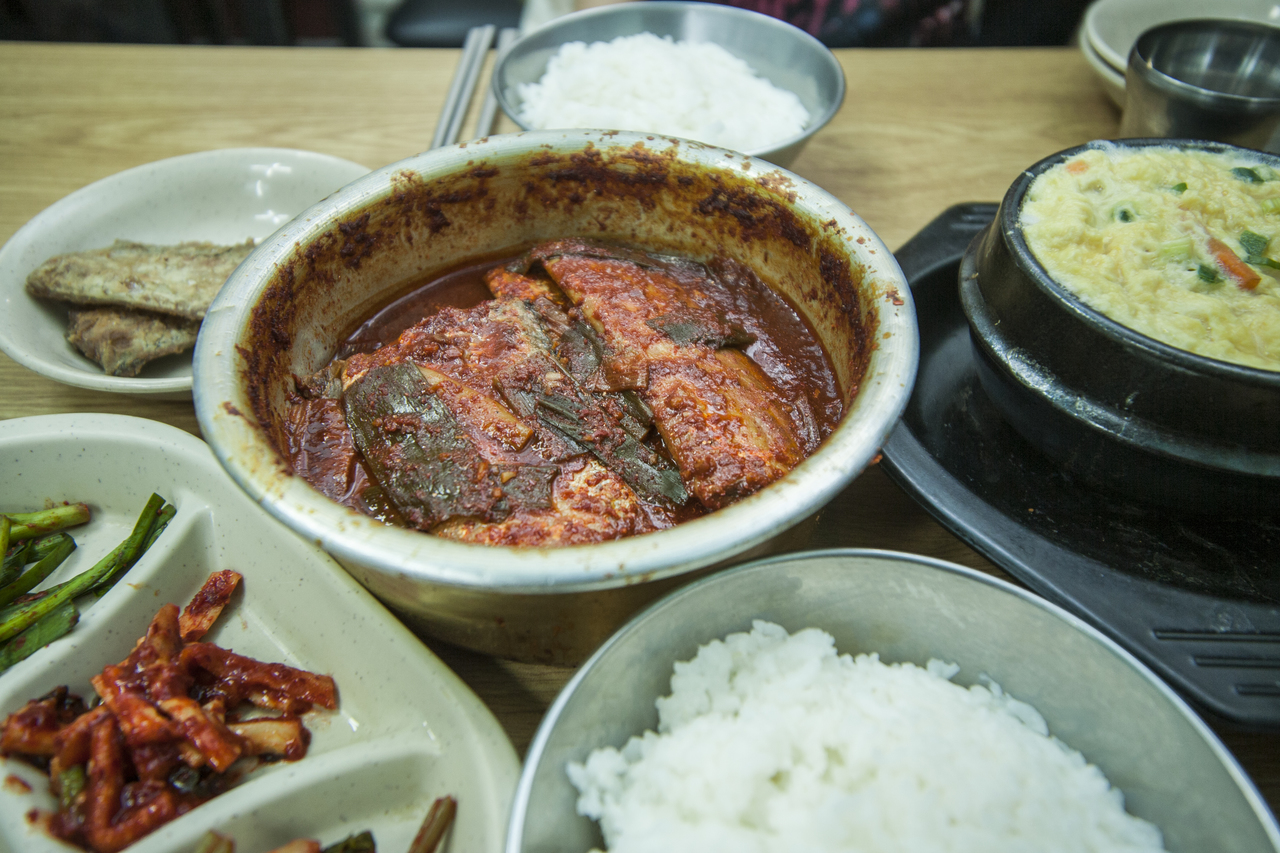
Galchi jorim — braised hairtail in a spicy radish broth — with rice and banchan. Photo: 남대문시장, Korea Tourism Organization 관광사진갤러리 (KOGL Type 1).
Galchi Jorim Alley is the signature. Galchi is hairtail — a silvery fish braised in a spicy radish-and-chili broth until it falls off the bone — and a single narrow lane cooks almost nothing else. You sit elbow-to-elbow, a set lands in front of you with rice and a spread of banchan, and the whole meal runs about 7,000–10,000 KRW. It is spicy, deeply savory, and tastes like a local secret even though every guidebook lists it.
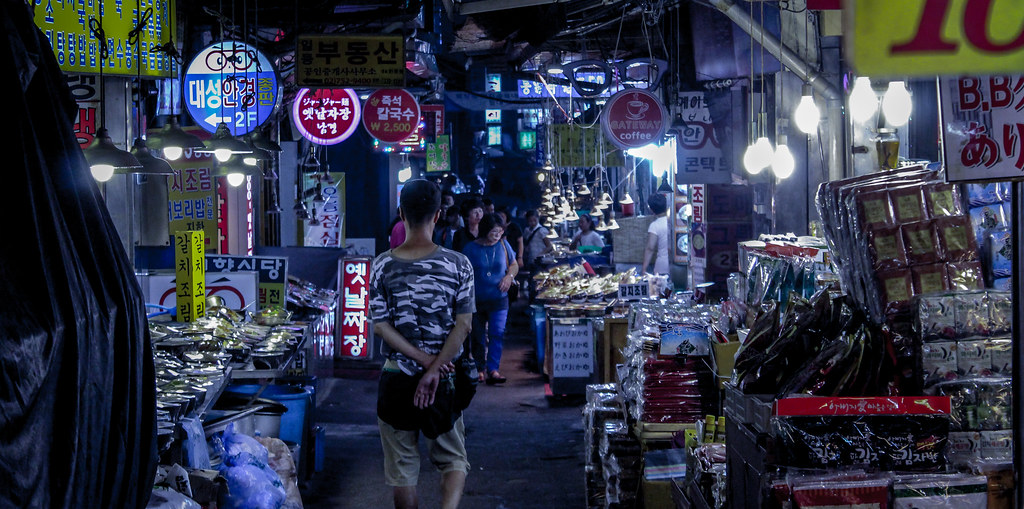
An evening in one of Namdaemun’s covered food alleys, neon noodle signs and all. Photo: sunbeams879, CC BY 2.0 via Flickr.
Kalguksu Alley — sometimes called the “gourmand” alley — is the other one. A dozen-odd vendors hand-cut knife noodles into hot broth, alongside barley bibimbap and cold bibim-naengmyeon in summer. It is cheap, fast, and exactly the warm bowl you want after an hour on your feet.
The shopping, and who it actually suits
Namdaemun is a wholesale market first, which shapes what is worth your time. For kids’ clothes, eyeglasses, hats, hair accessories, hanbok, kitchenware, or ginseng, it is genuinely one of the cheapest places in Seoul to buy them — prices sit well below Myeongdong and the department stores. As a rough guide, first-timers report the same sunglasses or hair accessories running roughly 30–50% under Myeongdong shelf prices, and eyeglasses can be fitted for a fraction of a mall optician’s quote. Vendors often expect bulk purchases, but most will sell single pieces to tourists.
For trendy fashion or sit-down boutiques, though, Myeongdong is the better call. Namdaemun’s strength is volume and value, not browsing comfort. A common approach that works: come with a target in mind — sunglasses and a gift for a niece, say — and the market delivers. Arrive to aimlessly window-shop and the sheer density wears you down fast.
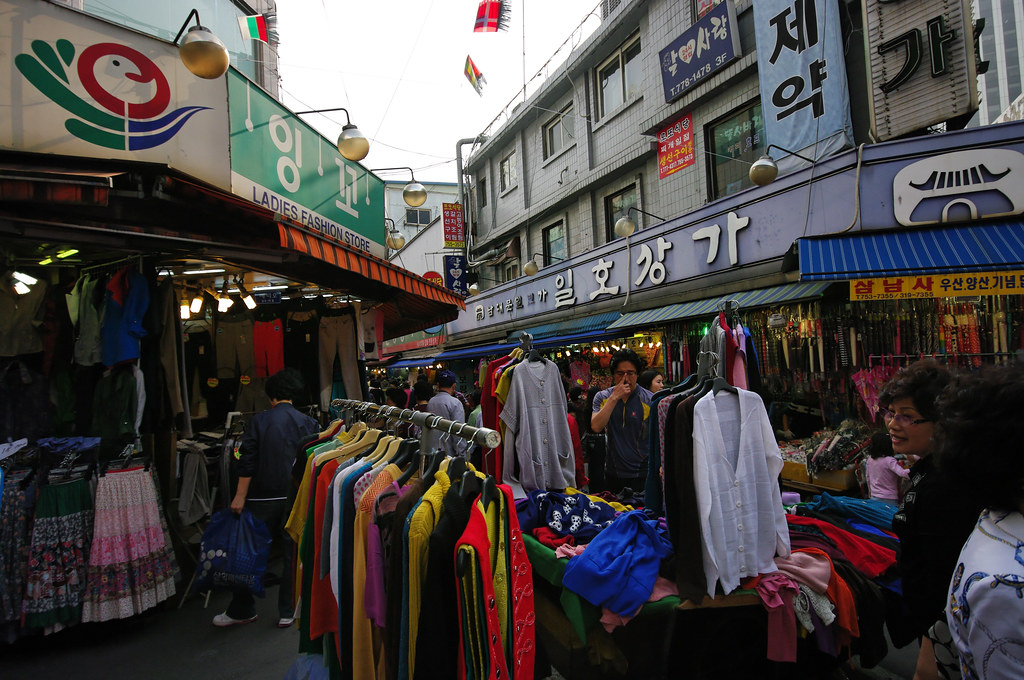
Threading the colorful clothing and accessory stalls at Namdaemun Market. Photo: Emmanuel Dyan, CC BY 2.0 via Flickr.
A few caveats worth knowing at Namdaemun Market
Namdaemun is not for everyone. It is crowded — packed and chaotic on weekends, with alleys that turn hot and cramped. The layout is a genuine maze; you will lose your bearings, and English signage is thin. Bring patience and a cash buffer, since some stalls don’t take cards.
The Namdaemun Market vendor experience divides opinion. Plenty of visitors find the sellers friendly and not pushy. Others report being quoted inflated prices as obvious foreigners, or pressured to buy. It is not universal and not a reason to stay away — just glance at a price before committing, and walk away if something feels off.
The hard sell is real in places. Korean shoppers describe the hawking in the clothing sections as full-on, and say plainly that anyone who finds that stressful should shop elsewhere. It is not aggression so much as volume. A smile and a steady walk works.
Namdaemun Market: the honest word on hygiene and the food alleys
Kalguksu Alley is not spotless. This comes up often enough in Korean reviews to state plainly: diners who loved the food still flagged the cleanliness. The stalls are open, the turnover is furious, and the wiping-down is quick. Most people eat happily and are fine. If you are squeamish about that sort of thing, this alley is the wrong one for you.
Galchi Alley has slipped. Cutlassfish prices have climbed, and regulars now report smaller portions — two modest pieces where there used to be more — for the same money. It is still an experience worth having, but go in expecting a fair meal rather than the bargain of legend.
Expect to queue at Namdaemun Market, even midweek. The famous dumpling and hotteok stalls run lines at almost any hour, not only at lunch. The lines move fast because packing is quick. Just know that queueing for a hot griddled hotteok in August is its own kind of endurance test.
Namdaemun Market’s underground arcades are a genuine maze. Below street level the import shops run along passages narrow enough that you brush past people constantly. It is fun if you are in the mood and claustrophobic if you are not. And opening hours differ building by building, so a section you planned around may simply be shut.
Pairing it into your day
Namdaemun rewards visitors who want the real, unvarnished version of a Korean market, enjoy eating their way through a place, or are hunting cheap, practical buys. It pairs neatly with Sungnyemun gate right next door and a walk up to Namsan, or with Myeongdong eleven minutes away — enough for an easy half-day.
If big crowds drain you, if you want polished retail, or if you are not here to eat, keep the visit short or steer toward Gwangjang or Myeongdong instead. For more options in this vein, browse our full Markets guides.
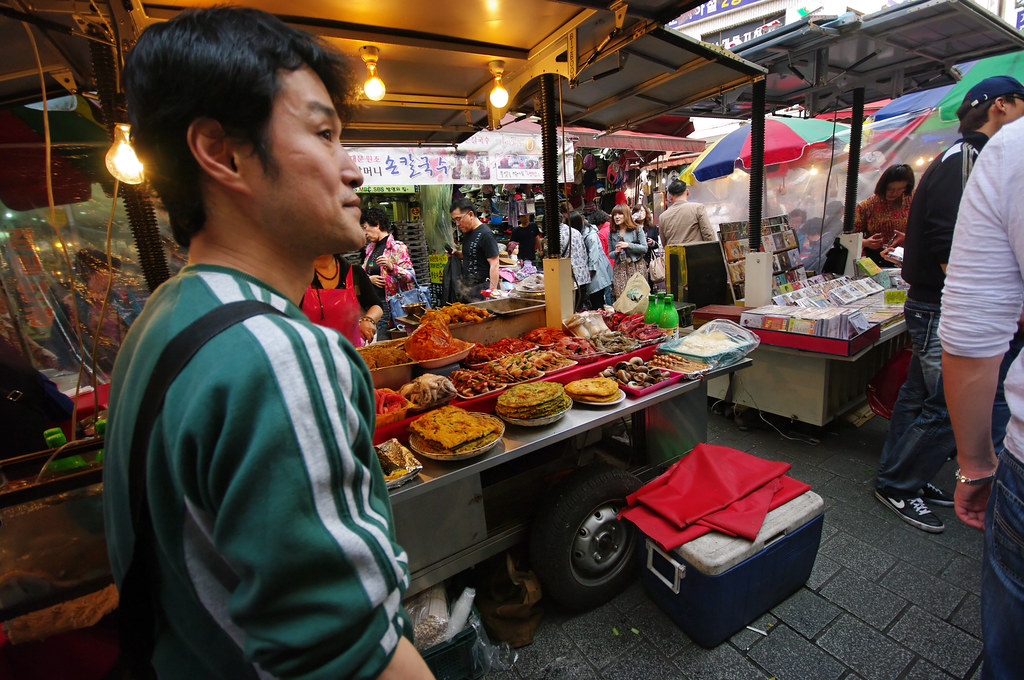
Street-food carts just outside the market — grab a hotteok and dive in. Photo: Emmanuel Dyan, CC BY 2.0 via Flickr.
Find it
Namdaemun will not charm you the way a quiet palace garden does. It grabs you by the sleeve, feeds you something spicy, and sends you back out a little dazed. That is the whole point — six hundred years of Seoul still doing business at full volume. Visitors who come hungry and dive in tend to leave glad they made the time.