
Myeongdong is Seoul’s most famous shopping and street-food district — and its most polarizing. It’s a car-free grid of pedestrian lanes in Jung-gu. By day it’s wall-to-wall K-beauty flagships and fashion stores. After dark it becomes one of the city’s liveliest street-food night markets. For many first-timers it’s the default first stop: central, walkable, English-friendly, and packed with things to buy and eat. But Myeongdong also draws the most divided opinions in Seoul. This guide lays out what it does well, what it costs, and where it falls short.
- 📍 Address: Myeongdong-gil, Jung-gu, Seoul (명동길, 중구) — navigate by the area name and Myeong-dong Station rather than a single street number
- 🕒 Hours: Shops typically 10:00–22:00 daily; street-food stalls set up from ~16:00, in full swing 17:30–23:00 (peak atmosphere 19:00–23:00), with more stalls Fri–Sun. Individual carts keep their own hours, so the line-up shifts night to night
- 💳 Price: Street-food items roughly ₩2,000–₩10,000 (most ₩4,000–₩6,000) — around 30–50% pricier than other Seoul markets; many stalls are cash-only. Cosmetics often cheaper than abroad; tax-free over ₩30,000
- 🚇 Getting there: Line 4 to Myeong-dong Station, Exit 6 or 7 (direct to the main shopping street). Euljiro 1-ga Station (Line 2) serves the north edge
- ⏱ Time needed: 2–3 hours; best as a late-afternoon-into-evening slot to catch both shops and stalls
- 🔗 Nearby: Myeongdong Cathedral (~8 min walk), Namsan / N Seoul Tower (~10–15 min walk + cable car), Namdaemun Market (~15 min walk), Cheonggyecheon Stream (~15–20 min walk)
- ✅ Verified as of June 2026
One district, two completely different faces
Myeongdong works best as a single evening slot rather than a fixed attraction. The core is Myeongdong-gil and the lanes branching off it. Cars are banned. The streets run wall-to-wall with cosmetics shops, mid-range fashion, department stores, and upper-floor cafés. Through the day it reads as a shopping district. From late afternoon, vendors wheel food carts down the middle and the whole grid flips into a street-food night market.
That transformation is why arrival time matters more here than at almost any other Seoul stop. Come before mid-afternoon and you find the famous stalls still boxed up and half-assembled. Come after 17:30 and shops and food run at full tilt together. The ideal window is roughly 16:30 to 19:00. That’s late enough for the carts to be lit and cooking, early enough to beat the thickest evening crush. The district’s enduring anchor is Myeongdong Cathedral, Korea’s first Gothic brick church, completed in 1898. It sits on a rise just east of the shopping streets and pairs naturally with a walk up to Namsan.
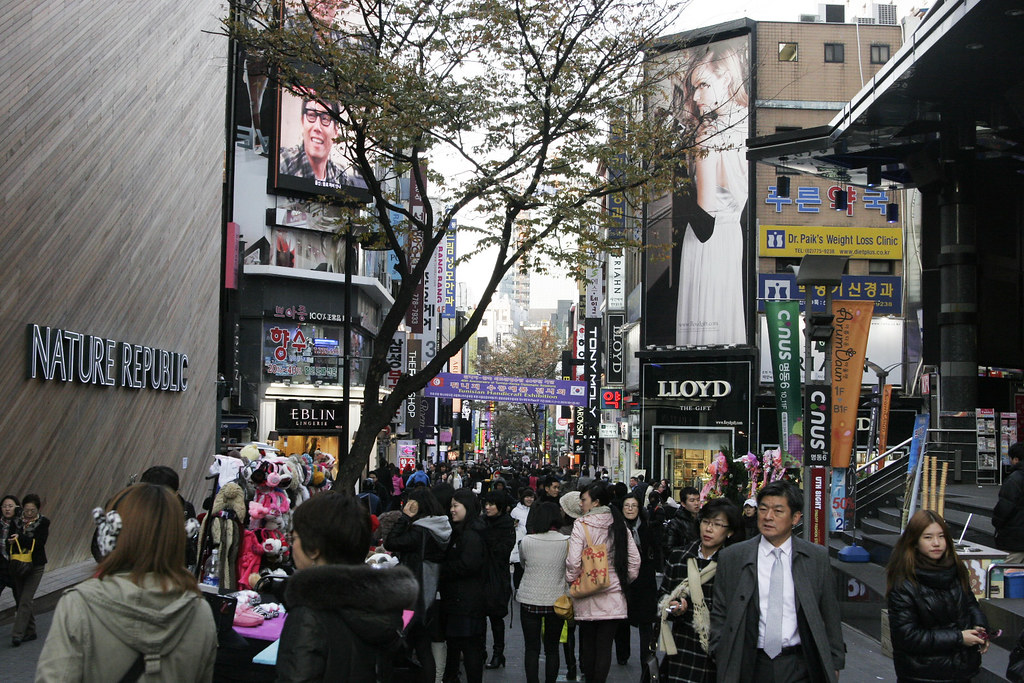
Photo: The pedestrianized main drag of Myeongdong, lined with K-beauty flagships — CC BY 2.0 via Flickr.
Where Myeongdong earns its reputation
It is central, convenient, and easy to navigate. The lanes are pedestrianized, the subway drops you right at the edge, and signage and staff are unusually English-friendly. For anyone new to the city, that makes it a low-friction place to start.
It also holds Korea’s densest concentration of K-beauty. First-timers gravitate to the cluster of beauty flagships and drugstores like Olive Young, where many products run cheaper than they do abroad. On the tax side, purchases over ₩30,000 qualify for tax-free shopping. The immediate in-store refund at larger retailers is usually smoother than queuing at an airport kiosk on departure day. The evening street-food scene delivers real energy and novelty bites. And the one-stop variety genuinely helps — shopping, cafés, the Cathedral, and Namsan all sit within a short walk of one another.
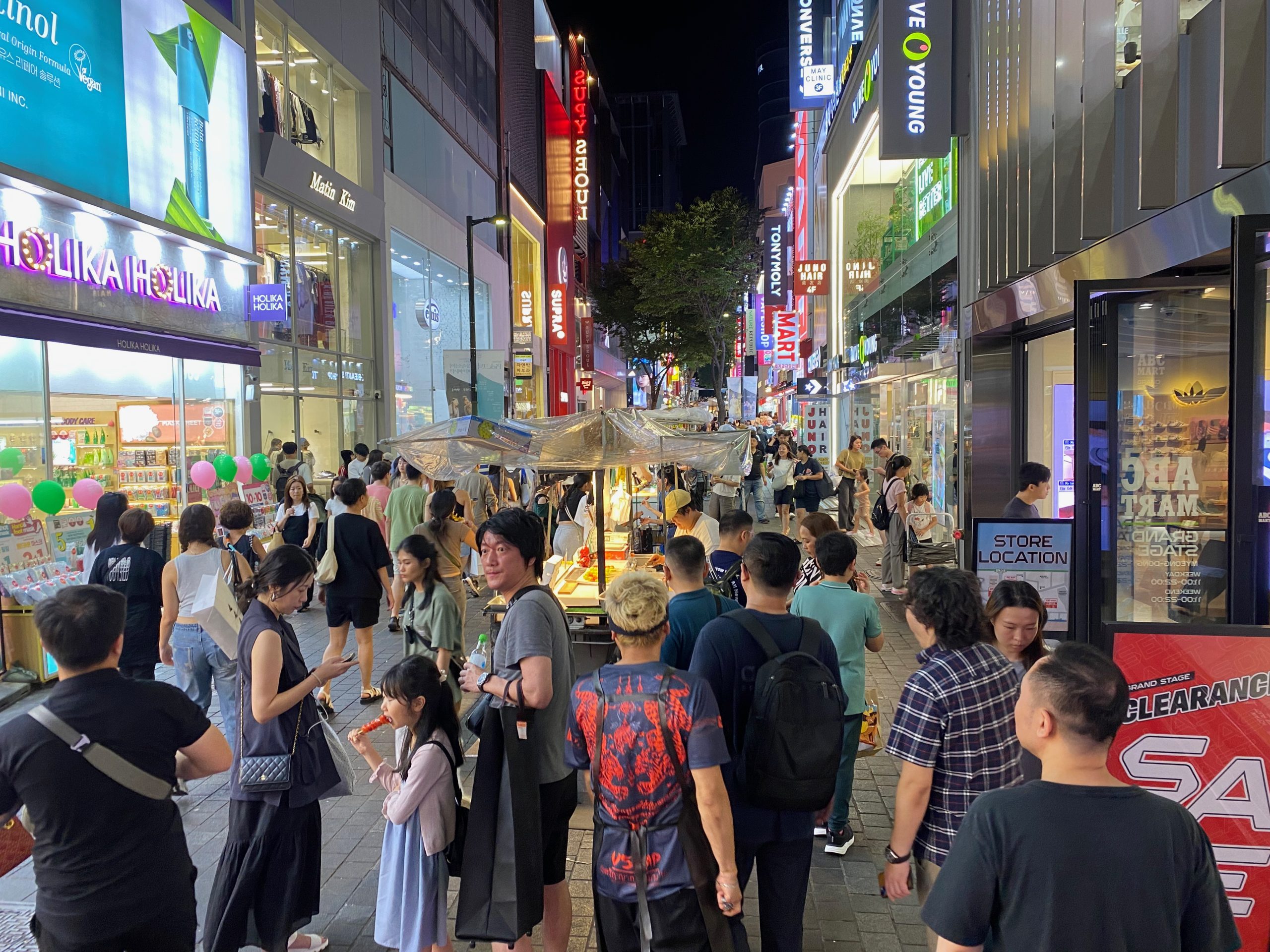
Photo: Myeongdong’s street-food night market in full swing — Sgroey, CC BY-SA 4.0 via Wikimedia Commons.
Myeongdong, Seoul: the drawbacks nobody mentions
Myeongdong splits opinion harder than almost anywhere in Seoul, and the criticisms are consistent enough to take seriously.
Price is the loudest one. Street food here costs noticeably more than at other Seoul markets — roughly 30–50% more. Skewers that once ran about ₩3,000 now sit closer to ₩5,000, and foreign visitors have been turning away over it since 2023. As a rough benchmark, a filling street-food meal costing about ₩10,000 in Myeongdong often lands closer to ₩6,000–₩7,000 at Namdaemun or Gwangjang. If value is your priority, this is not where it lives.
And not everything is worth it even at those prices. Korean food bloggers who work through the carts item by item end up with a recommend list and a much longer don’t-bother list. The common verdict on the weaker stalls is blunt: there’s no reason to eat this particular thing here when it’s better and cheaper elsewhere in the city. Pick two or three things you actually want. Grazing indiscriminately is how the bill climbs and the disappointment sets in.
Crowding, and thin infrastructure. The lanes get heavily congested in the evening. There are few places to sit, limited bins, and patchy signage once you leave the main drag. The edges of the district also carry real traffic, so the calm of the pedestrian core ends abruptly.
If you’re planning to sit down and eat
The famous restaurants run queues. Lunch at the best-known spots means waiting, often around twenty minutes and longer at peak. Many of these places have small ground floors seating only fifteen to twenty people, so when the indoor waiting chairs fill, the line continues up the stairs. A weekday morning or an early lunch avoids the worst of it. Some restaurants accept remote registration through a waiting app, which is worth checking before you walk over.
Tables are tight. Interiors here are cramped, and at busy hours you may well be seated alongside strangers at a shared table. It’s normal and nobody minds, but it surprises visitors expecting a leisurely meal. Decide your order while you’re still in the queue — service moves fast once you’re in.
It can feel uniform. Block after block of near-identical cosmetics shops, and the same skewers and cheese sticks end to end. A persistent minority writes the district off as an overhyped tourist stop unless K-beauty is the specific draw. None of this is a dealbreaker. Together, though, it explains why Myeongdong rewards a focused visit over an open-ended wander.
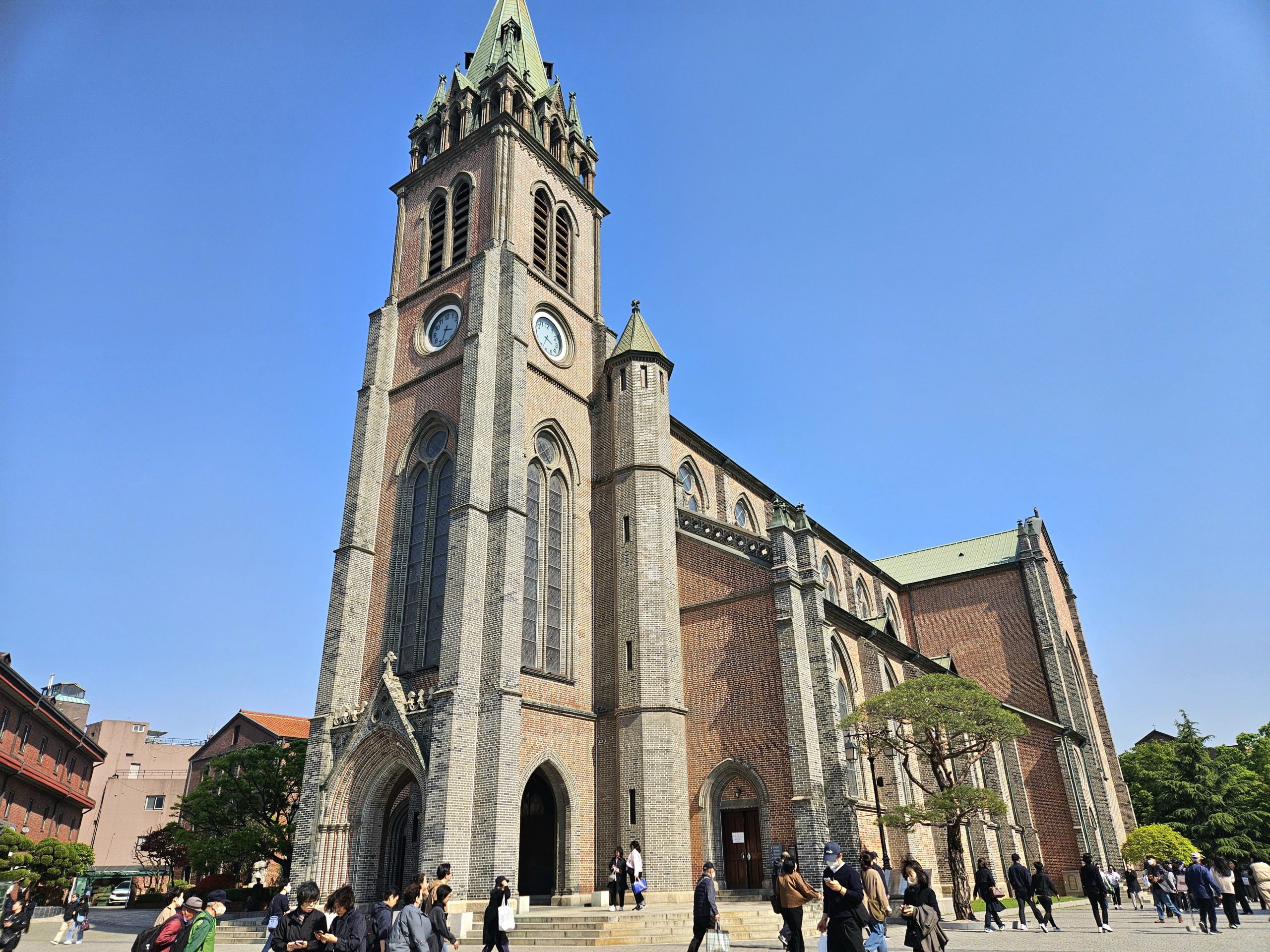
Photo: Myeongdong Cathedral, Korea’s first Gothic brick church — Kimhs5400, CC BY 4.0 via Wikimedia Commons.
The right visitor for Myeongdong — and the wrong one
The area suits first-timers who want a convenient, low-friction introduction to Seoul shopping. It suits anyone with K-beauty on their list. And it suits travelers who enjoy a buzzy night-market atmosphere and don’t mind paying a premium for the convenience and spectacle. It slots easily into a Namsan or N Seoul Tower evening.
Chasing serious street food? Go elsewhere — Namdaemun and Gwangjang Market both deliver more for less. The same applies if you dislike dense crowds or want a more local-feeling neighborhood. The sensible compromise is to treat Myeongdong as a sharp 60–90 minute walk-through for the energy and a few specific cosmetics buys, then move on to the Cathedral or up to Namsan. For more market slots, browse our other Markets guides.
Making the most of a Myeongdong evening
Here’s the sequence that works. Arrive in the late afternoon. Shop the K-beauty while stores are open. Then graze a few stalls as they light up, cash in hand. Eating strategically rather than at every cart keeps the bill in check, because those ₩4,000–₩6,000 items add up fast. The upper-floor cafés are the standard escape from the crush. Finish with the short uphill walk to Myeongdong Cathedral, or push on to Namsan, and a shopping errand turns into a proper evening. Time-boxed and entered with clear expectations, Myeongdong holds its place on a Seoul itinerary.
Pingback: T-money Card: Seoul Subway & Bus Guide (2026)