
Most famous Korean temples hide in the mountains. Haedong Yonggungsa does the opposite — it clings to wave-washed rocks on Busan’s east coast, golden statues facing open water, spray hitting the stone below. The setting is genuinely spectacular, and nothing else among Korea’s major temples looks like it.
Here’s the thing, though. Whether you leave delighted or annoyed comes down almost entirely to what time you show up.
Arrive before 09:00 on a weekday and you get a cliff-side sanctuary. Arrive at 13:00 on a Saturday and you get a crowd crush with food stalls. Entry is free and the gate opens at 04:30, so the temple never limits you. Your alarm clock does.
- Address: 86 Yonggung-gil, Gijang-eup, Gijang-gun, Busan (부산 기장군 기장읍 용궁길 86)
- Hours: 04:30–19:20 daily, last entry 18:50 — open every day of the year. In winter the place empties at sunset, so treat closing as sunset plus about half an hour.
- Price: Free. Parking is ₩2,000 for the first 30 minutes, then ₩500 per 10 minutes (card only) — about ₩6,500 for a two-hour visit.
- Getting there: Busan Metro Line 2 to Haeundae Station, Exit 7, then bus 1001 (express, ~27 min), 181 (40–50 min) or 100 (~32 min) to the “Yonggungsa · National Institute of Fisheries Science” stop. Then walk about 700 m (10–15 min) downhill to the gate.
- ⏱ Time needed: 60–90 minutes inside; budget 1.5–2 hours with the walk in and out.
- 🔗 Pair it with: Skyline Luge Busan (beside the bus stop), Lotte Premium Outlets Dongbusan, or lunch at Songjeong Beach.
- Verified as of July 2026
What makes Haedong Yonggungsa different 🌊
Haedong Yonggungsa is a working Jogye-order Buddhist temple built onto sea cliffs in Gijang-gun. Korea’s tourism board itself flags a shoreline temple as a rare find, because almost every significant one sits inland among peaks.
You enter at the top and go down. The route drops through bamboo on the 108-step “long-life” staircase (백팔 장수계단), one step per Buddhist affliction, with twelve zodiac guardian statues at the entrance above it. Benches along the way help older visitors pace it.
At the bottom the temple spreads across rock ledges. The Haesu Gwaneum Daebul stands about 10 metres tall facing the water — said to be Korea’s largest single-stone Buddha image. A golden Jijang Bosal looks out to sea nearby, and a healing Yaksayeorae Buddha sits within the complex.
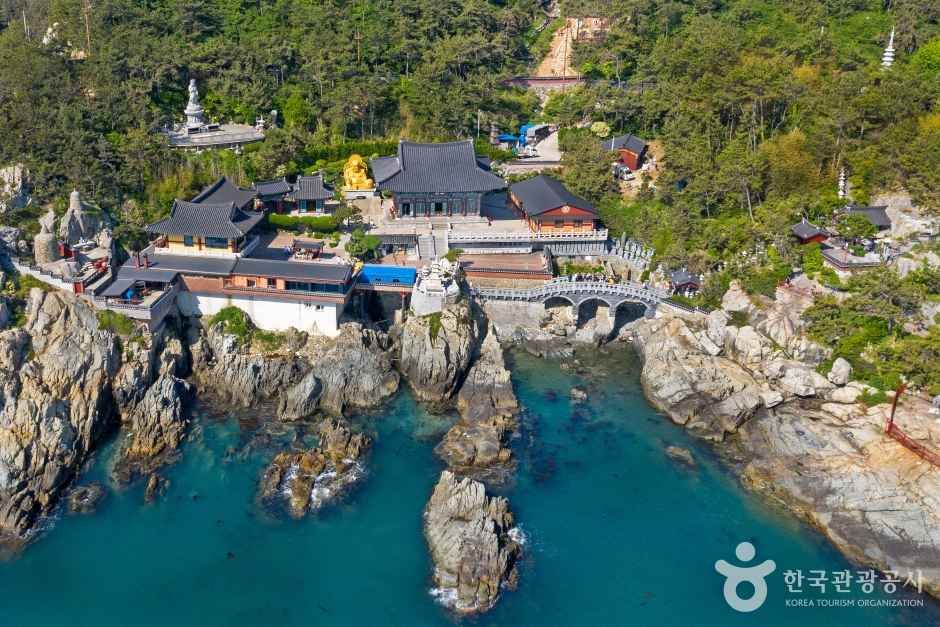
Photo: Haedong Yonggungsa from above — halls and golden statues set on the sea rocks / Source: Korea Tourism Organization 관광사진갤러리 (KOGL Type 1)
Cross the Yongmun stone bridge and you’ll find people flicking coins into a wishing pool. Yongdu-am dragon-head rock juts out below, and Ilchul-am (일출암), “Sunrise Rock”, is the seaward platform that makes a dawn trip worth it.
The devotional layer is real, not decorative. The Deuknam-bul (득남불) is a pot-bellied figure whose nose and belly shine from couples hoping for a son, plus there are shrines for exam success and wealth. Roughly 390,000 people come each year, and plenty are here to pray. In front of the main hall stands a four-lion three-storey stone pagoda, raised in 1990, holding seven relics from Sri Lanka. Don’t confuse it with the taller traffic-safety prayer pagoda up at the entrance.
How old is Haedong Yonggungsa really?
Haedong Yonggungsa dates its founding to 1376, by Naong Hwasang (나옹화상), royal preceptor to Goryeo’s King Gongmin. He supposedly chose the site for its geomancy: mountains behind, open sea in front. The original name was Bomunsa.
That claim is disputed, and you should know it before you go. What you see is essentially a 20th-century temple. The Japanese invasions of 1592–98 destroyed the site, it lay ruined for centuries, it was rebuilt in 1930, then restored again in 1974. The marvel here is the setting, not the age of the timber.
Even the name is young. In 1974 the abbot Jeongam vowed to restore the place as a Gwaneum sanctuary, and after a hundred-day prayer retreat he dreamed of a white-robed Avalokiteśvara rising to heaven on a dragon — hence “Dragon Palace Temple of the East Sea”. If you want temples whose buildings carry the centuries, browse our Korean heritage sites guides instead. Come here for the cliffs.
Timing is the whole game ⏰
Reviews of Haedong Yonggungsa split cleanly, and not along “tourist trap versus must-see” lines. They split by hour of the day.
Most negative accounts describe a weekend afternoon. The raves describe early morning, or dusk. One traveler went on a packed Saturday afternoon and again on a quiet weekday morning, and said the two visits felt like completely different places.
Best window: before 09:00 on a weekday, ideally Tuesday to Thursday. Crowds build from 10:00 and peak through the afternoon. Second-best is after 17:00 on a weekday, though dusk pulls its own crowd, and even quiet weekdays bring a steady trickle. Worst: weekends, cherry-blossom season, Buddha’s Birthday, and 1 January.
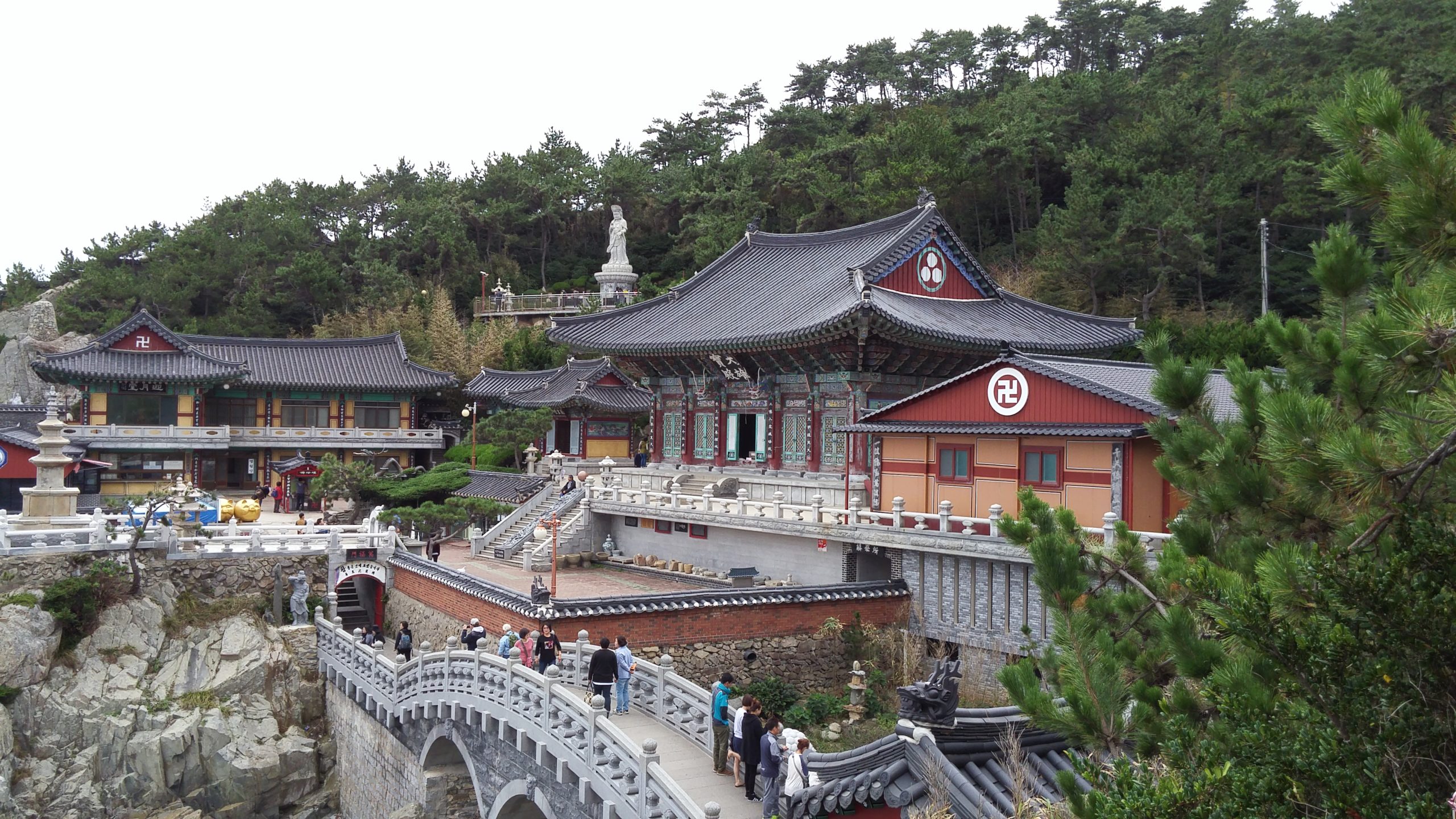
Photo: Haedong Yonggungsa Temple near Busan — visitors crossing the Yongmun stone bridge. Christian Bolz, CC BY-SA 4.0 via Wikimedia Commons
Last entry is listed as 18:50, so rolling up at 18:45 for a relaxed sunset visit is a classic mistake.
Two seasonal notes. Cherry blossoms hit late March to early April — beautiful, mobbed. At Buddha’s Birthday thousands of lanterns hang over the approach path: spectacular, even more mobbed.
Small stuff that saves you grief
Carry a few coins. Several spots on the way down invite you to toss a coin for luck, and the wishing pots are one of the small pleasures people remember. Arriving with nothing but a card is a mildly deflating way to walk past them.
A modern restroom block sits near the approach road, and the cubicles may well have no paper, so carry tissues. Bring a T-money or Cashbee card for transit; cash fares cost ₩100–150 more and earn no transfer discount. The car park takes card only.
One weather caveat: this is a low, unprotected sea-rock site on Korea’s typhoon-exposed southeast coast, roughly July to September. In rough seas, the seaward platforms may be roped off. Phone ahead if that’s your reason for coming.
Getting to Haedong Yonggungsa properly
The bus does not stop at the gate. Buses stop at “Yonggungsa · National Institute of Fisheries Science” on the main coastal road. From there it’s about 700 m, some 10–15 minutes down Yonggung-gil — downhill in, uphill out, straight through the stalls. Guides claiming a “5-minute walk” are wrong.
From Haeundae is easiest: Metro Line 2 to Haeundae Station, Exit 7, then bus 1001, the red express, about every 12 minutes, ₩2,100 by card, roughly 27 minutes. Bus 181 (₩1,550) covers it in 40–50 minutes and bus 100 in about 32. Door-to-door from Haeundae Beach runs 45–60 minutes. A taxi takes 20–25 minutes, roughly ₩12,000–20,000, and taxis queue at the entrance for the return.
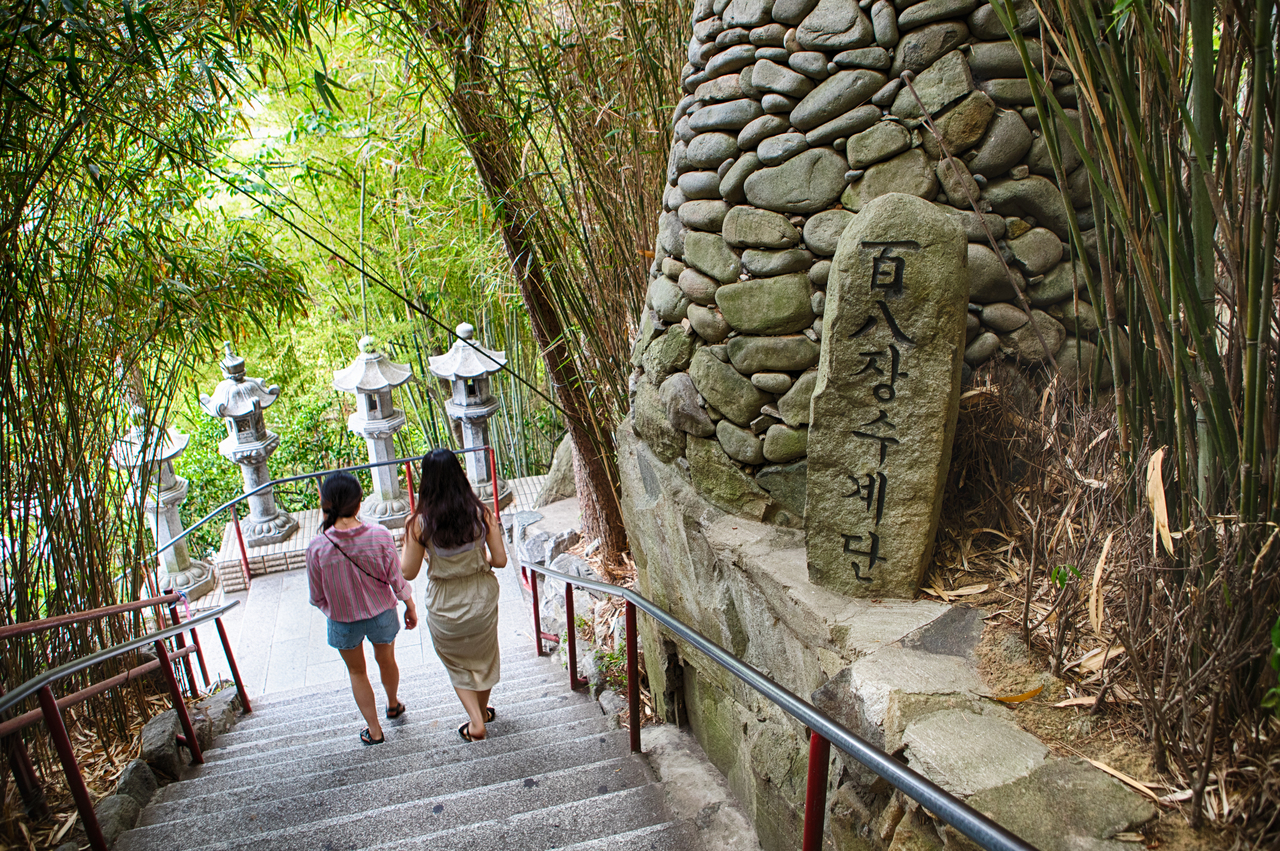
Photo: The 108-step “long-life” staircase and its stone marker, dropping through bamboo toward the sea / Source: Korea Tourism Organization 관광사진갤러리 (KOGL Type 1)
From Busan Station and Osiria
From Busan Station, bus 1001 runs direct with no transfer, ₩2,100 — but it’s a long surface run of 70–90 minutes. Faster: Metro Line 1 to Seomyeon, Line 2 to Haeundae (about 50 min), then bus 1001 or 181. Total roughly 1 hour 35 minutes, and about ₩1,950–2,550 by card once the metro-to-bus transfer discount kicks in.
From Osiria Station on the Donghae Line, take Exit 1, turn left to the main road, right to the bus stop. Then bus 139 or 1001 for about 4 minutes, then the walk. A taxi from Osiria takes 6 minutes; walking the whole way takes 30. The Donghae Line runs Bujeon – Sinhaeundae – Songjeong – Osiria – Gijang every 20–40 minutes. Careful here: it does not serve Haeundae Station on Metro Line 2. Sinhaeundae is a separate station.
If I had one morning in Busan’s east, here’s my plan: Donghae Line to Osiria, bus 139 or 1001, temple right at opening. Then walk back up to Skyline Luge Busan beside the bus stop, and finish at Lotte Premium Outlets Dongbusan or lunch at Songjeong Beach.
The honest downsides
Crowds are the number one complaint at Haedong Yonggungsa, and they’re severe. Weekends and holidays are 인산인해 — a sea of people. I wouldn’t bring small children on a weekend.
At peak hours it stops feeling like a temple. Vendors line the approach, there are designated selfie spots, and food stalls operate even near the sunrise platform. Plenty of travelers describe it as closer to a theme park than a place of worship.
The stall gauntlet is a documented problem, not just an aesthetic gripe. Stalls pack the route from the car park to the zodiac statues, and price-gouging is normal. In August 2025 a video of a ₩3,000 single fish-cake skewer here went viral in Korea. Over the months that followed, Gijang-gun referred 15 unlicensed vendors to police under food-sanitation law — then said it has no authority to regulate prices at all. The stalls sit on private land in a development-restricted zone where food permits are legally impossible, and they’ve operated since the 1990s. Expect the gauntlet to still be there. Honestly, skip the stalls and buy food elsewhere.
Stairs, sun and signage
The terrain is work. Those 108 steps go down, and you must re-climb them to leave. Add uneven stone paths and steep sections through the cliff complex. It’s rough on bad knees. Wear proper shoes, because the rocks get slick with spray.
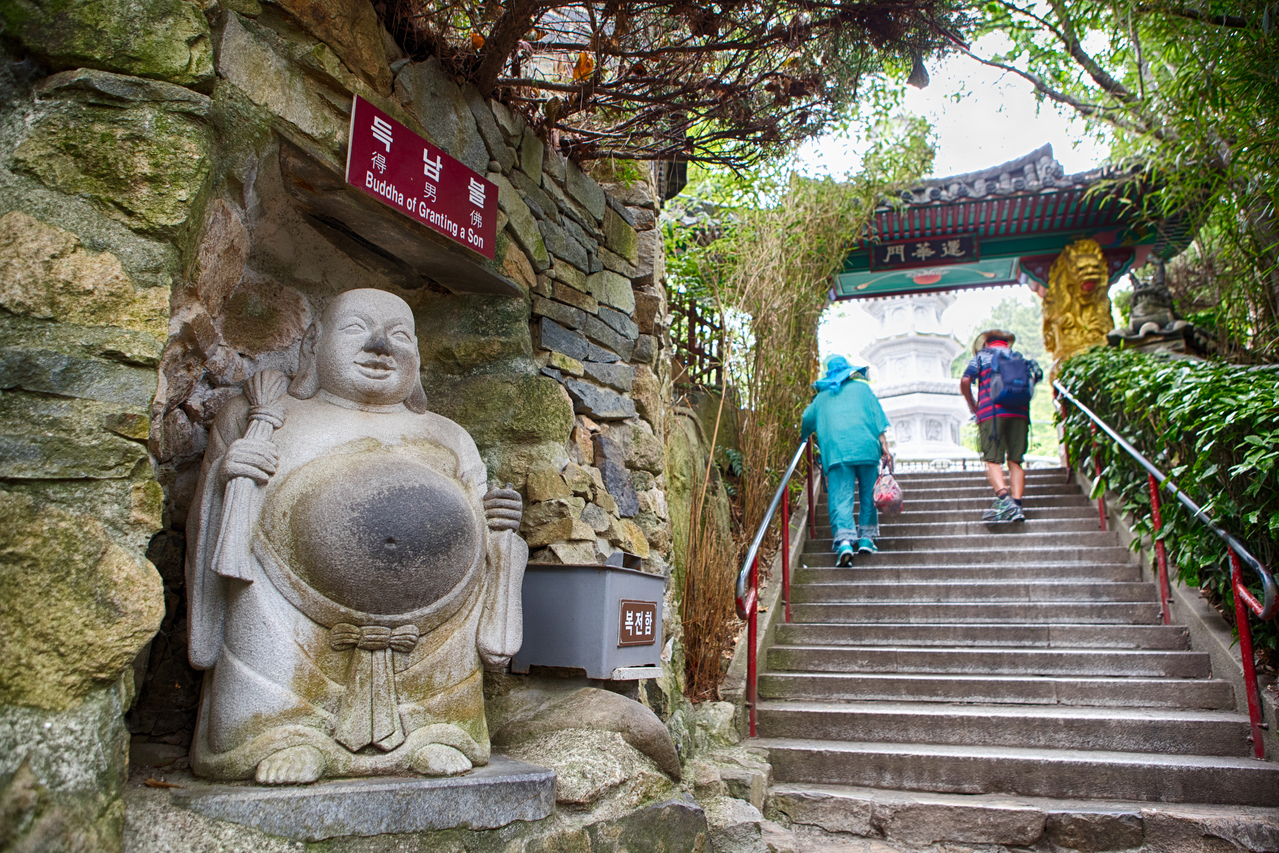
Photo: The Deuknam-bul, the “Buddha of Granting a Son”, beside the steps climbing back to the Yongmun gate / Source: Korea Tourism Organization 관광사진갤러리 (KOGL Type 1)
Accessibility is thin, and I won’t dress it up. The official barrier-free record lists exactly two things here: an accessible restroom and five disabled parking spaces. No elevator, no wheelchair rental, no step-free route to the halls. The cliff-side core involves unavoidable stairs and uneven stone. Call +82-51-722-7744 before you rely on any of it.
Leave the stroller in the car — or at the hotel. Korean parents are blunt about this one, and several say outright not to bring one. Between the 108 steps, the uneven stone and the narrow cliff paths, a stroller becomes something you carry rather than push. A baby carrier is the workable answer here.
Summer is punishing, too. The seaward rock platforms have no shade at all, and July–August delivers heat, humidity and crowds at once.
Some people just find it underwhelming. A recurring minority view calls it smaller than expected, kitschy or overrated. Architecturally it is mostly 20th-century.
Two more annoyances: the trip is a real hassle, and there’s almost no English interpretation, so keep your phone handy. Parking also fills fast on weekends, and tour buses clog the approach road.
Go, or skip?
Go to Haedong Yonggungsa if you’re a photographer, if dramatic coastal scenery moves you, or if you want a Korean temple that looks like nowhere else. Go if you can make an early weekday morning or a late weekday afternoon work. Go if you’re already heading to Osiria for the luge, the outlets or Lotte World Adventure Busan — the pairing is excellent and the temple costs nothing.
Skip it if your only free slot is a weekend midday, if stairs are a problem, or if you dislike crowds intensely. Skip it if you have one day in Busan and haven’t yet seen Gamcheon Culture Village. And skip it if you want contemplative Buddhist architecture — mountain temples serve that far better.
It scores 4.8 out of 5 across roughly 445 Trip.com reviews, so it clearly delivers for most people. That score reflects the setting, and the setting is real.
One last tip if the crowds get to you: a couple of hundred metres away sits a small Zen hall, Haedong Seonwon (해동선원), that almost nobody visits. Quiet antidote, right there.
Pingback: Gyeonghuigung Palace: Seoul's Free, Quiet Fifth Palace
Pingback: Seodaemun Prison: Seoul's Sobering History Hall
Pingback: Changgyeonggung: Seoul's Quiet Garden Palace