
Here’s my honest take: if you’ve done the Seoul palace circuit and you’re craving something that feels less polished and more lived-in, Hwaseong Fortress in Suwon is the day trip I’d send you on. It’s a UNESCO World Heritage wall — 5.7 kilometres of it — wrapped around a real, working Korean city rather than a manicured tourist zone. You walk the ramparts, ring a giant bell for luck, loose ten arrows at a target, and eat outrageous grilled ribs afterward. And the wall itself? Free.
But let me be upfront, because I’d want someone to tell me: this is not a quick, flat stroll, and it’s not a single tidy “site.” It’s a whole city you climb through. Whether that’s a plus or a headache depends on you — so let’s figure out if it’s your slot.
🏯 What Hwaseong Fortress actually is
Hwaseong (“brilliant fortress”) went up between 1794 and 1796 under King Jeongjo — partly to honor his father, Crown Prince Sado, who died in one of Korea’s darkest royal stories, and partly as a bold plan to move the capital here to Suwon. The design came from Jeong Yak-yong, a brilliant Silhak scholar who introduced brick construction and a pulley-crane called the geojunggi that slashed the labor. Jeongjo even paid the workers real wages instead of conscripting them — genuinely ahead of its time.
The Korean War battered the wall, and restorers rebuilt it with unusual accuracy, because the original 1801 construction records survived in obsessive detail. Hwaseong Fortress joined the UNESCO World Heritage list in 1997. So yes, parts are reconstructed — but reconstructed from the blueprints of the people who built it. I don’t lose sleep over that, and I don’t think you should either.
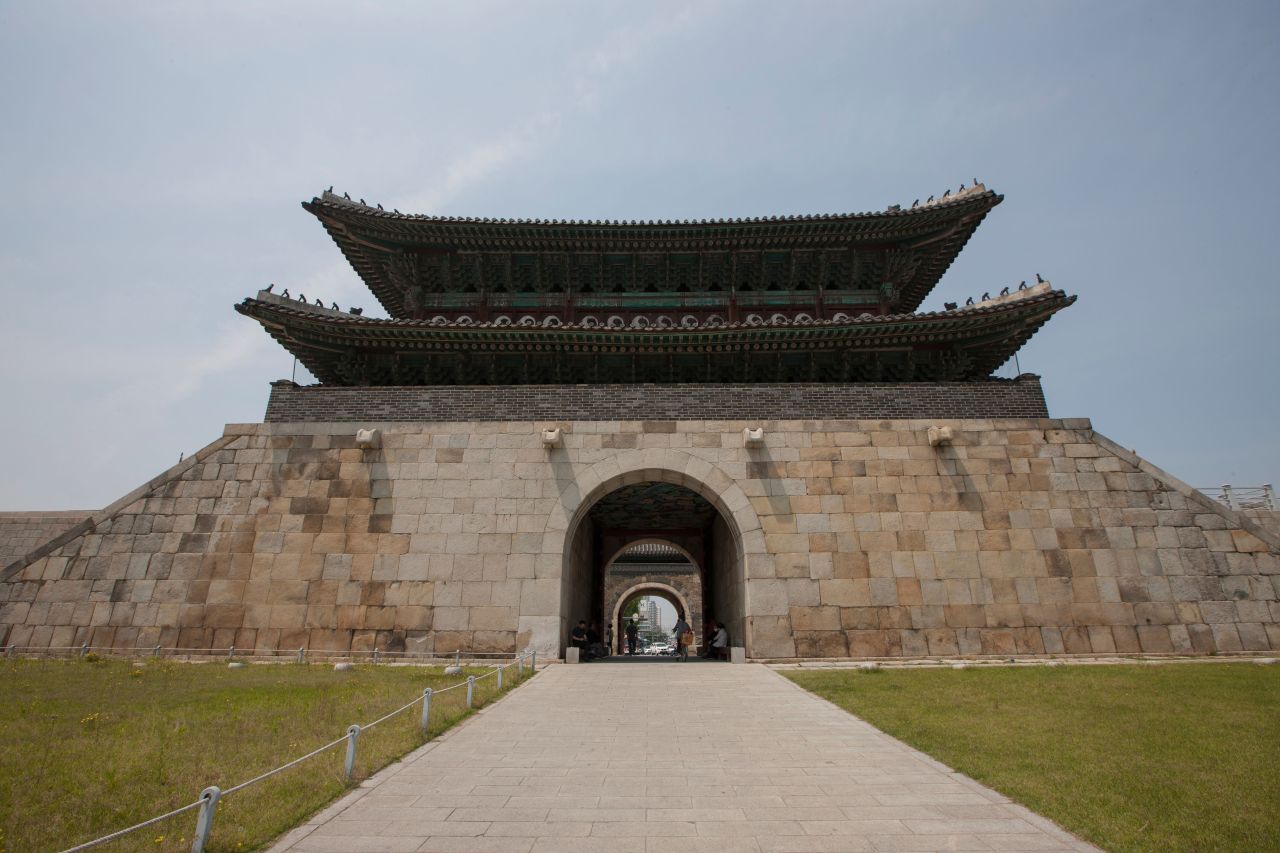
Photo: One of Hwaseong Fortress’s grand two-story gates, Suwon / Source: Korea Tourism Organization 관광사진갤러리 (KOGL Type 1)
The wall walk — the real reason to come
The Hwaseong Fortress loop runs about 5.7 km and threads through four grand gates: Janganmun in the north (the largest fortress gate in Korea — this is the showstopper), Paldalmun in the south, plus Changnyongmun east and Hwaseomun west. Between them you get signal-fire beacon towers, secret sally ports, and command posts.
The catch: the western stretch climbs steeply up forested Paldalsan to Seojangdae, the hilltop command post with the best view over all of Suwon. It’s a genuine little hike with big stone steps. My strong advice — walk it counterclockwise from Paldalmun so you tackle that climb while your legs are fresh, and coast the flat northern section at the end.
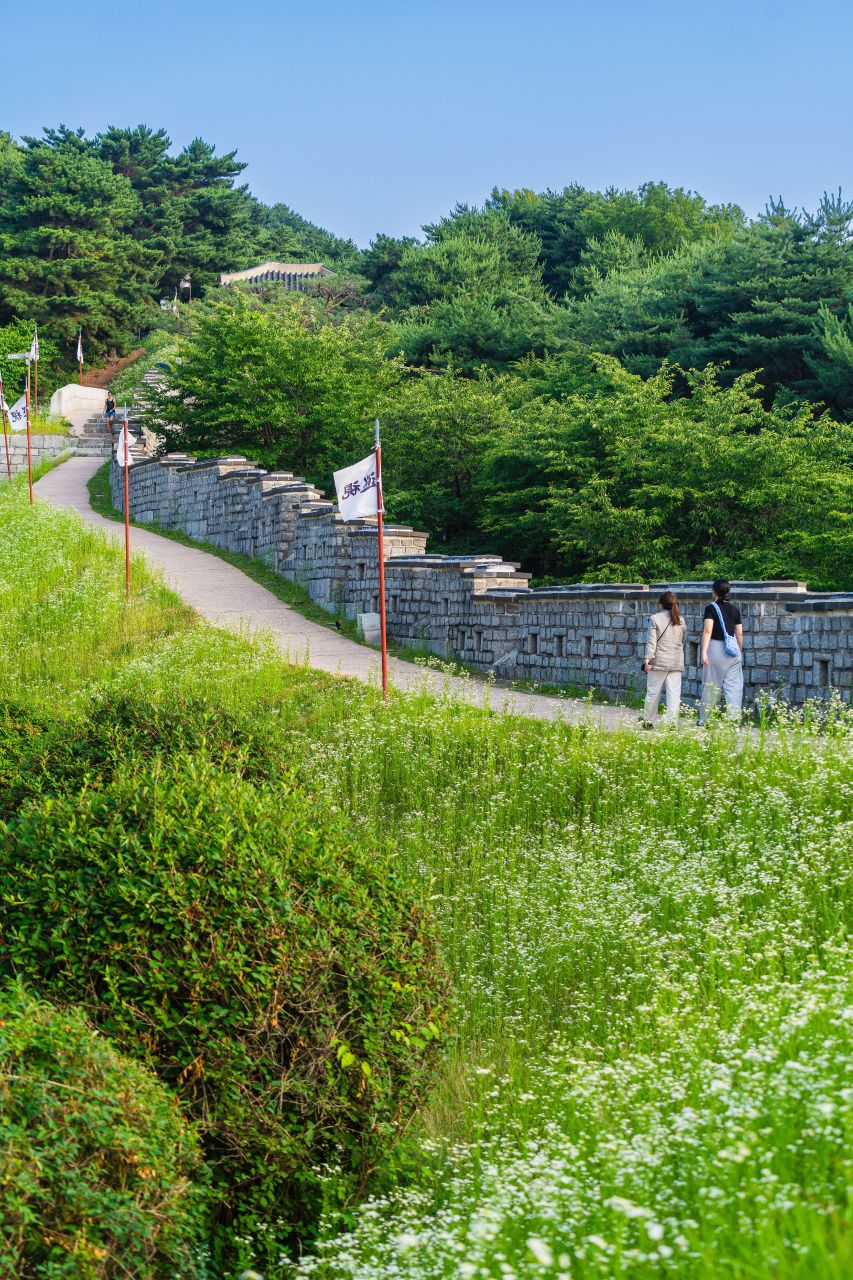
Photo: Walking the ramparts of Hwaseong Fortress toward the hills, Suwon / Source: Korea Tourism Organization 관광사진갤러리 (KOGL Type 1)
Don’t skip the water gate 💧
If I could photograph one spot here, it’d be Hwahongmun, the seven-arched floodgate where the Suwoncheon stream slips under the wall, paired with the Banghwasuryujeong pavilion perched over a lotus pond just above it. It’s the most quietly beautiful corner of the fortress and, mercifully, it sits on the flat northern side — so you don’t have to earn it with a climb.
Up at Seojangdae, there’s also Hyowon’s Bell, an 11-tonne monster you pay 1,000 won to ring three times — once each for your parents, your family, and yourself. Touristy? Sure. But the sound rolls out over the whole city, and I’d do it.
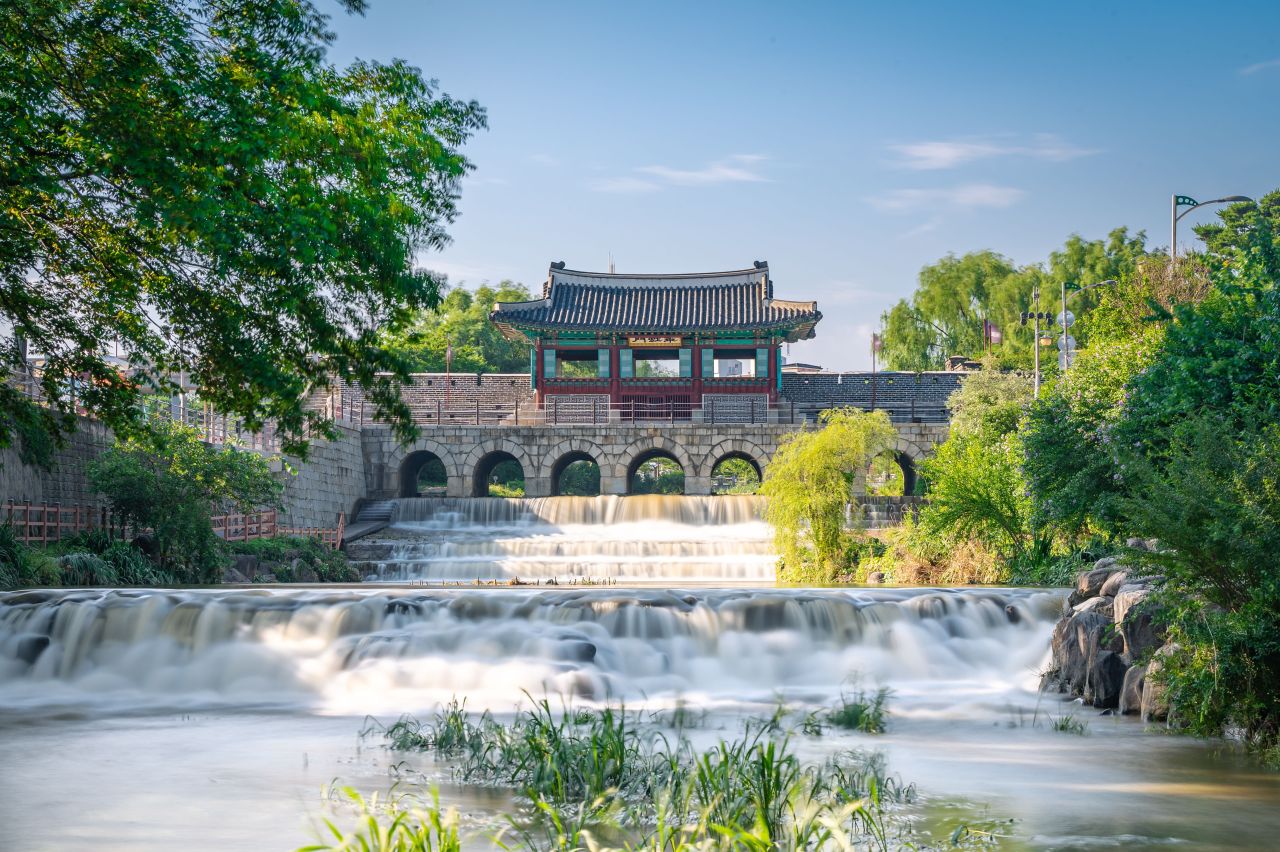
Photo: Banghwasuryujeong pavilion above the Hwahongmun water gate, Hwaseong Fortress / Source: Korea Tourism Organization 관광사진갤러리 (KOGL Type 1)
Hands-on bits: archery and the palace
At Yeonmudae, the old eastern training ground, you can shoot traditional Korean archery — ten arrows for 3,000 won. It’s the single most fun thing on site and it sells out by late morning, so do it early if you want it. Slots are small (around 25 people at a time).
Then there’s Hwaseong Haenggung, the detached palace where King Jeongjo stayed on visits to his father’s tomb — the largest such palace of the Joseon era. Admission is only 2,000 won, and it’s where you’ll catch changing-of-guard and martial-arts performances. Real talk: if you’ve palace-fatigued in Seoul, Haenggung won’t blow your mind. But at that price, and with the performances, I’d still pop in.
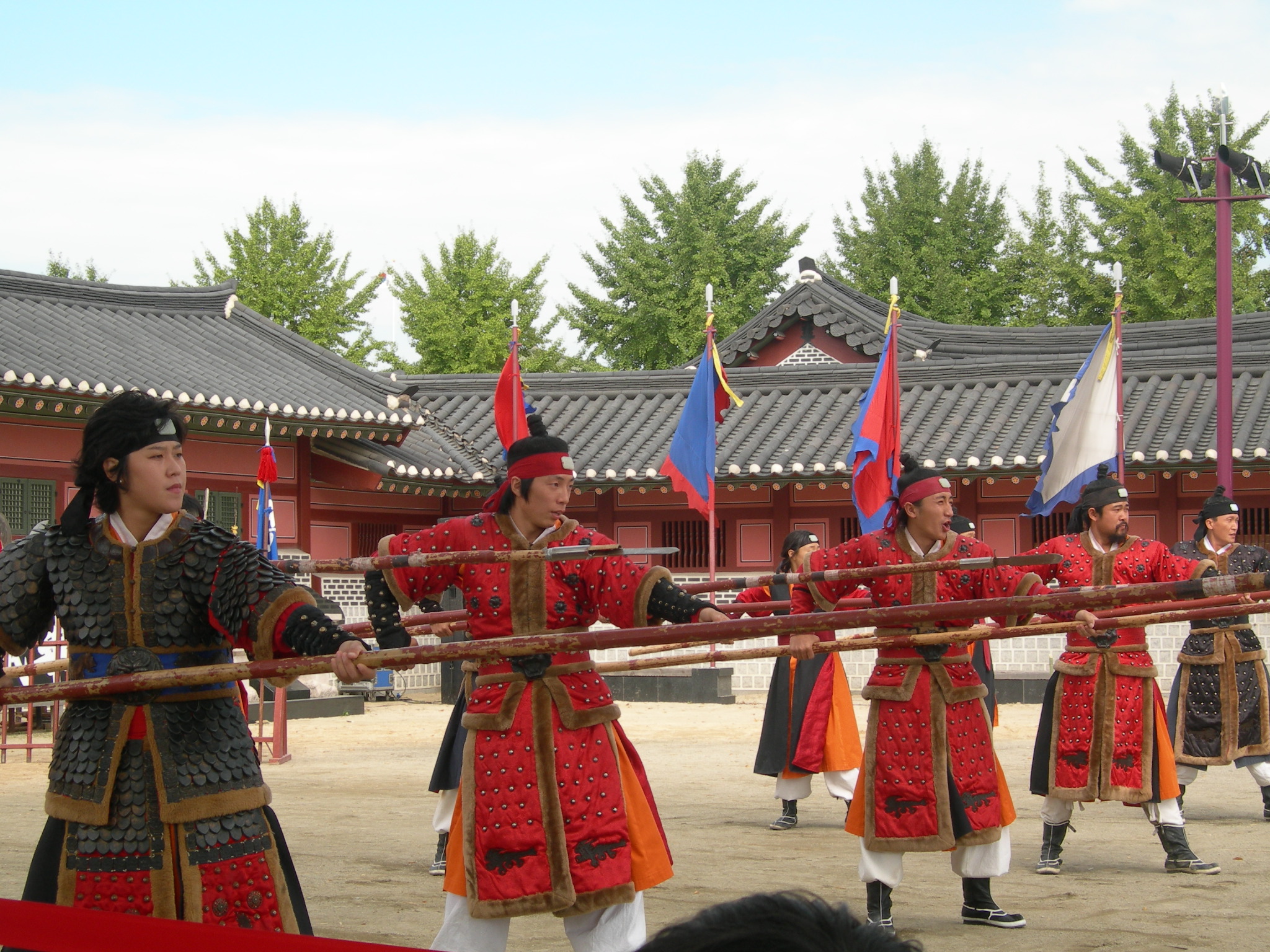
Photo: A martial-arts performance in the courtyard of Hwaseong Haenggung palace, Suwon / Source: KOCIS, CC BY-SA 2.0 via Wikimedia Commons
The honest downsides
I love this place, but it isn’t for everyone, and here’s where it can annoy you:
- It’s a real workout. The Paldalsan climb has been called “never-ending agony” by more than one tired blogger. Big steep steps make parts genuinely hard for small kids and older visitors.
- Little shade. Much of the loop is exposed. On a hot July or August afternoon it’s punishing — bring water, a hat, and lower your ambitions (or take the trolley).
- It’s spread out. The gates, Haenggung, Yeonmudae and the museum are scattered across a modern city. It doesn’t feel like one compact attraction, and walking between them eats time.
- English signage thins out once you leave the headline spots. History buffs may want more interpretation than they get.
- Festival crowds. During the October Suwon Hwaseong Cultural Festival the atmosphere is fantastic, but parade routes close and it gets busy.
- Some stretches are single-file. Parts of the wall walk narrow to one person wide, so passing means someone stands aside. It also means you move at the pace of whoever is in front.
- Not every building opens. Several interiors along the route are locked or access-restricted, and there is rarely a sign explaining why. Treat the wall itself as the attraction and any open interior as a bonus.
Park further out than feels sensible. There are plenty of car parks around the fortress, but the ones closest to Haenggung are both the busiest and the most expensive. Walking an extra few minutes from a cheaper lot is the better trade — and on a festival day it may be the only option.
A booking does not mean you skip the queue. For the ticketed experiences here, reserving online still leaves you collecting an on-site number and waiting your turn. Plan for it rather than arriving at your slot time expecting to walk straight in.
Leave time for the bus back. Services toward Suwon Station can leave you standing a while, especially after an event or late in the day. If you are tight on a train connection, a taxi removes the risk.
Who should go — and who shouldn’t
Go if you like history you can physically walk through, you want a calmer half-day away from Seoul’s crowds, or you just want big city views and a fun archery session. Reconsider if you’re traveling with a stroller, you have limited mobility, or you’re visiting in peak summer and hate heat — in those cases, do the flat northern section plus the trolley and call it a win. If your trip is short and you’ve only got time for one historic site, honestly, Seoul’s palaces are more concentrated. Hwaseong Fortress rewards people who have a full day to give it.
Plan your visit
- 📍 Address: Hwaseong Haenggung, 825 Jeongjo-ro, Paldal-gu, Suwon-si, Gyeonggi-do (경기도 수원시 팔달구 정조로 825)
- 🕘 Hours: Fortress wall — free & open dawn to dusk (evening walks OK). Haenggung palace — 09:00–18:00 (last entry 17:00). Trolley 09:40–17:00, closed Mondays.
- 💵 Price: Wall free · Haenggung 2,000 won · Trolley 6,000 won · Archery 3,000 won (10 arrows) · combo ticket (Haenggung + 2 museums) 4,000 won
- 🚉 Getting there: Seoul → Suwon Station (Line 1, ~60–70 min, ~2,000 won; or KTX ~30 min). From Suwon Station Exit 4, bus 11 / 13 / 39 to Paldalmun (~10–20 min), or a ~10 min taxi.
- ⏱ Time needed: Full wall loop 2–3 hrs; wall + Haenggung + a meal 5–6 hrs; flat highlights only ~1.5–2 hrs.
- 🔗 Nearby: Suwon wang-galbi houses · Haengridan-gil café lane & mural village (beside Haenggung) · Paldalmun/Nammun traditional markets
- ✅ Verified as of July 2026 — prices and hours change; double-check the trolley and Haenggung on the day.
Find it on the map
Hwaseong Fortress is one of the most rewarding day trips in the country if you match your plan to your legs. For more UNESCO walls, royal tombs and temples beyond the capital, browse our Heritage Sites guides.
Pingback: Gyeongbokgung Palace: Seoul's Main Royal Palace Guide
Pingback: Bongeunsa Temple: A Free Calm Escape in Gangnam
Pingback: Jongmyo Shrine: Seoul's Solemn UNESCO Royal Shrine