
Bulguksa: the Silla masterpiece worth building a Gyeongju day around 🏯
Okay—real talk. Gyeongju is stacked with royal tombs, museums, and moody lakeside pavilions. But if you only had one morning in the old Silla capital? I’d send you straight to Bulguksa Temple. It’s the closest thing Korea has to a “picture in the textbook” temple. And it earns the hype: granite terraces, two of the most famous stone pagodas in the country, and a UNESCO stamp that isn’t handed out lightly.
Here’s the angle I’d actually take. Bulguksa is compact and photogenic. Come early, walk the core in under an hour, then decide whether you’ve got the legs for its sister site, Seokguram, up the mountain. Do that, and you get the best of Gyeongju before the tour buses swallow the parking lot.
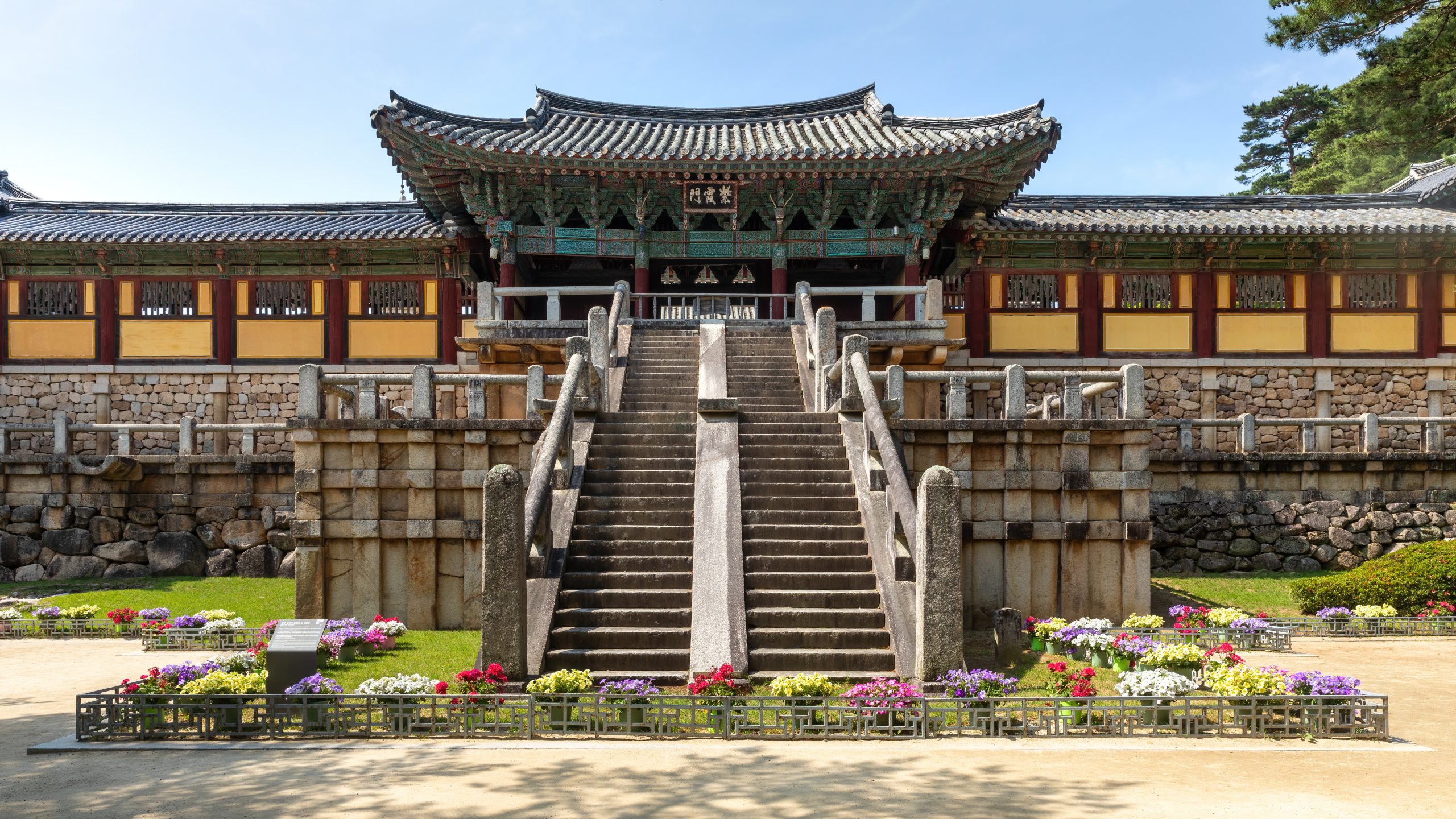
Bulguksa Temple’s front entrance — the Jahamun gate above the Cheongun-gyo / Baegun-gyo staircase-bridge. Photo: Basile Morin, CC BY-SA 4.0 via Wikimedia.
- Address: 385 Bulguk-ro, Jinhyeon-dong, Gyeongju, Gyeongsangbuk-do (경주시 불국로 385)
- Hours: Roughly 07:00–18:00 (shorter in winter; hours shift by season, so check on arrival)
- Price: FREE — admission was abolished in May 2023. The old ~6,000 KRW ticket no longer applies. Parking still costs a small fee.
- Getting there: Bus 10 or 11 from central Gyeongju (~40–50 min), or Bus 700 from Gyeongju KTX/Singyeongju Station. Taxis run ~15–20 min from the old-town tomb district.
- ⏱ Time needed: 45–75 min for the temple core; add 1.5–2 hours if you tack on Seokguram.
- 🔗 Nearby pairing: Seokguram Grotto (Shuttle Bus 12 up the mountain), plus Gyeongju National Museum and the Daereungwon tombs back in town.
- Verified as of July 2026
What you’re actually looking at inside Bulguksa Temple
Bulguksa (불국사, “Temple of the Buddha Land”) dates to around 751 CE. The Silla statesman Kim Daeseong built it at the height of the kingdom’s golden age. It’s a masterclass in stone. The whole complex sits on massive fitted granite terraces. That engineering is half the reason it made the UNESCO World Heritage list in 1995.
The first showstopper is the approach. Two twin staircase-bridges, Cheongun-gyo and Baegun-gyo (청운교·백운교, the Blue Cloud and White Cloud Bridges), climb toward the main gate. They’re roped off now, so you admire them from below rather than climb them—but they’re gorgeous, and easily the most photographed corner of the site.
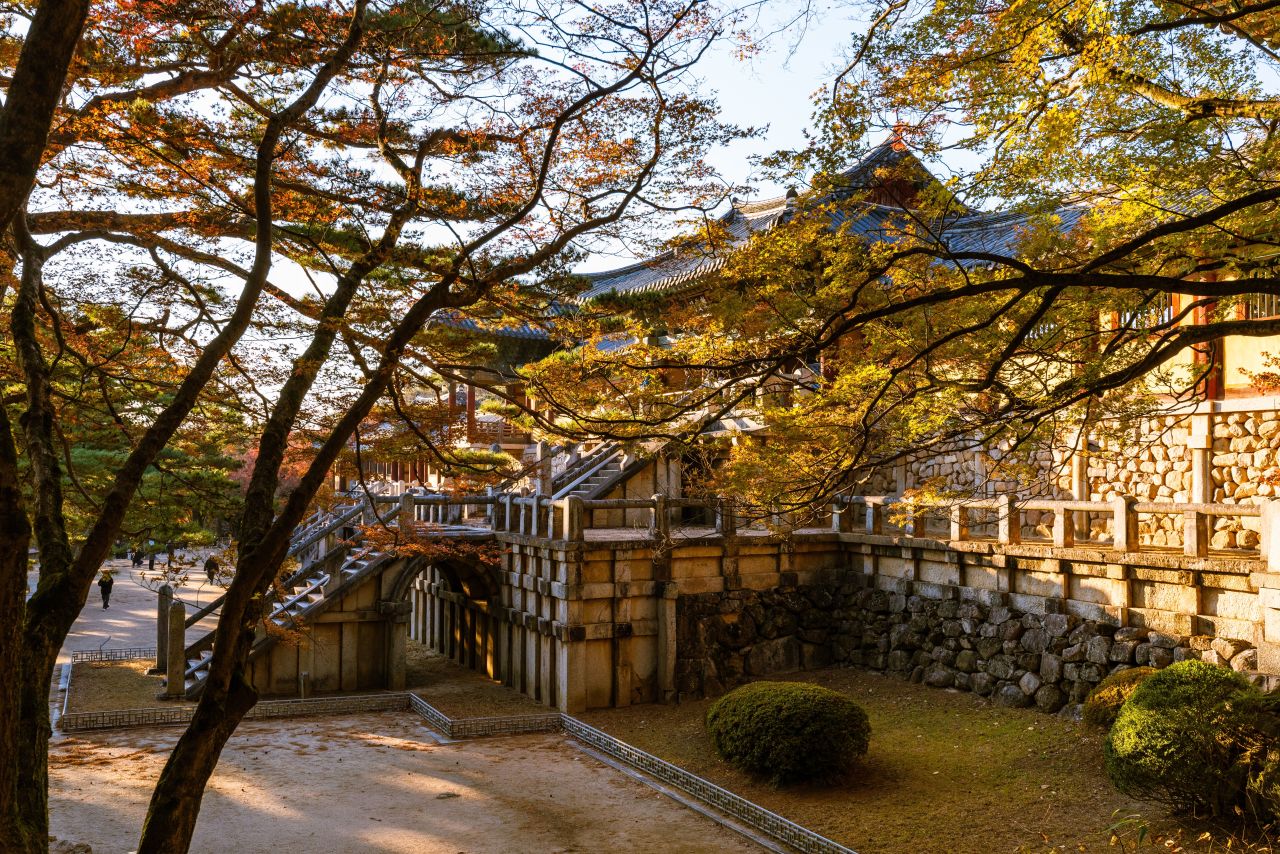
The stone arched staircase-bridge glowing in autumn light. Photo: 불국사 / Source: Korea Tourism Organization 관광사진갤러리 (KOGL Type 1).
Up in the main courtyard in front of Daeungjeon (the main hall) stand the two pagodas that make this temple famous. Dabotap (다보탑) is the ornate one—so iconic it’s on the back of the 10-won coin. Facing it is Seokgatap (석가탑), a starker, more austere design that once held the Great Dharani Sutra, the world’s oldest surviving woodblock-printed text. Together they’re a deliberate study in contrast: elaborate versus plain, both flawless.
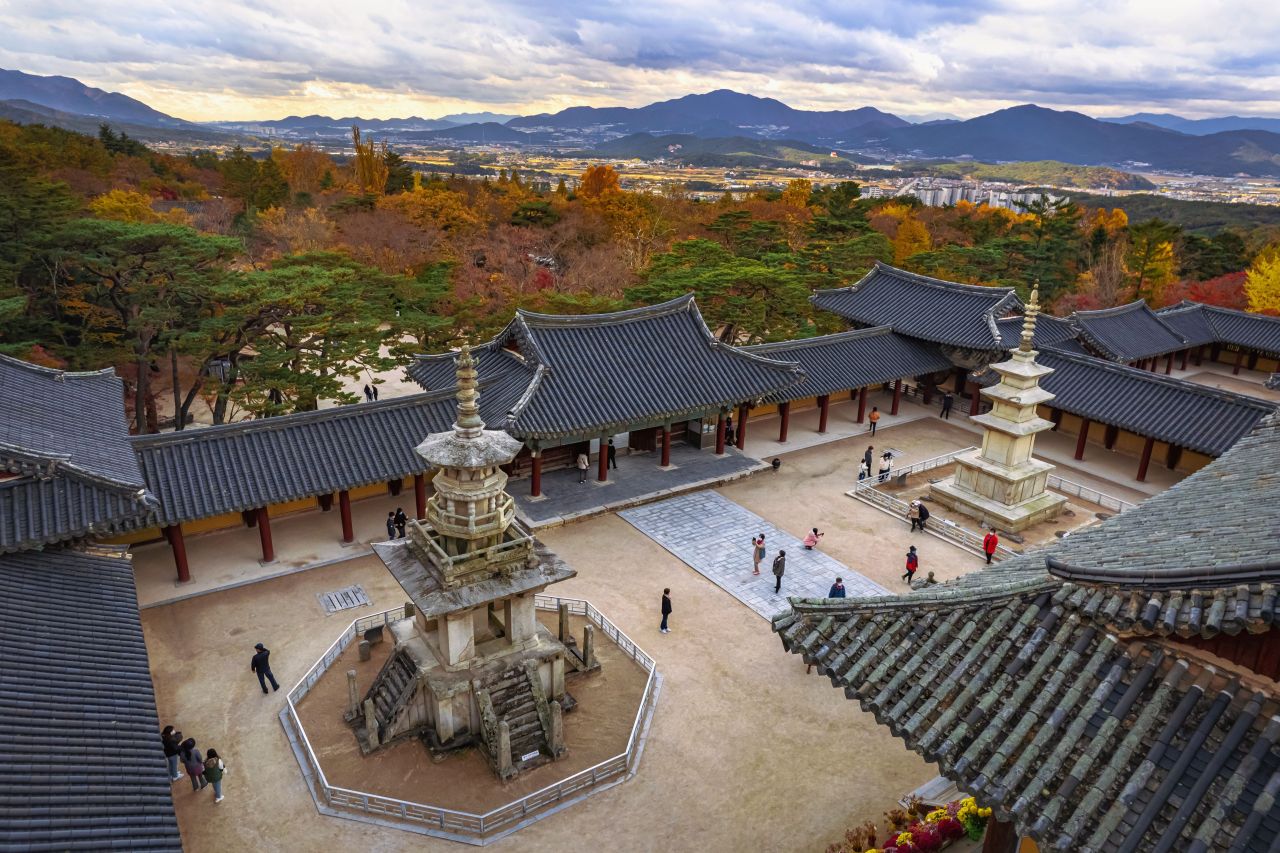
The two pagodas — ornate Dabotap and austere Seokgatap — flanking Daeungjeon, with the Gyeongju basin beyond. Photo: 불국사 / Source: Korea Tourism Organization 관광사진갤러리 (KOGL Type 1).
Beyond the courtyard, don’t rush past the gilt-bronze Buddha halls—the Vairocana and Amitabha Buddhas are National Treasures in their own right—and the smaller shrine buildings that step up the hillside. The granite terracing means the whole place unfolds in levels, so slow down and let it reveal itself.
A quick history that explains the ruins-and-restoration mix
Built around 751 CE, Bulguksa Temple flourished for centuries as a spiritual heart of Silla. Then came the Imjin War (1592–98). The Japanese invasions torched most of the wooden buildings. The granite bones—terraces, staircases, pagodas—survived the fire. That’s why the stonework feels so much older and truer than the halls around it.
What you see today is largely a careful 1966–73 reconstruction of the timber structures on those original foundations. In 1995 UNESCO inscribed Bulguksa together with nearby Seokguram Grotto as a single World Heritage listing. So you’re looking at authentic Silla stone dressed in modern Silla-style wood—an honest layering, not a fake.
The honest downsides (read this before you go) ⚠️
Bulguksa Temple is wonderful, but it’s not flawless, and I’d rather you go in clear-eyed.
Parking at Bulguksa Temple is the real ordeal. On weekends the lots fill early, and the approach road turns into a one-out-one-in crawl. The public lots are cheaper, but some of them sit a long walk from the gate. The paid lot by the ticket office runs about ₩2,000 — roughly ₩1,000 more — and it is far closer. That is usually money well spent. Coming back, the quickest move is grabbing one of the taxis already waiting at the lot.
The photo queue is real. A clean, straight-on shot of the twin pagodas means waiting your turn in line. Stepping aside to dodge the queue just puts other people in your frame. Even a rainy weekday can bring coach groups. The corridors wrapping Daeungjeon stay noticeably quieter, so shoot there instead — or go low and shoot upward.
School groups own the mornings. Gyeongju is Korea’s field-trip capital, and class after class rolls in through the morning. The first admission slot of the day is the one genuinely calm window.
It can also feel smaller than its fame suggests. The core walk is genuinely under an hour. Travelers expecting a sprawling mountain monastery sometimes leave thinking, “…that was quick?”
Stairs, Seokguram, and logistics
Then there’s the climbing. From the parking area it’s a ~10–15 minute uphill walk just to reach the temple, with more stairs between the terraced levels. The stone stairways inside are steep and narrow in places. Wheelchairs, heavy luggage, and unsteady legs will all struggle. Wear proper shoes — in summer the approach alone will have you sweating.
Seokguram asks a lot and gives back less than you’d hope. Shuttle Bus 12 runs up the mountain only about hourly. The grotto itself is viewed through a glass wall from a short distance. Reflections on that glass genuinely get in the way of seeing the Buddha properly. Opinions split on whether it lands as magical or anticlimactic.
Finally, logistics. English signage is limited and uneven, and public transport from the KTX station is slow and roundabout. Last admission also shifts by season, so check the day’s closing time rather than assuming. This is not a “hop off the train and you’re there” attraction.
Who should go, who should skip
Go if you care about history, architecture, or that one perfect Korea photo. If Gyeongju is on your itinerary at all, Bulguksa Temple is the anchor—full stop. It’s also a great intro temple for first-timers, because the layout is legible and the highlights are famous for a reason.
Consider skipping, or at least keeping it short, if you’ve already toured several major Korean temples this trip and you’re chasing a big, atmospheric mountain complex. Bulguksa is refined and orderly rather than vast and wild. And if stairs are a hard no, the upper terraces will frustrate you.
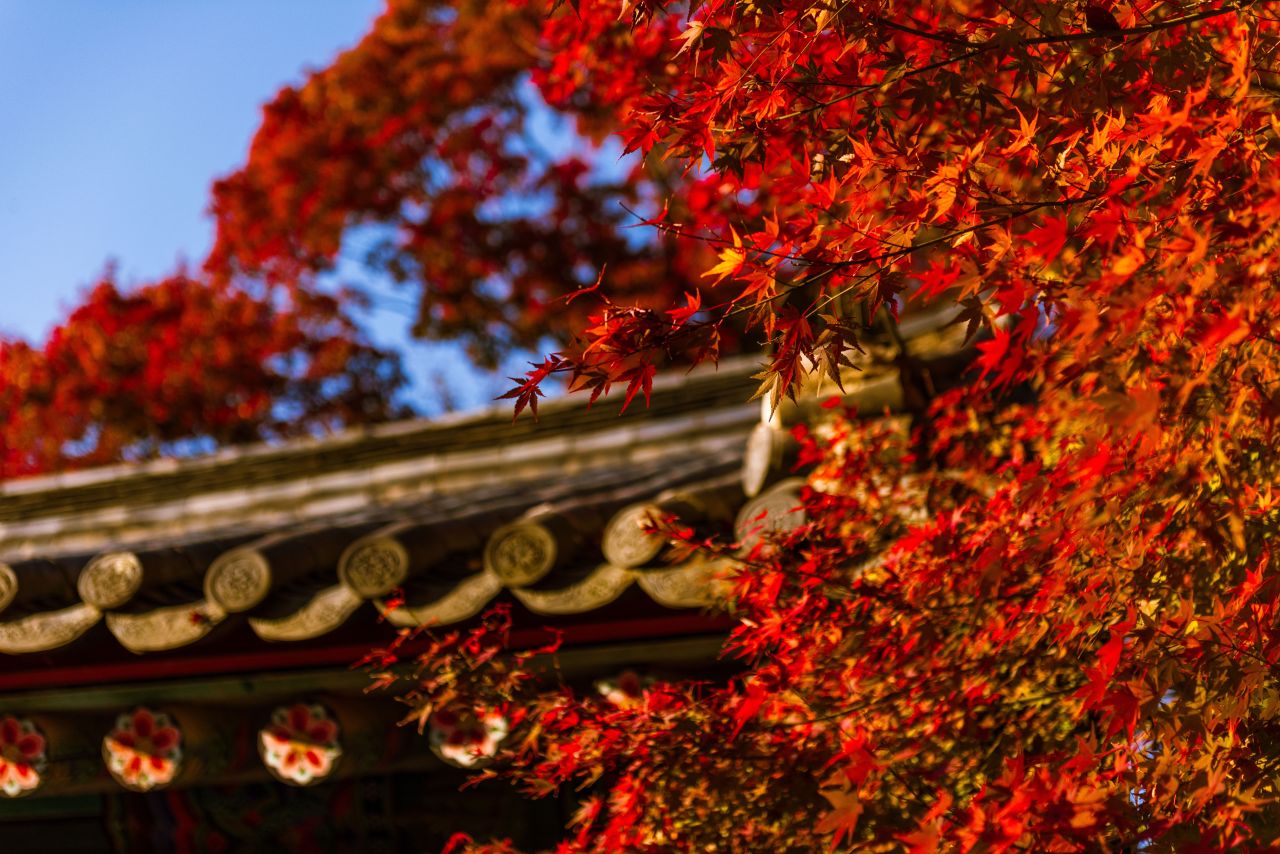
Crimson maples against Bulguksa’s tiled eaves in late autumn. Photo: 불국사 / Source: Korea Tourism Organization 관광사진갤러리 (KOGL Type 1).
Practical tips to do it right ✨
Timing is everything here. Arrive at opening—somewhere around 7–8am—or swing by in late afternoon, and you’ll dodge the worst of the tour buses. The light is better then too.
For the prettiest visit, aim for peak autumn foliage from late October to mid-November, when the maples around the bridges go crimson. The other sweet window is spring, when lotus lanterns line the grounds near Buddha’s Birthday.
To combine Seokguram, take Shuttle Bus 12. It departs Bulguksa at roughly :40 past the hour and leaves Seokguram on the hour, a ~20-minute ride each way—but confirm the printed timetable when you arrive, because it shifts by season. Wear comfy shoes; there’s more walking and stair-climbing than the compact map suggests.
Navigation-wise, use Naver Map or KakaoMap, not Google—Google transit is unreliable in Korea and will steer you wrong. Bring a little cash for parking, since the lot isn’t always card-friendly.
If I had one morning in Gyeongju, honestly, I’d open Bulguksa at 7:30, shoot the pagodas and bridges in the quiet, catch the ~:40 shuttle up to Seokguram, and be back in town for lunch by the tombs. That’s the trip. For more of Korea’s heritage sites, Gyeongju is the deepest well in the country—and Bulguksa Temple is where I’d start digging.
Pingback: Daereungwon: Gyeongju's Free Royal Tomb Park Guide