
Haeundae Beach is the most famous stretch of sand in Korea, and it is not a quiet, palm-fringed escape. It is a 1.5 km city beach with a wall of apartment towers behind it, a subway station ten minutes away, and — in August — roughly the population of a mid-sized town squeezed under matching blue parasols. That sounds like a warning. It isn’t. Haeundae is worth a slot precisely because it is urban, loud and easy, and because you can go from train seat to seawater in about fifteen minutes.
Real talk: the version of Haeundae Beach you get depends almost entirely on the month you show up. Come in late June or September and you get a wide, walkable, genuinely lovely bay. Come on the second Saturday of August and you get a crowd photo. This guide covers both, so you can pick your day instead of gambling on it.
- 📍 Address: 11 Jungdong 2-ro, Haeundae-gu, Busan 48095 (beach office); the sand runs along Haeundaehaebyeon-ro
- 🕘 Hours: the beach itself is open and free 24/7, year-round. The official 2026 swimming season runs 26 June – 15 September, with supervised water hours 09:00–18:00 and lifeguards on the towers during those hours
- 💰 Price: free to enter. Parasol + mat about ₩10,000 (cheaper by card or online booking), beach bed ₩10,000–12,000, life jacket ₩5,000, shower ₩1,000 per 60 seconds, lockers ₩1,000–4,000
- 🚇 Getting there: Busan Metro Line 2 → Haeundae Station, Exit 3 or 5, then walk about 8 minutes down Gunam-ro straight to the sand. For the eastern (Mipo) end, use Jung-dong Station, Exit 7
- ⏱ Time needed: 1.5–2 hours for a walk and a coffee; 3+ hours if you swim or add Dongbaekseom
- 🔗 Nearby: Dongbaekseom Island coastal trail and Nurimaru APEC House (west end, 15-min walk) · Haeundae Traditional Market (5 min inland) · Blueline Park Sky Capsule from Mipo (east end)
- ✅ Verified as of July 2026
Haeundae Beach, honestly described 🌊
Picture Haeundae Beach as a gentle crescent of pale sand, about 1.5 km long and 70–90 m deep, curving between two rocky headlands. Behind it stands one of the densest skylines in Korea — hotels, the Marine City towers to the west, and the enormous LCT complex to the east. The water is calm, shallow for a long way out, and warm enough to swim in from late June through early September.
And that skyline is the whole point. Haeundae Beach doesn’t pretend to be a desert island, and it stops feeling disappointing the moment you stop expecting one. What you actually get is a proper seaside promenade in the middle of a working city: joggers at 7am, families at noon, couples with convenience-store beers at sunset, and the towers lighting up behind the sand after dark.
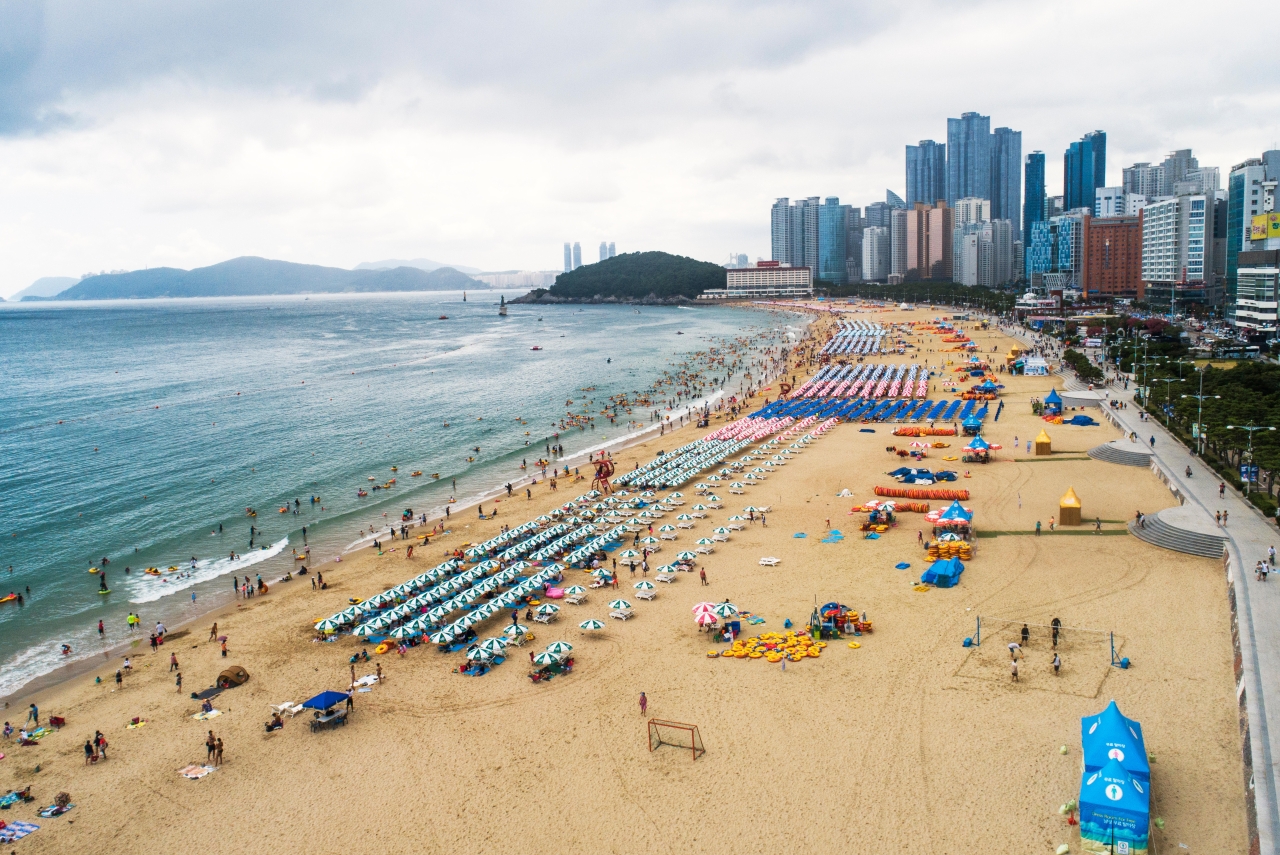
Photo: 해운대해수욕장 / Source: Korea Tourism Organization 관광사진갤러리 (KOGL Type 1)
Because Haeundae Beach never closes and costs nothing, it also works as a filler slot rather than a destination. If your Busan day collapses — museum closed, rain clears late, train delayed — Haeundae absorbs an hour with zero planning.
When to visit Haeundae Beach — timing beats everything 🗓️
Honestly, I’d argue nothing about Haeundae Beach matters more than when you go. Same sand, but wildly different days:
| When | What you get |
|---|---|
| Late June & early September | The sweet spot. Water is open and warm, lifeguards are on duty, crowds are thin enough to actually lie down. |
| July–August | Peak festival energy and peak misery. Parasols sit edge to edge, the water fills up, and hotel prices spike. |
| April–May, October | My favourite for a walk. No swimming, but soft light, empty sand and a promenade you can have to yourself. |
| Winter | Bracing, grey-blue and weirdly beautiful. Cafés stay open, the beach is nearly empty, and seagulls take over. |
Then time of day matters almost as much. Early in the morning, before 9am, you get the cleanest sand and the best photos. Sunset delivers the skyline glow. Midday in summer just gives you sunburn and queues.
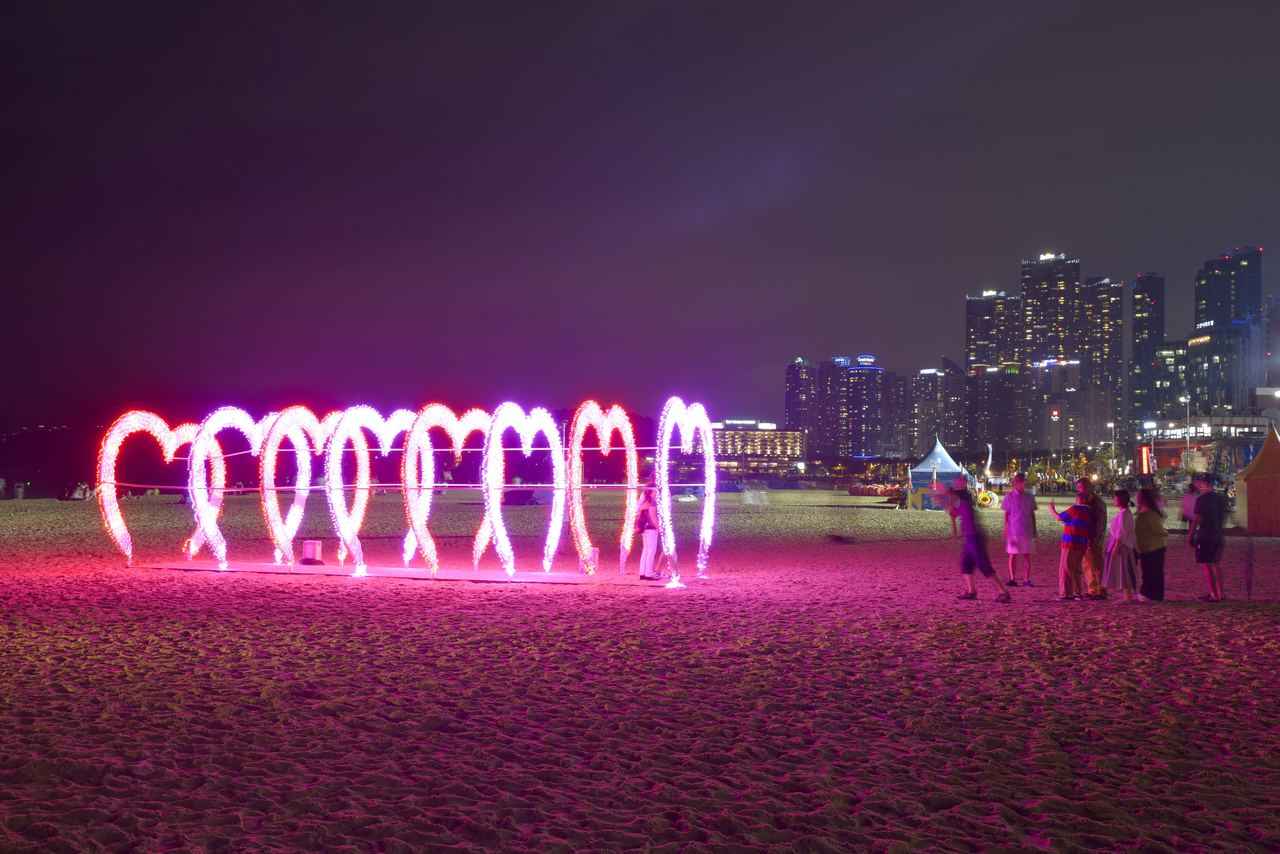
Photo: 해운대해수욕장 / Source: Korea Tourism Organization 관광사진갤러리 (KOGL Type 1)
What I’d actually do with a Haeundae Beach slot
So skip the idea of “doing” the beach as an activity. Here’s the route I’d take instead, and it fills about two hours comfortably.
Start at the Haeundae Station end and walk down Gunam-ro, the pedestrianised strip that funnels you toward the water. Hit the sand, turn right (west), and walk the full promenade to the far headland. That end is quieter, the sand is wider, and the Marine City towers stack up beautifully across the bay.
Keep going and the path lifts into Dongbaekseom Island — not really an island any more, but a wooded coastal loop with a boardwalk, camellia trees, a mermaid statue and Nurimaru APEC House at the top. The full loop takes 30–40 minutes and it is free. Honestly, this is the part most day-trippers skip, and it’s the part I’d protect if time got tight.
If you’d rather go east instead, walk to Mipo at the other end and pick up the Blueline Park Sky Capsule — a small pastel pod that runs the coastline to Cheongsapo, about 7–10 m above the rocks. It is charming and it is not cheap: roughly ₩40,000 one-way for two people, and it books out on weekends.
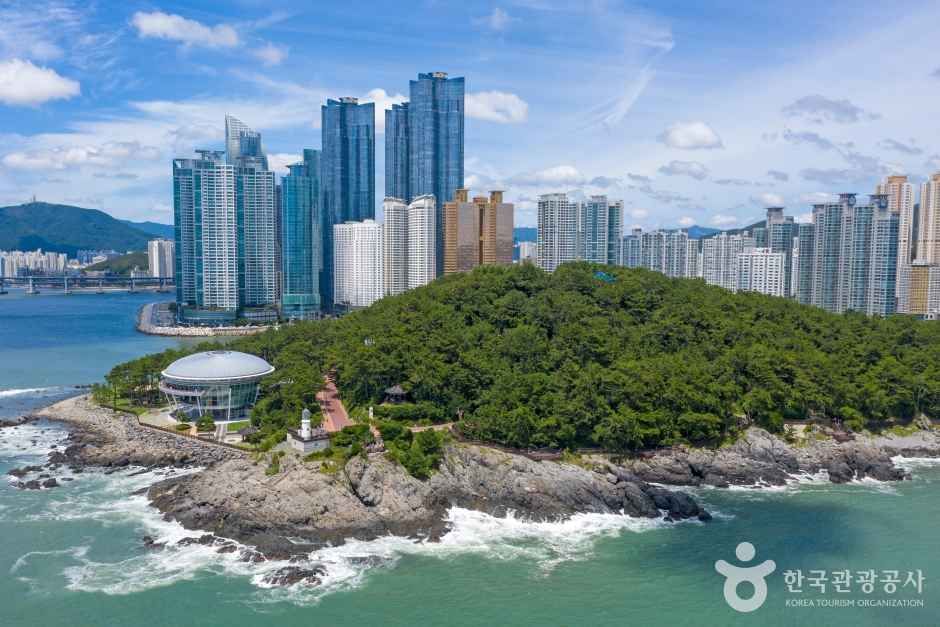
Photo: 해운대 동백섬 / Source: Korea Tourism Organization 관광사진갤러리 (KOGL Type 1)
Eating around the sand 🍜
The restaurants facing Haeundae Beach charge a view premium, and most of them are fine rather than great. So walk five minutes inland to Haeundae Traditional Market instead. It is a short covered lane packed with the stuff you actually came to Korea for: ssiat hotteok stuffed with seeds and honey, fried mandu, tteokbokki, grilled eel, and stalls selling live seafood by weight.
Busan’s signature dishes are close by too. Milmyeon, the cold wheat-noodle bowl invented here, is a perfect post-swim meal. Dwaeji gukbap — pork and rice soup — suits a cold-weather visit better than anything on the seafront menus.
Convenience stores also line the beach road, and drinking on the sand is normal and legal. A cold beer and a bag of snacks at sunset is the classic local move, and it beats most restaurant terraces for atmosphere.
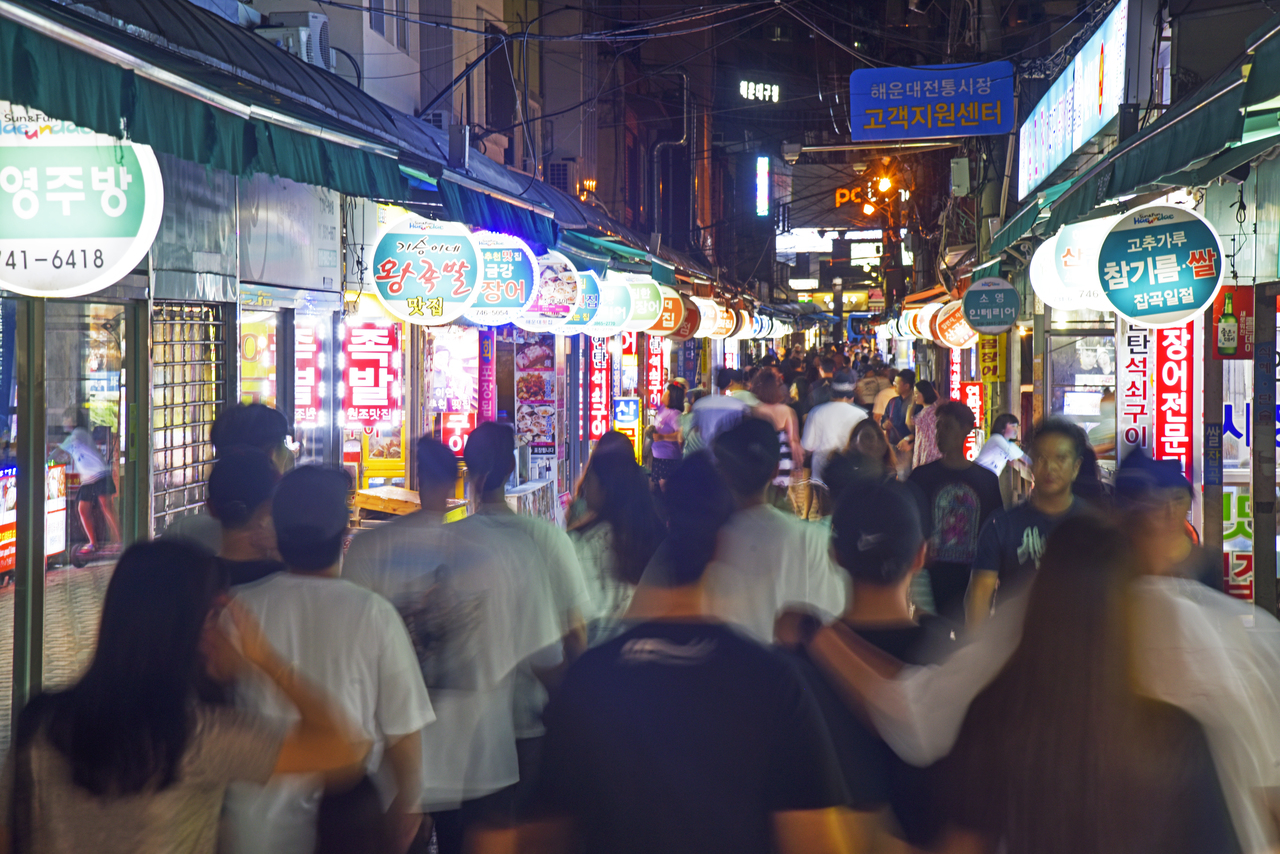
Photo: 부산 해운대전통시장 / Source: Korea Tourism Organization 관광사진갤러리 (KOGL Type 1)
The honest downsides of Haeundae Beach
Now let’s be fair about what annoys people here, because plenty of visitors leave underwhelmed.
Summer crowds are genuinely extreme. In July and August the parasol grid covers nearly every usable metre. Reviewers describe stretching a leg and landing under a stranger’s umbrella, and that is not much of an exaggeration. If you want a rented spot on a hot weekend, arrive early.
It doesn’t look like a postcard beach. The sand is decent rather than dazzling, and the setting is thoroughly urban. Travellers arriving from Southeast Asia or Australia often find it ordinary — opinions genuinely split on whether the skyline reads as dramatic or as a wall of concrete.
Driving is a bad idea. Parking near the beach is scarce and expensive, and summer traffic around Haeundae jams badly. The public lots run their own queue: half an hour of waiting is a normal summer afternoon, and visitors report two to three hours on long holiday weekends. The tolled underpass into the area is pricey on top. Take Line 2.
Swimming has rules and limits. Supervised water hours end at 18:00, so an evening swim is off the table. Jellyfish turn up occasionally in late summer, though they rarely cause real trouble.
The sea can be closed outright, and this catches people cold. Haeundae gets rip currents, and when the risk is high lifeguards ban entry to the water — sometimes for a whole day, with no reopening. Travellers have arrived for a beach day and spent it looking at the sea rather than swimming in it. Check the national weather service’s beach forecast for wave height and rip-current risk before you commit the day. You cannot change the surf, but you can stop it ruining your plan.
Keep children within arm’s reach. In peak season the beach is dense enough that a child who wanders twenty metres genuinely disappears into the crowd. Parents describe the scramble of trying to spot one small swimmer among hundreds. Agree a meeting point and keep them beside you in the water.
Prices creep — but not where you’d expect. Seafront restaurants and peak-season hotels cost noticeably more than elsewhere in Busan. The beach operation itself is the fair part: Korean visitors who arrived braced for tourist-trap pricing on parasols and gear report finding none. Budget for the meals and the room, not for the sand.
Two small mechanical things while you’re here. The free changing tents dotted along the sand move quickly and are the easy option, and lockers come in a range of sizes. The rinse-off showers, though, are fixed overhead sprays — fine for washing salt off entirely, awkward if you only wanted to clean sandy feet.
Who should go — and who shouldn’t bother
Go to Haeundae Beach if you want an easy, free, high-energy slice of Busan; if you like walking promenades; if you’re travelling with kids who need to burn off an afternoon; or if you want a sunset that costs nothing. It also pairs neatly with the Dongbaekseom trail, the market and Blueline Park, so one trip out here can fill half a day.
Skip it if you’re chasing a quiet, natural coastline instead. Korea has those, and this is not one. Songjeong is calmer and better for surfing, and the small coves along the Blueline route feel far more remote for a fraction of the effort.
My verdict: give Haeundae Beach one slot, not a whole day — ideally at golden hour, ideally outside peak August, and ideally with a walk to Dongbaekseom tacked on the end. Treated that way, it earns its reputation. Treated as a beach holiday, it will disappoint you.
Looking for more open-air slots around Korea? Browse the rest of our Parks & Nature guides.
Pingback: Seokchon Lake, Seoul: Blossoms, Night Walk & Lotte Tower
Pingback: Inwangsan: Seoul's Best Short Historical Hike