
Here’s the thing about Wolji Pond: turn up at two in the afternoon and you’ll wonder what the fuss is. A pond, some grass, three wooden pavilions. Fine. Pleasant. Forgettable.
Come back at nine at night and it’s the best hour you’ll spend in Gyeongju. The pavilions light up, the water goes glass-flat, and the whole thing doubles itself in the reflection. Korean visitors who write about this place almost all say the same thing — night beats day, and it isn’t close.
So this guide is really about timing. Get that right and ₩3,000 buys you Gyeongju’s signature image. Get it wrong and you’ve paid for a walk around a lake.
- 📍 Address: 102 Wonhwa-ro, Gyeongju-si, Gyeongsangbuk-do (경주시 원화로 102) — search “안압지” if your map app struggles
- 🕘 Hours: 09:00–22:00 daily, year-round. Last tickets and last entry at 21:30
- 💵 Price: ₩3,000 adult · ₩2,000 teen · ₩1,000 child. Parking is free
- 🚌 Getting there: Bus 10 or 11 from Gyeongju Intercity/Express Bus Terminal, about 20 min (~₩1,200). From Singyeongju KTX station take bus 700 or 50. From Cheomseongdae it’s a 15-minute walk
- ⏱ Time needed: 1–1.5 hours for the full loop at a photo-taking pace
- 🔗 Nearby: Cheomseongdae (free, 15 min walk), Woljeonggyo Bridge, Hwangnidan-gil for dinner
- ✅ Verified as of August 2026
What you’re actually looking at 🏯
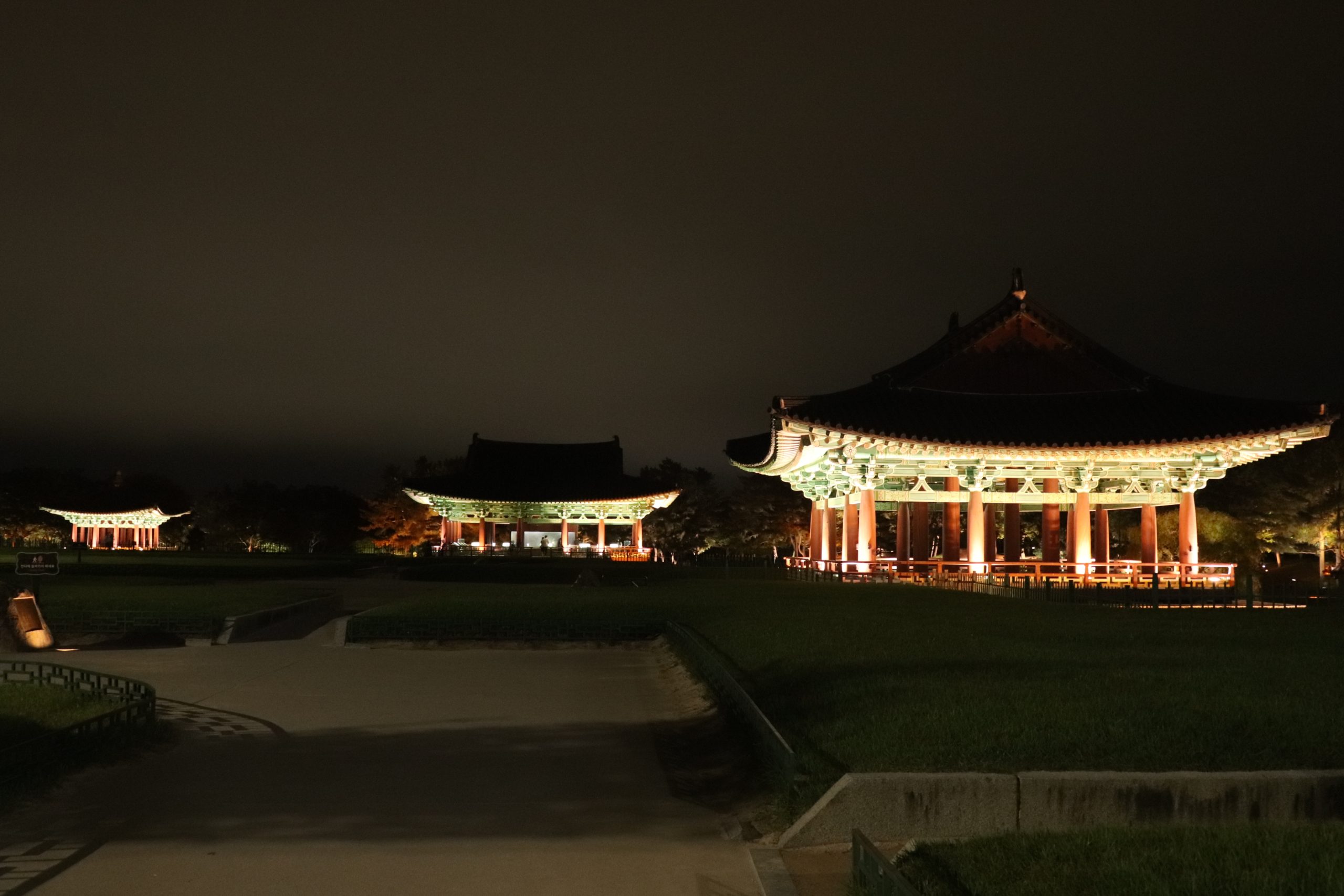
The three rebuilt pavilions seen from the landward side — everything else on the site is foundation stone and lawn. Photo: Gyeongju Donggung Palace and Wolji Pond (경주 동궁과 월지) 4 — Kouz14, CC BY-SA 4.0 via Wikimedia Commons
This was the Silla crown prince’s palace. Not the main royal seat — the secondary one, where the court threw banquets for state occasions and important guests. King Munmu had the pond dug in the 670s, and for roughly 250 years this was where the kingdom showed off.
Then Silla fell, and Wolji Pond went to ruin. Joseon-era poets found a reedy pond with geese and ducks on it and named it Anapji — literally “goose and duck pond.” That name stuck for centuries.
Archaeologists dug the site up in 1975 and 1976. They found 26 building foundations, tens of thousands of artefacts, and eventually a pottery shard with “Wolji” inscribed on it. That shard settled the argument: the original name was Wolji, the moon pond. Korea made the rename official in 2011.
Of the five pavilions that once stood on the bank, three had foundations solid enough to rebuild. Those three are what you photograph. Everything else is footprint and lawn — which is exactly why daylight underwhelms and darkness works.
Why Wolji Pond earns its ticket after dark
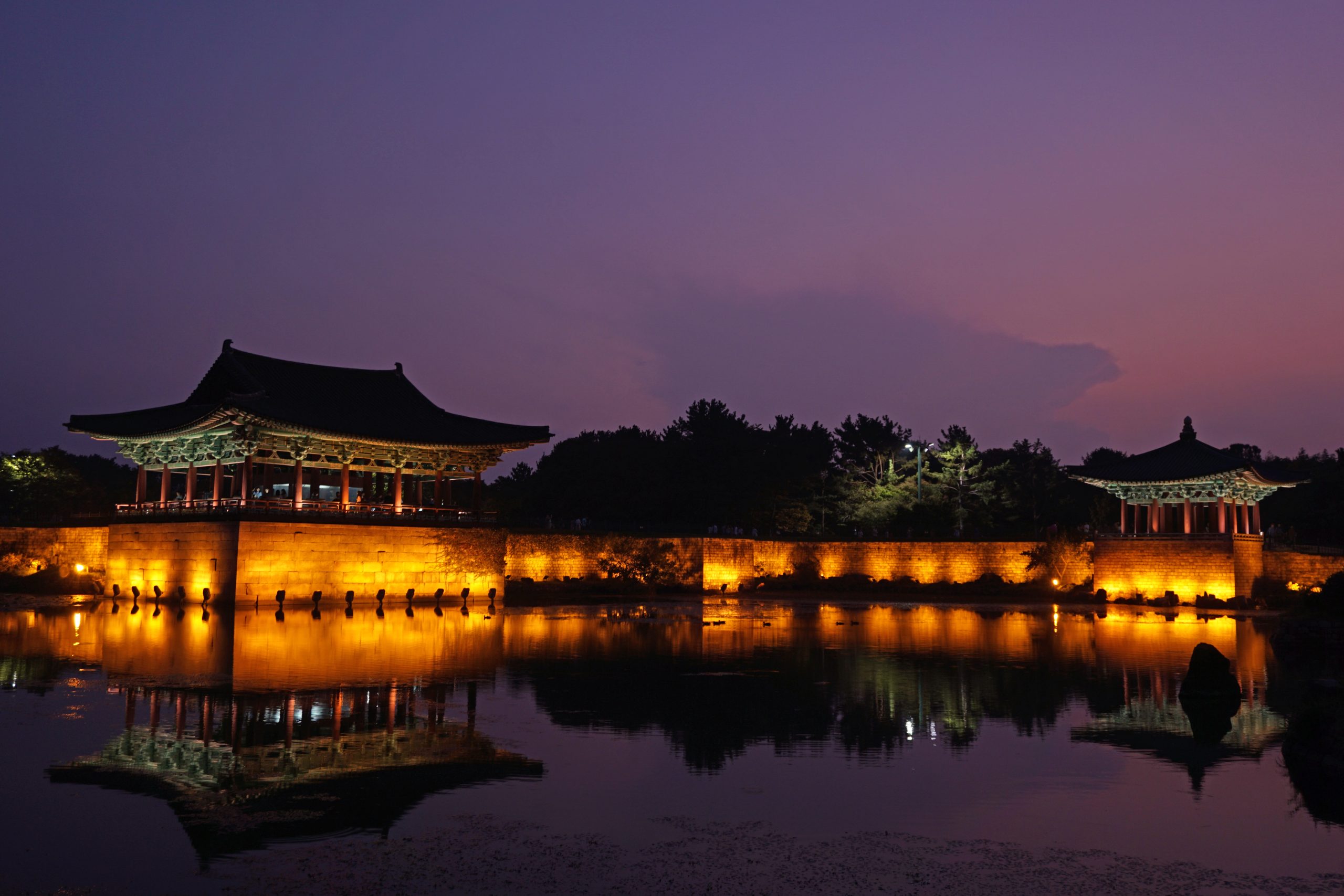
Twilight, before the sky goes fully black. Photo: Donggung Palace and Wolji Pond in Gyeongju 동궁과 월지1 — Heera7, CC BY-SA 4.0 via Wikimedia Commons
The lighting at Wolji Pond is unusually good. Warm floodlights pick out the pavilion timbers and the curved eaves, and on a still evening the pond mirrors all of it almost perfectly. You get the building and its double in one frame.
The classic shot is from the far side of the water, with all three pavilions lined up. Walk the loop anticlockwise and you’ll hit it about a third of the way round. Everyone stops there, so expect company.
What surprised me reading through Korean trip reports is how consistent the reaction is. People arrive expecting a nice-enough historic site and leave calling it the highlight of the trip. That’s rare for a ₩3,000 ticket.
Getting the timing right ⏰
Wolji Pond rewards one decision above all others, so here’s the honest breakdown.
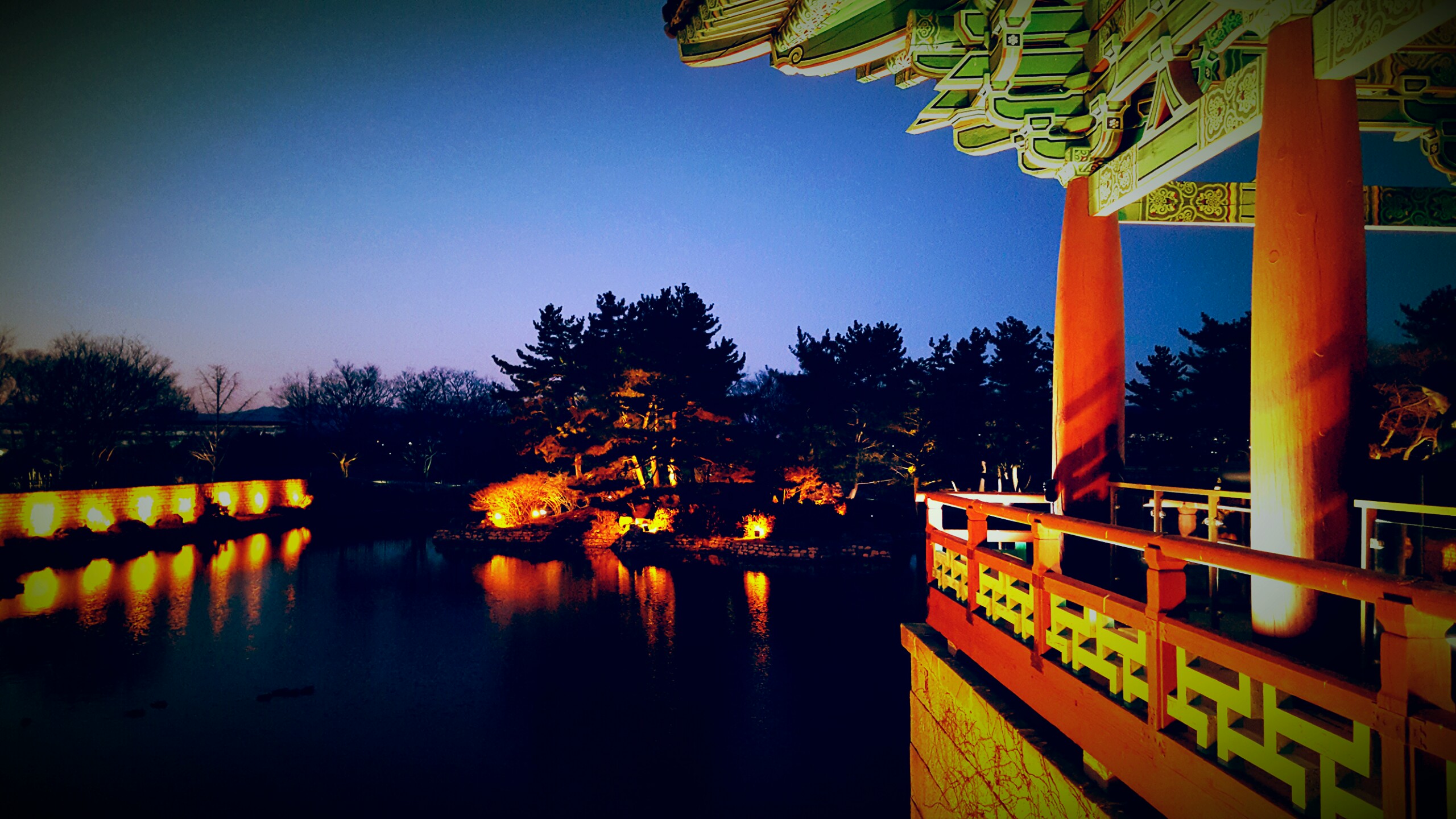
The blue-hour window from inside one of the pavilions — sky still blue, floodlights already on. Photo: Gyeongju donggung palace and wolji pond — 최수호, CC BY-SA 3.0 via Wikimedia Commons
| Arrival | What you get | Verdict |
|---|---|---|
| Before 17:00 | Pond, lawn, three pavilions in flat daylight | Skip — you’re paying for the worst version |
| ~30 min before sunset | Blue hour, lights coming on, reflections | Best. Aim for this |
| After 20:00 | Full illumination, black sky, biggest crowds | Good, and still worth it |
| After 21:30 | Nothing — the gate is closed | Don’t |
One catch worth knowing. If you arrive well before sunset, there’s a genuinely dull stretch where you’ve seen the loop and the lights still aren’t on. One visitor described exactly that boredom. Don’t arrive at four and try to wait it out — go do Cheomseongdae, then come back.
The summer lotus field almost nobody mentions 🪷
Here’s a genuine surprise. The Wolji Pond grounds include a lotus field that blooms through July, with white and pink flowers mixed together. It’s substantial, and in the morning light it’s lovely.
Korean bloggers who went for the lotus field say it changed their opinion of the place — they’d assumed it was a night-only stop. If you’re in Gyeongju in July, you can honestly justify two visits: lotus in the morning, reflections after dark.
Outside July, though, the daytime case is weak. I wouldn’t build an afternoon around it.
The honest downsides
Wolji Pond by day is genuinely underwhelming. This is the near-unanimous verdict in Korean reviews, and several bloggers put it in their post titles: prettier at night, not much at noon. One wrote flatly that without the night lighting there’s little reason to come. Take that seriously.
The photo spot has a queue. At the main reflection viewpoint you’ll wait your turn, and on peak evenings that wait is real. Groups deal with it by sending one person ahead to hold the spot. If you want a people-free frame, you’ll be standing around a while.
Parking backs up before sunset. The lot is free, which is great, but everyone arrives in the same 45-minute window. Visitors report queuing 20 minutes just to get in, and queuing again to get out. Walking or taking a bus sidesteps the whole problem.
The 21:30 cutoff is hard. Ticketing closes at 21:30 and the staff mean it — if you’re still in the ticket queue when it hits, you’re not getting in. On busy evenings that queue itself takes a while, so don’t cut it fine.
Crowds don’t thin out late. Turning up at 20:30 on a summer weekend won’t buy you solitude. It stays busy until closing, and the paths get slow. Worth knowing if you’re bringing small kids.
There’s almost no shade. Relevant only if you come by day in summer, but the grounds are open lawn and the sun is unrelenting.
Slotting it into a Gyeongju evening
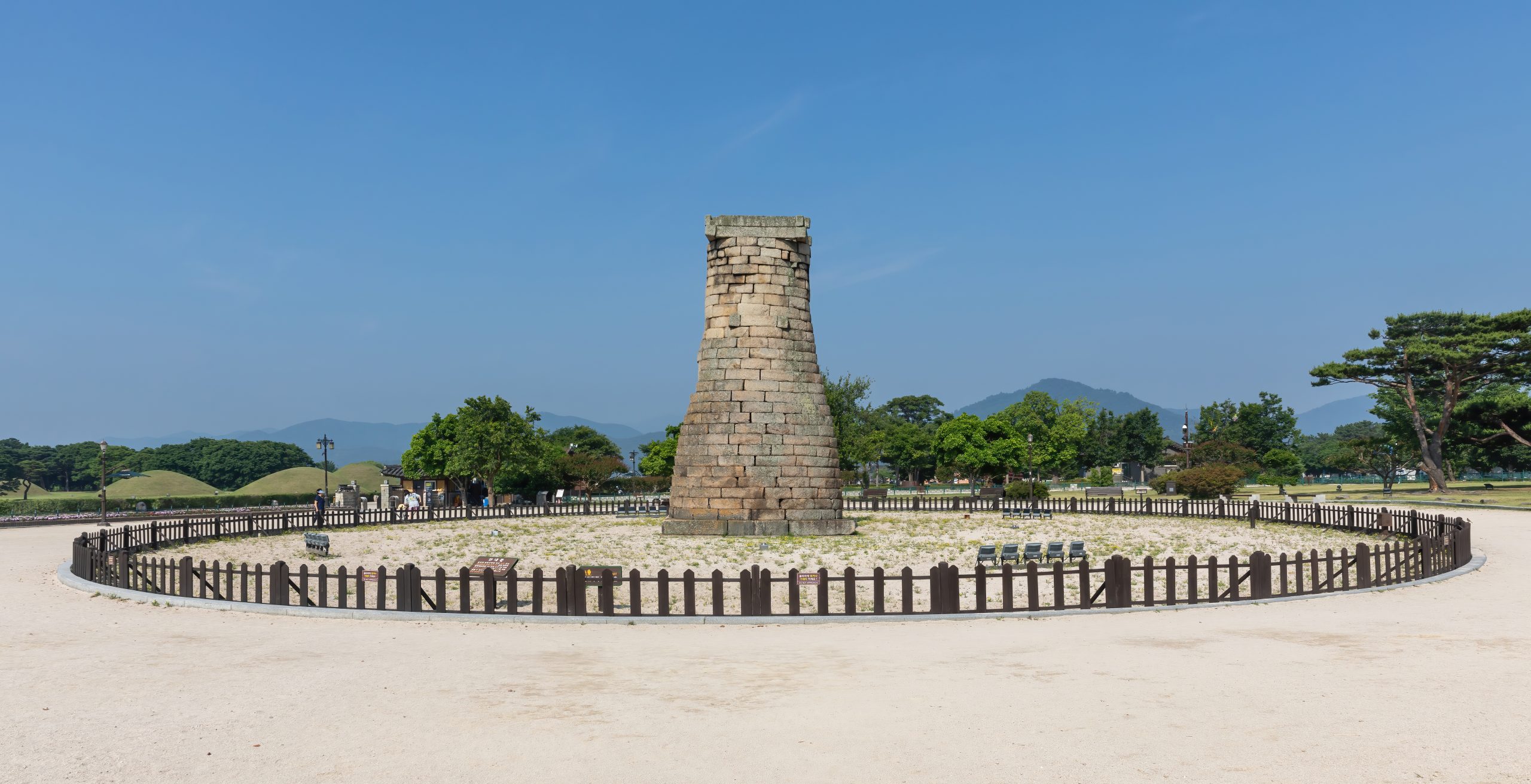
Cheomseongdae, a 15-minute walk away and free to visit — shown here by day, but it’s floodlit at night too. Photo: Cheomseongdae Observatory under blue sky in Gyeongju South Korea — Basile Morin, CC BY-SA 4.0 via Wikimedia Commons
The standard route works, so use it. Spend the afternoon at Daereungwon and Cheomseongdae — both free now — then eat early on Hwangnidan-gil. Walk over here for sunset, and finish at Woljeonggyo Bridge, which is lit too and costs nothing.
If I had one evening in Gyeongju, that’s exactly what I’d do, and I’d put Wolji Pond at the centre of it rather than the end. Save the bridge for last — it’s quieter, and a calmer place to finish.
Cheomseongdae also runs a media art projection in the evenings. Check the schedule when you arrive, because it changes, and time your walk over so you catch the tail end of it.
Who should go, and who can skip it
Go if you’re spending a night in Gyeongju. The city empties of day-trippers after dinner, and this is the single best thing to do with that evening.
Go if you like photographing buildings. Few sites in Korea hand you a reflection as clean as Wolji Pond’s, and the ticket is cheap enough that a mediocre-weather night still isn’t a big loss.
Skip it if you’re day-tripping from Busan and have to catch an evening train. You’d be seeing the version everyone says to avoid. Put Bulguksa or the National Museum in that slot instead.
Skip it if it’s pouring. Rain kills the reflection, and there’s no indoor anything here — no hall, no exhibition, nowhere to shelter.
One honest caveat: this is a reconstruction on an excavated site, not an intact ancient palace. If that distinction bothers you, adjust your expectations. For everyone else, Wolji Pond after dark is the postcard, and the postcard is earned.
Planning more of Gyeongju’s Silla sites? Our Heritage Sites guides cover the temples, tombs and palaces worth your time — and the ones worth skipping.
Pingback: Haedong Yonggungsa: Busan's Cliff Temple Guide
Pingback: Changgyeonggung: Seoul's Quiet Garden Palace
Pingback: Seonjeongneung: Royal Tombs in the Heart of Gangnam
Pingback: Hwaseong Fortress: Suwon's Walkable UNESCO Wall (2026)
Pingback: Gyeonghuigung Palace: Seoul's Free, Quiet Fifth Palace
Pingback: Daereungwon: Gyeongju's Free Royal Tomb Park Guide