
Here’s a Seoul park that started life as a water-treatment plant — and honestly, that’s the whole appeal. Seonyudo Park sits on a small island in the Han River. When the plant shut down, the city left the old concrete filtration tanks standing. Plants crawled over them, and the result got called a garden. The result is one of the strangest, most photogenic green spaces in the city. Ivy-wrapped pillars, sunken pools full of reeds, and a footbridge with a full sweep of the river. If you like your nature with a little grit and a good story, give it a slot. If you’re picturing a big rolling lawn, adjust your expectations now. This is a compact, moody, industrial-eco hybrid, and it’s better for it. 🌿
- Address: 343 Seonyu-ro, Yeongdeungpo-gu, Seoul (선유로 343) — an island in the Han River beside Yanghwa Bridge
- Hours: park open daily 06:00–24:00; the indoor Han River Exhibition Hall runs 09:00–18:00 (to 17:00 in winter), closed Mondays
- Admission: free (only optional eco-programs and the on-island café charge)
- Getting there: Dangsan Station (Line 2 & 9), Exit 4, then a ~10–15 min riverside walk across the Seonyugyo footbridge. No general parking exists on the island (only six disabled bays), so drivers use the Yanghwa Hangang Park lots and walk ~5 min over the bridge
- ⏱ Time needed: ~1.5–2 hours
- 🔗 Pairs well with: Yanghwa Hangang Park, Hapjeong & Mangwon, or Hongdae for the evening
- Verified as of July 2026
How Seonyudo Park went from water plant to garden 💧
From 1978 to 2000, this island supplied tap water to Seoul’s industrial southwest. When the filtration plant closed, the city did something unusual: it kept the bones. Landscape architect Jeong Yeong-seon and her team left the concrete sedimentation basins, the pillars, and the pipework in place. Then they planted into and around them. Seonyudo Park opened in April 2002, just before the World Cup, as Korea’s first eco-park recycled from a water-treatment facility. It later picked up an American Society of Landscape Architects design award, and it still gets studied by landscape designers today.
What that means for you on the ground: this doesn’t feel like a normal park. You walk between weathered concrete walls one minute and stand in a quiet reed pond the next. Old machinery bays now frame flower beds; drainage channels carry water gardens. It’s part ruin, part garden. That contrast is exactly why photographers, film crews, and couples shooting wedding photos keep showing up. Come knowing the backstory and the whole place reads differently — every scarred wall is a piece of the city’s plumbing history.
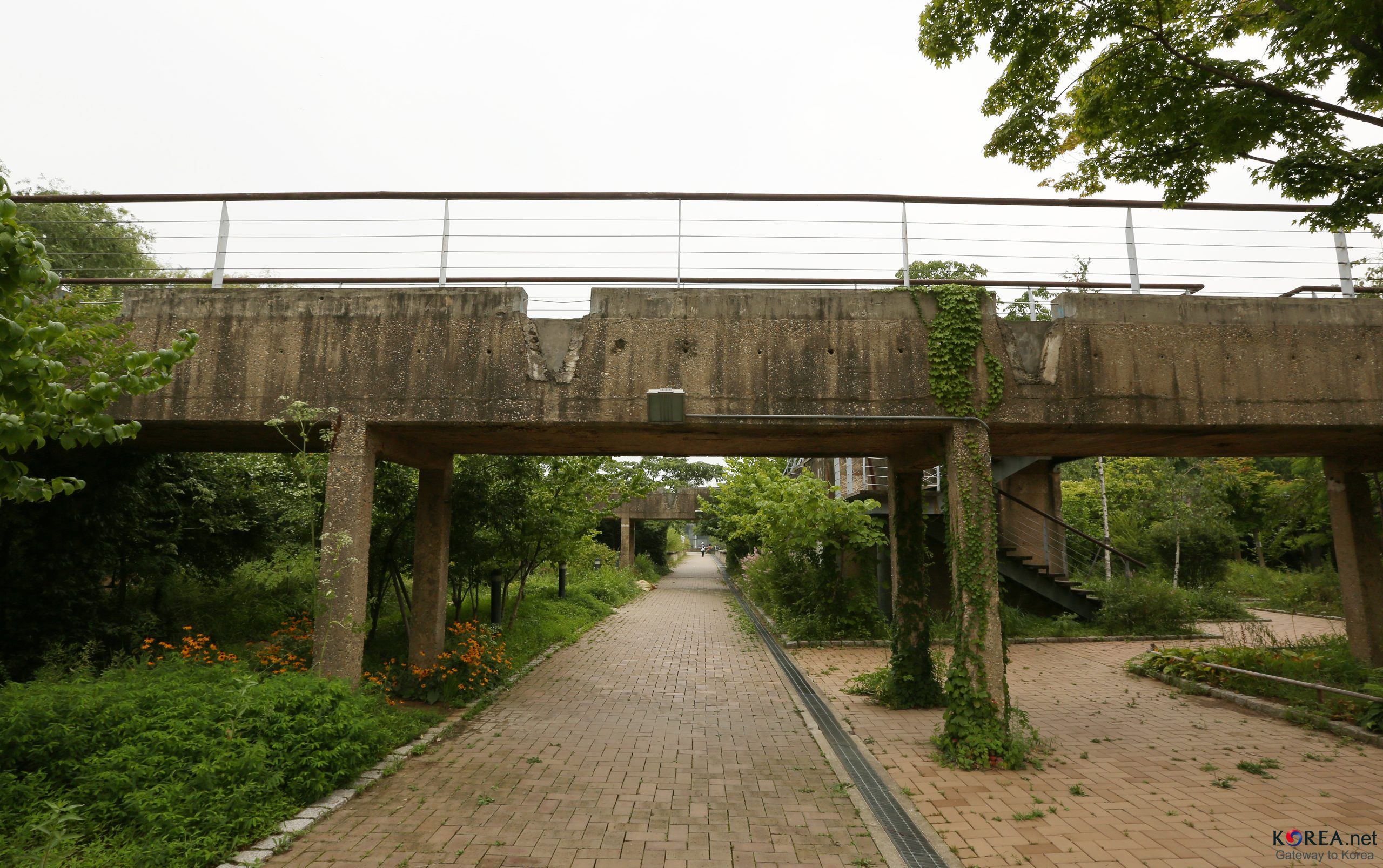
Photo: Old water-plant structures now overgrown with greenery along a garden path at Seonyudo Park — Republic of Korea, CC BY-SA 2.0 via Wikimedia Commons.
The gardens actually worth your time
The park is small, so you can see the highlights without rushing. A few spots earn the trip on their own:
- The Garden of Green Columns (녹색 기둥의 정원) — bare concrete pillars from the old plant, now wrapped in ivy. It’s the park’s signature shot and the most “beautiful ruin” corner of the island.
- The water-purification basin gardens — the old filtration tanks reborn as sunken aquatic gardens, thick with reeds and water plants. In summer they’re genuinely lush.
- The greenhouse — a compact glasshouse with 200-plus plant species. A warm, quick stop, handy in colder months when the outdoor gardens go bare.
- The Han River Exhibition Hall — a small indoor space on the river’s story and the site’s history. Skip it if you’re short on time; it’s a bonus, not the reason you came.
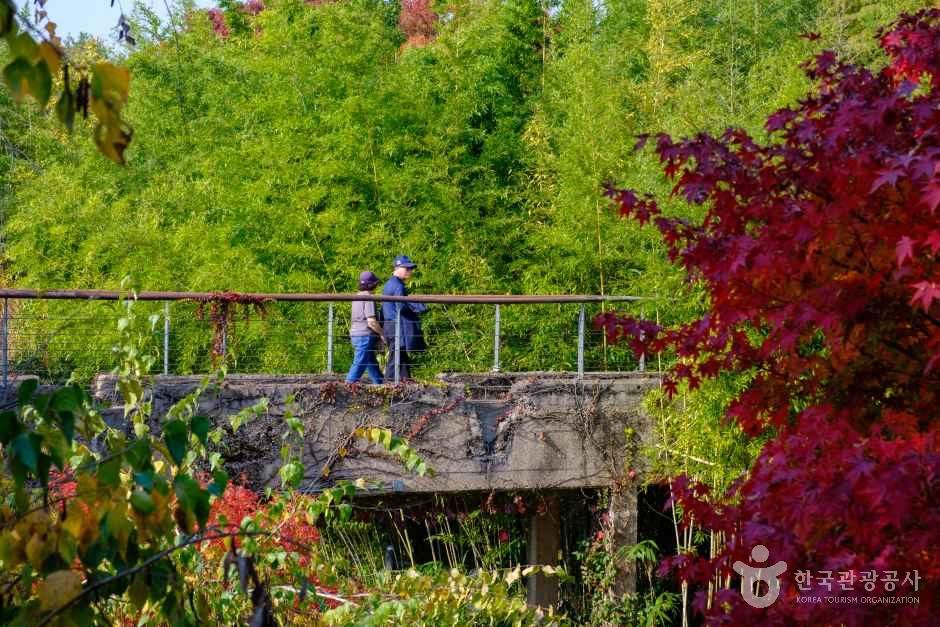
Photo: Ivy-covered remnants of the old filtration plant amid the greenery at Seonyudo Park — Source: Korea Tourism Organization (KOGL Type 1).
The footbridge and the river views 🌆
You reach the island on the Seonyugyo (선유교), a long arched footbridge that locals sometimes call the Rainbow Bridge for its night lighting. Crossing it is half the experience. You get a wide, open view up and down the Han River, and back toward the Seoul skyline. After dark the bridge and the park paths are well lit. That is why this is such a popular evening and date spot. It’s calm, it’s a little cinematic, and it never feels as mobbed as the bigger riverside parks.
One honest note on the vibe: a few visitors find the lit concrete at night “beautiful and slightly eerie.” I’d call that a feature. If you want manicured and cheerful, this isn’t it. If you want atmosphere, it delivers. The golden hour on the water is the real reason to time your visit for late afternoon. The sunset over the Han River from the middle of the bridge is one of the better free views in this part of Seoul. It costs you nothing but the walk.
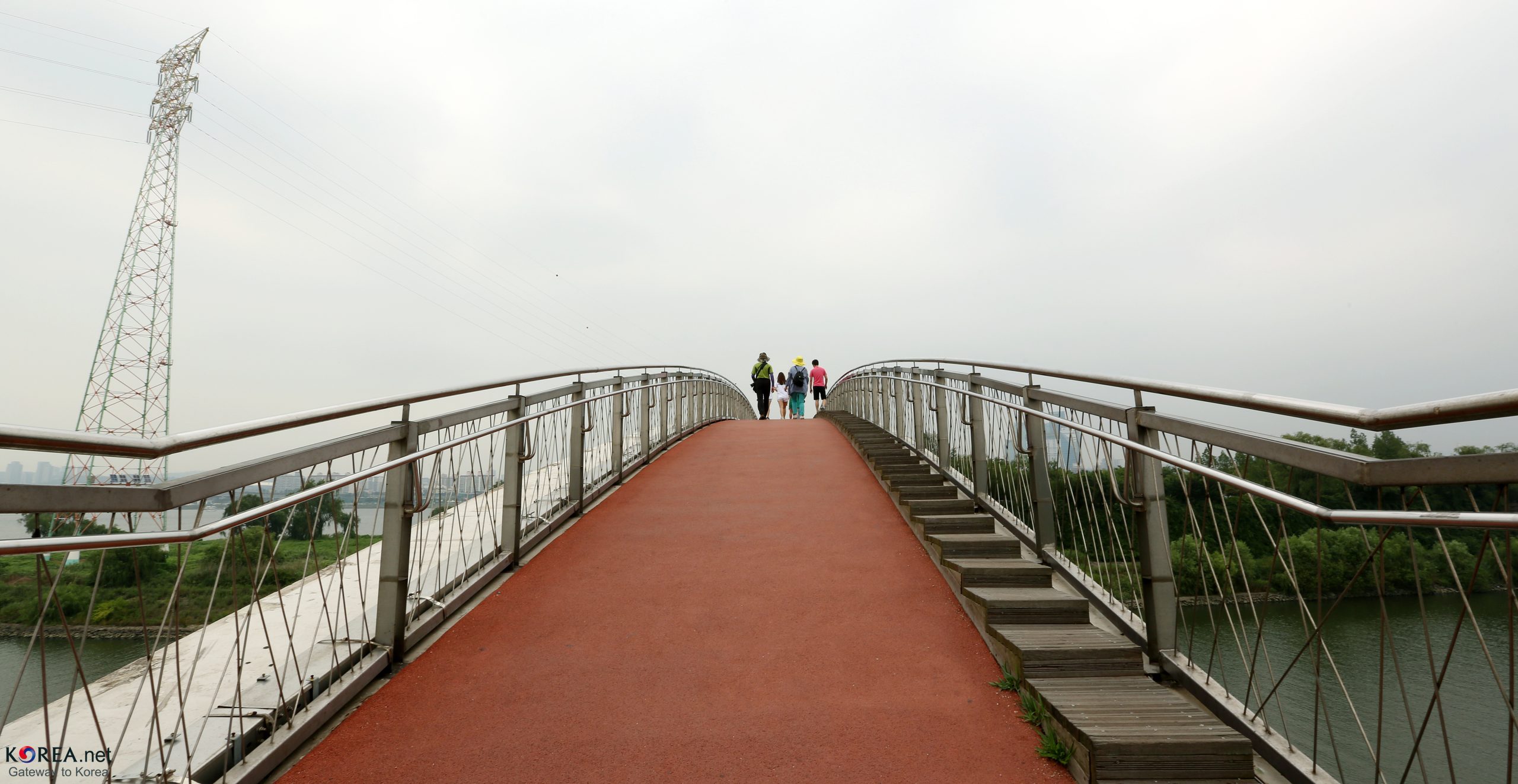
Photo: Walking the arched Seonyugyo footbridge to Seonyudo Park over the Han River — Republic of Korea, CC BY-SA 2.0 via Wikimedia Commons.
The honest downsides
Real talk, so you’re not disappointed:
- It’s smaller than you might expect. This is an urban eco-island, not a sprawling park. A full loop is short — that’s why I’d treat it as a 1.5–2 hour slot, not a half-day.
- Weekends and cherry-blossom season get packed, and there isn’t much shaded seating. Weekday visits are far calmer. One evening to avoid unless it is the reason you came: the island is a known vantage point for the autumn fireworks festival over Yeouido, and it is mobbed for it.
- Food on the island is thin, and not reliably open — there is essentially one convenience store and one café, both called overpriced, and visitors have turned up to find each of them shut for building work. Carry your own water and snacks rather than counting on a coffee here.
- The best corners have queues of their own. The Garden of Green Columns collects a line of people waiting their turn to shoot it, and the park is a standing favourite for wedding and portrait sessions, so a professional shoot may be holding the spot you wanted. Early morning is the reliable fix.
- Summer is the hard season. Shade is limited, the full loop is longer than the small footprint suggests, and it asks a lot of young children in August heat. The cicadas overhead are genuinely loud too, which catches out anyone expecting a hushed garden.
- It’s a walk from the subway, then across the bridge. Not far, but factor it in if mobility is a concern — and remember, no cars come onto the island.
- Driving is the weak point. With no general parking on the island you use the Yanghwa Hangang Park lots and walk over. They fill, and the catch is that a full lot will often turn you away rather than let you wait in line, so visitors end up driving between lots hunting for one that accepts a queue. Even a weekday afternoon can be tight. The subway really is the easier arrival.
- The industrial-concrete look isn’t for everyone. If “old water tanks and bare pillars” doesn’t sound charming to you, you may prefer a greener, softer park.
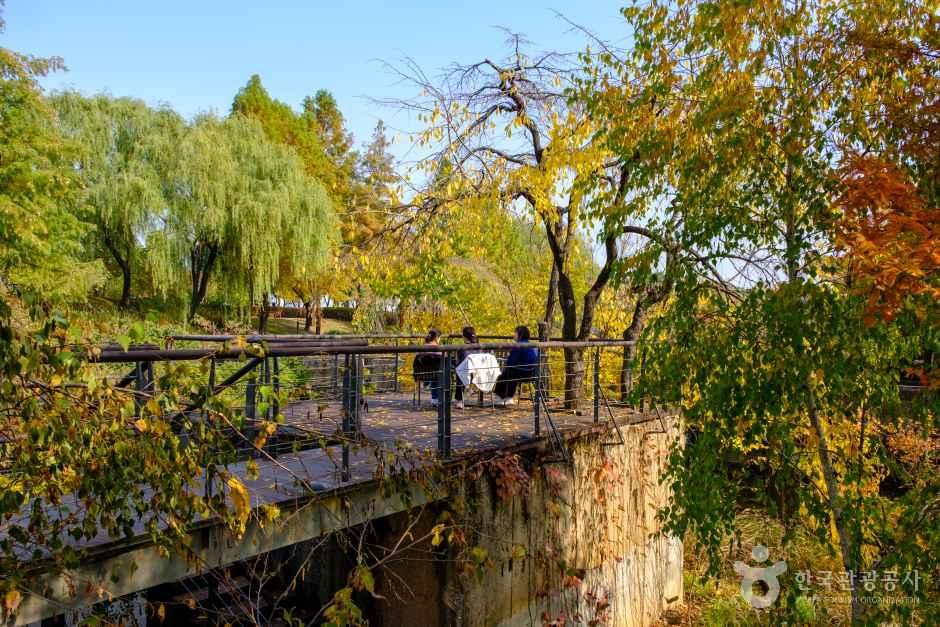
Photo: A viewing deck built onto the old concrete basins at Seonyudo Park, framed by autumn foliage — Source: Korea Tourism Organization (KOGL Type 1).
Who should go — and who should skip
Go if you like design, photography, or unusual spaces. Go if you want a quieter Han River experience than Yeouido or Banpo. It also works as a scenic warm-up before a Hapjeong or Hongdae evening. It’s a great low-cost, low-stress addition to a Seoul day.
Skip it if you’re after wide lawns for a big picnic. Skip it too if time is very limited and the industrial angle holds no interest. Travelling with small kids who need playgrounds and running room? Other Hangang parks suit that better. Seonyudo Park rewards slow looking, not big open space, so match it to your mood.
If I had one free afternoon on the west side of the city, I’d pair Seonyudo with a Mangwon Market snack run. Then cross into Hongdae for dinner. A genuinely good, unhurried loop. For more green picks around the city, browse our Parks & Nature guides.