
Okay—real talk. Most of Seoul’s greenery sits in the old center. So a botanical garden way out west near Gimpo Airport is an easy thing to skip. Don’t. Seoul Botanic Park hides Korea’s most striking greenhouse — a giant glass bowl sunk into the ground with a rainforest and a Mediterranean grove inside. Around it spreads 50 hectares of free lakeside parkland. If I had one slow half-day and a subway pass, I’d come here on a cold or rainy day. That’s when the warm glasshouse feels like a small miracle. On a bleak January afternoon, this is one of the best-value tickets in the city.
Here’s the thing to understand before you go: the park is really two places bolted together. The wide outdoor zones — forest, lake, wetland — are free and open 24 hours. Only the greenhouse and its themed garden cost money and keep hours. Get that split right and you’ll plan the visit properly.
- Address: 161 Magokdong-ro, Gangseo-gu, Seoul (서울특별시 강서구 마곡동로 161)
- Hours: Outdoor zones — open 24h, free, year-round. Greenhouse + Themed Garden — 09:30–18:00 (Mar–Oct), 09:30–17:00 (Nov–Feb); last tickets 1 hour before close. Closed Mondays, Jan 1, Seollal & Chuseok.
- Price: Outdoor park free. Greenhouse/Themed Garden — ₩5,000 adults, ₩3,000 youth (13–18), ₩2,000 children (6–12); free for under-6, 65+, disabled visitors, and national-merit recipients.
- Getting there: Magongnaru Station (마곡나루역), Line 9 and Airport Railroad (AREX), Exit 3 or 4 — a 3-minute walk. Or Magok Station (마곡역), Line 5, Exit 2, ~10 min.
- ⏱ Time needed: 2–4 hours for the full park; ~1 hour if you only want the greenhouse.
- 🔗 Nearby: Lotte Mall Gimpo Airport, the Magok/LG Science Park district, and the Gyeongin Ara Waterway toward the Han River.
- Verified as of August 2026.
🌿 So what actually is Seoul Botanic Park?
Seoul Botanic Park opened in stages through 2018, then fully in May 2019, built on old farmland in Magok. Seoul billed it as the city’s first true “botanic park” — half arboretum, half public park. The whole thing sprawls across 50 hectares, roughly 70 soccer fields. Behind the scenes it’s a working research site with a seed bank and herbarium. But you don’t need to care about any of that to enjoy it.
What you’ll actually do is wander four connected zones. The Open Forest greets you off the station with lawns and tree groves. The Lake Garden loops around Magok Lake, the park’s photogenic centerpiece. The Wetland Garden runs marsh boardwalks toward the Han River. And the Themed Garden — the only paid part — holds the seasonal outdoor beds and the star of the whole place: the greenhouse.
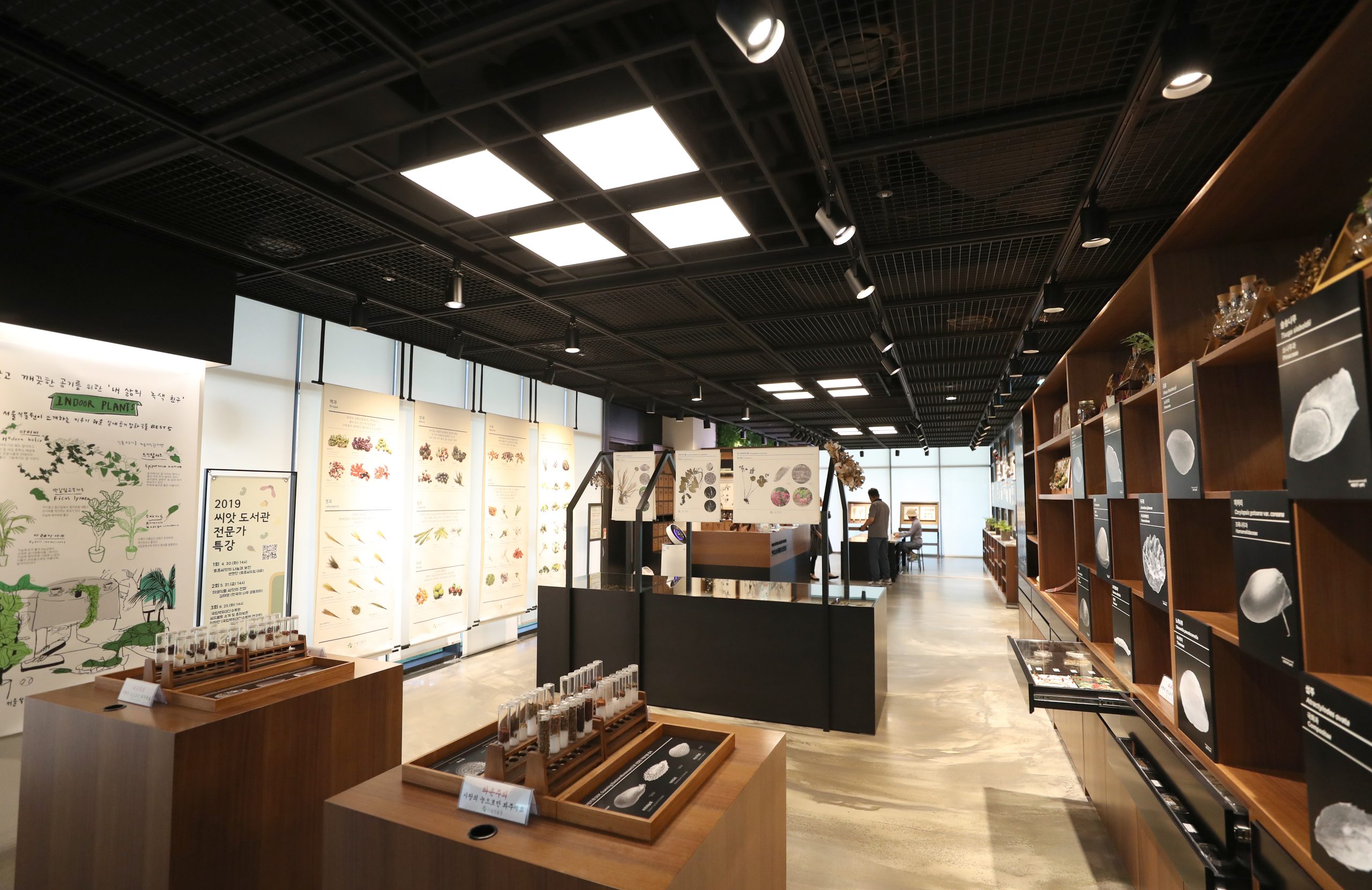
The seed library and herbarium — Seoul Botanic Park doubles as an urban-plant research site. Photo: korea.net, CC BY-SA 2.0 (Source: https://commons.wikimedia.org/w/index.php?curid=82801285)
The greenhouse is the reason you come
The Botanic Conservatory is genuinely unlike anything else in Korea. It’s a concave, dish-shaped glass dome — sunken in the middle rather than domed up top — and at roughly 4,000㎡ it’s one of the country’s largest greenhouses. Inside live more than 3,000 plants representing the native flora of twelve world cities, split across two climate zones.
The Mediterranean zone is bright and dry: olive and citrus trees, cacti, sculptural succulents from places like Barcelona and San Francisco. Cross over and the Tropical zone flips the mood — humid, dense, dripping, with rubber trees, palms, and a little waterfall doing rainforest cosplay. The best part is the elevated skywalk. This aerial corridor loops you up a level, so you’re looking down into the canopy. That view is the money shot.
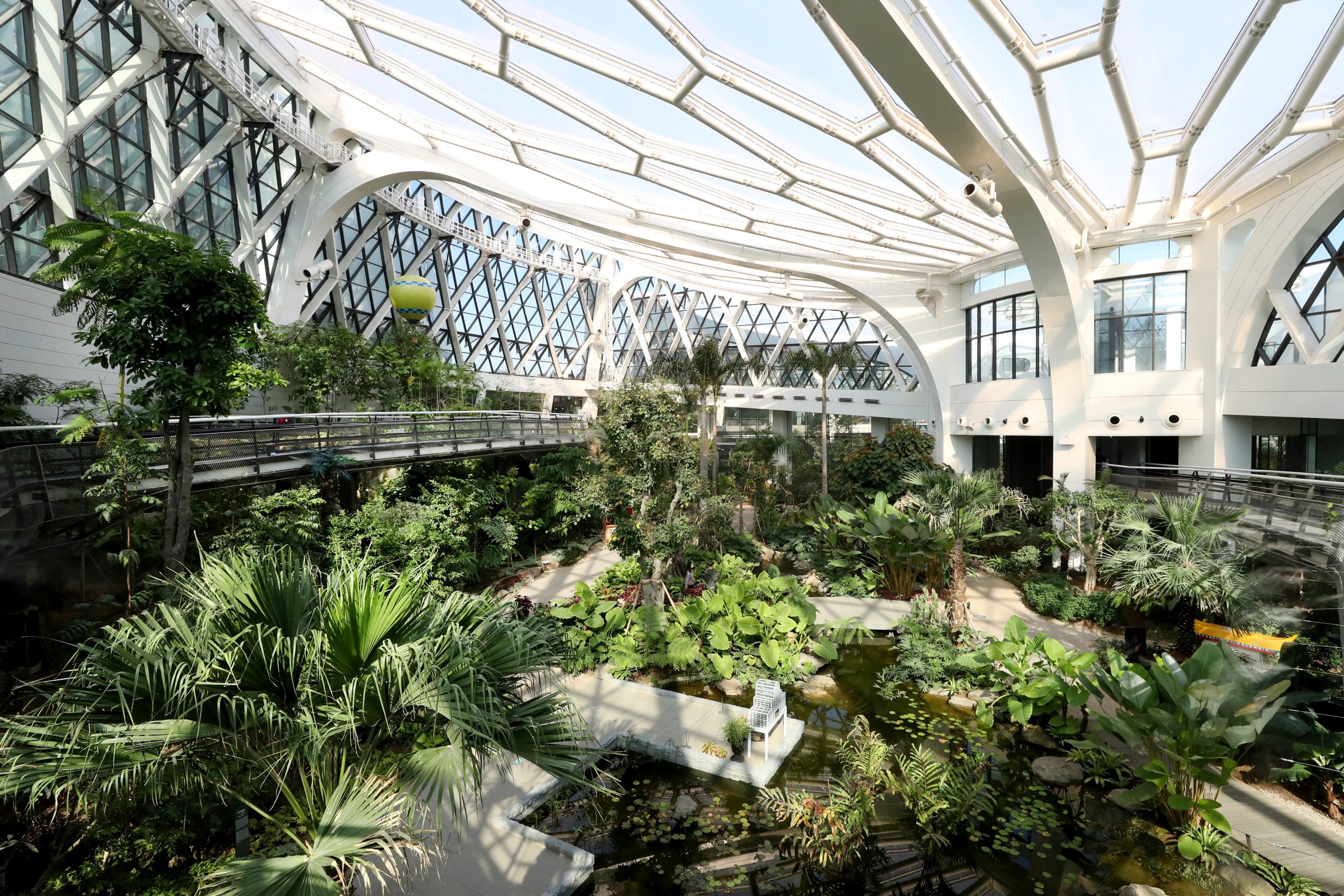
Inside the Botanic Conservatory: the elevated skywalk winds above the tropical planting under the glass roof. Photo: korea.net, CC BY-SA 2.0 (Source: https://commons.wikimedia.org/w/index.php?curid=82801228)
One thing nobody tells you about that winter visit: dress for the tropics, not for Seoul. The Seoul Botanic Park conservatory is held at rainforest temperature, so the long padded coat that got you across the car park becomes unbearable about two minutes past the door. There are lockers both outside the entrance and inside the building. Use the inside ones, because stripping off in the queue in January is its own small ordeal. Be aware they can all be taken on a busy afternoon too, which leaves you carrying a winter coat around the skywalk.
The free outdoor park is bigger than you’d think
Don’t treat the lake and wetlands as a warm-up act. Magok Lake has a proper waterfront loop that locals walk at sunset, and the wetland boardwalks are a quietly lovely stretch you’ll often have half to yourself. It’s a favorite date and family spot for a reason. These zones never close and never charge. So arrive early, walk the lake, then time your greenhouse ticket for the 09:30 opening and beat the weekend crush.
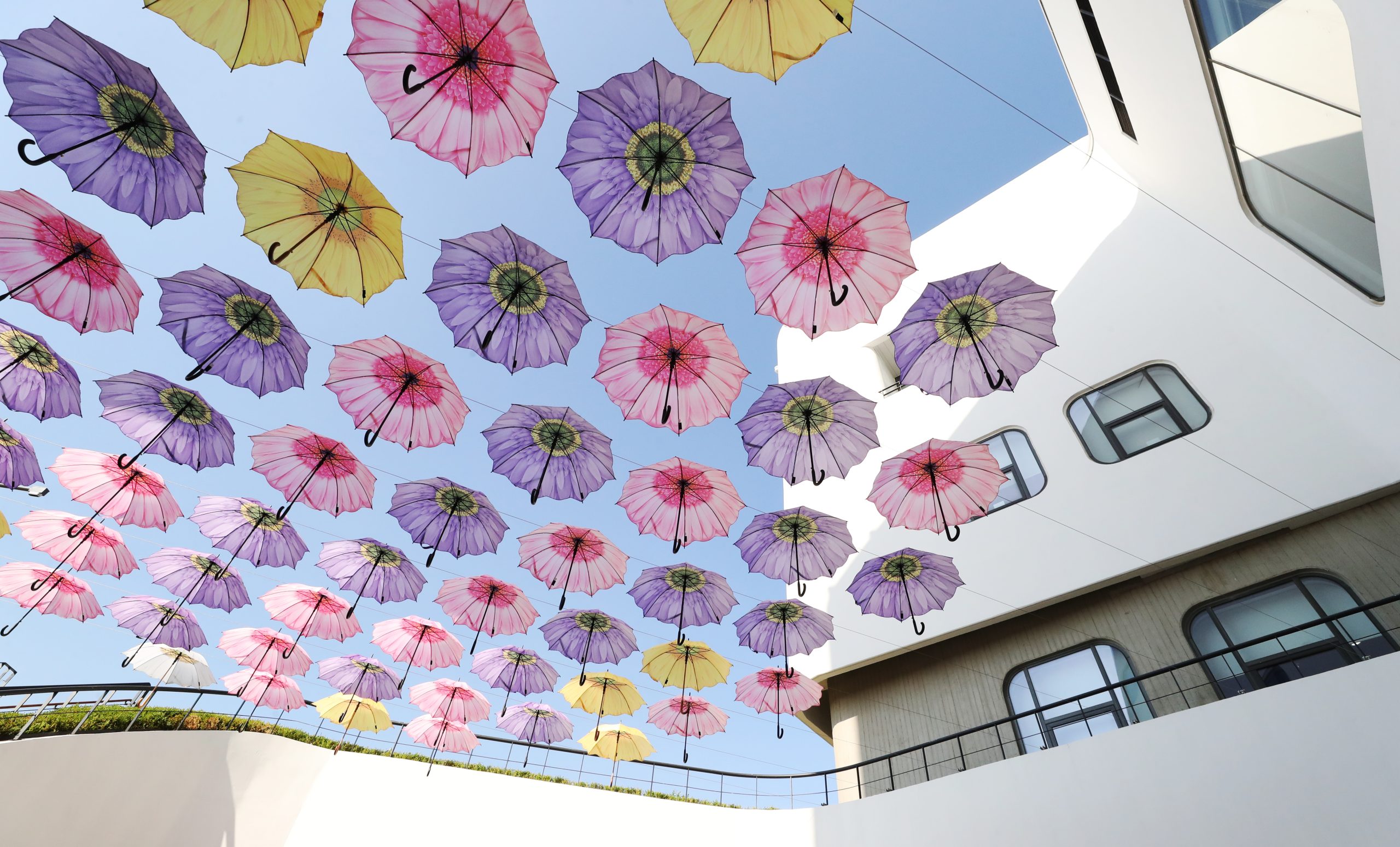
Seasonal installations dress up the grounds — a canopy of flower-print parasols by the greenhouse. Photo: korea.net, CC BY-SA 2.0 (Source: https://commons.wikimedia.org/w/index.php?curid=82801237)
Spring into early summer is peak season — the seasonal beds and flower shows (there’s usually a hydrangea display around June) are when the outdoor gardens earn their keep. If you’re a plant person, that’s your window. Check the park’s current bloom notice before you travel, though, rather than trusting a photo you saw online. These displays run on narrow windows, and arriving to find the tulips not yet open or the roses already finished is one of the more common disappointments here.
The honest downsides — read before you commit
This is a mixed bag, and I’d rather you know going in. The greenhouse at Seoul Botanic Park is smaller than the hype suggests. Plenty of visitors walk out feeling ₩5,000 was a touch steep for the indoor size, especially off-season. Manage your expectations and you’ll be fine. Expect Singapore’s Gardens by the Bay and you won’t.
Summer is the glasshouse’s weak spot. It’s a greenhouse — it gets hot and humid inside, and the cooling can’t fully keep up, so a July visit to the tropical zone can be sweaty and a little joyless. The outdoor zones don’t rescue you either: they’re vast and shadeless, brutal under the summer sun and bleak in deep winter when everything’s brown.
Two more practical gripes. There’s a fair bit of walking between the widely spaced zones — this is a big park, not a compact garden. And it sits far in the west of the city, so it’s a longish subway ride from the palaces and Hongdae. And take the train, seriously. The car park is small for the size of the place, and visitors report queueing up to forty minutes just to get in on a busy weekend.
On crowds, one correction to the usual advice. A weekday is no guarantee here, and plenty of people turn up on a Wednesday to find the greenhouse packed. What actually works at Seoul Botanic Park is going early. The first hour or two after the 09:30 opening is reliably calmer than a weekend afternoon, whatever day you pick.
Who should go — and who should skip it
Go if you love plants and photography. Come if you’re chasing a warm indoor escape on a cold or wet day. And swing by if you’re flying in or out of Gimpo or Incheon and want a calm couple of hours on the airport line. It’s also a genuinely nice, low-key spot for a date or a stroller-friendly family walk.
Skip it — or at least deprioritize it — if you’re on a tight first-timer’s three-day sprint through central Seoul, if you’re visiting in the dead of summer and can’t handle a hot glasshouse, or if you expect a vast, jaw-dropping conservatory. On a packed itinerary, the palaces and markets downtown will give you more per hour.
Make it a half-day out west
Because Seoul Botanic Park sits a hike from the center, pair it with its own neighborhood. Lotte Mall Gimpo Airport is a few stops away for food, shopping, and an observation deck. The surrounding Magok / LG Science Park district has cafés and glossy new architecture worth a wander. And if you want more nature, the Gyeongin Ara Waterway and little Gaehwasan hill sit just west toward the Han River. Build the day around the airport line and the distance stops feeling like a penalty.
For more green escapes and outdoor picks around the city, browse our Parks & Nature guides.
The verdict
Seoul Botanic Park isn’t a must-see for a two-day blitz. But as a half-day off the beaten path — especially in the cold months when that glass bowl glows warm and green — it’s one of the smarter, quieter picks in Seoul. Come with the right expectations and the right season, and it delivers.