
Okay—real talk: Gwanghwamun Square is not a “spend the afternoon here” destination. It’s a grand civic plaza, a national symbol, and one of Seoul’s best free photo spots, all at once. Give it a slot as a 20-minute anchor between bigger sights, not as a headline stop. Do that, and you’ll love it.
- Address: 175 Sejong-daero, Jongno-gu, Seoul (서울특별시 종로구 세종대로 175)
- Hours: Open plaza — free, 24 hours, year-round. Underground halls (B2, behind the King Sejong statue) — 10:00–18:30, last entry 18:00, Fridays to 21:00, closed Mondays.
- Price: Free — square, statues, and underground halls all cost nothing.
- Getting there: Gwanghwamun Station (Line 5) Exit 2 surfaces right at the square, about a 3-minute walk. Gyeongbokgung Station (Line 3) Exit 5/6 is best for pairing the palace.
- ⏱ Time needed: 20–30 min for the square and statues; 1–1.5 hr if you add the underground exhibition.
- 🔗 Nearby: Gyeongbokgung Palace (north end), Gwanghwamun Gate, Cheonggyecheon Stream, Insadong and Bukchon Hanok Village.
- Verified as of July 2026.
What Gwanghwamun Square actually is 🇰🇷
Gwanghwamun Square is a wide public plaza on Sejong-daero, Seoul’s historic ceremonial axis. It sits directly in front of Gwanghwamun Gate and Gyeongbokgung Palace, with Bugaksan mountain rising behind. In the Joseon era this was Yukjo-geori, the “Six Ministries Street” where the government ran.
Today it’s modern Korea’s civic heart. This is the stage for the 2016–2017 candlelight rallies that led to a presidential impeachment. So you’re not just visiting a pretty square — you’re standing where the country gathers when it wants to be heard.
The two heroes who anchor it
Two of Korea’s most revered figures watch over the plaza. The seated bronze King Sejong the Great, 6.2 meters tall, holds the Hunminjeongeum — the document that introduced Hangeul, the Korean alphabet he created. He’s approachable, golden, and endlessly photographed.
To the south stands Admiral Yi Sun-sin — a 17-meter monument, the dark bronze admiral raised high on a granite pedestal. He’s the naval genius who repelled Japanese invasions in the 1590s. Together the two statues turn a plaza into a national portrait gallery. Frankly, they’re the reason most people come.
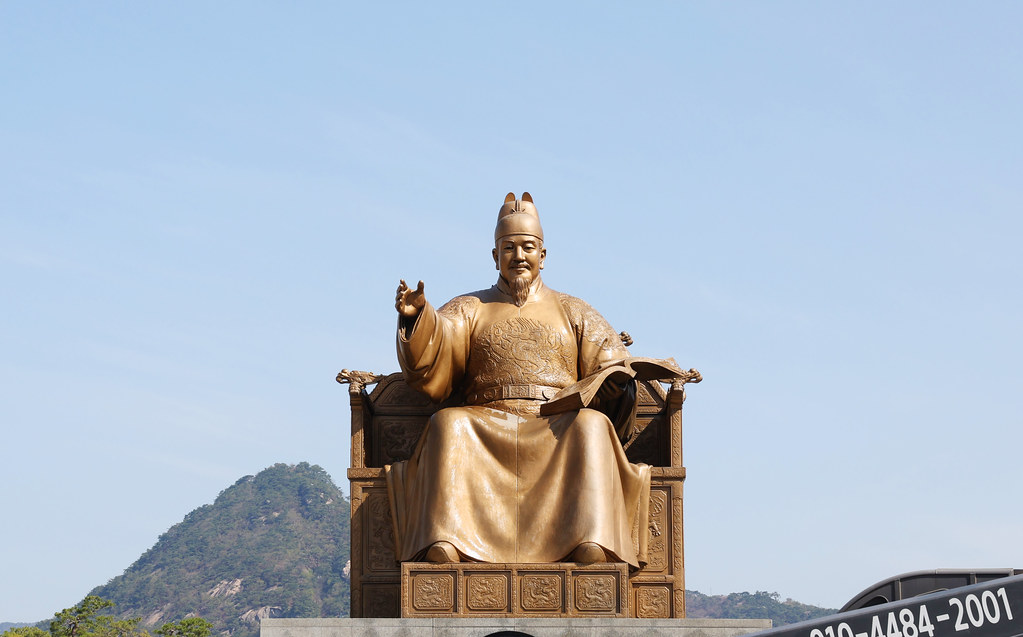
The golden, seated King Sejong the Great — creator of Hangeul — with Bugaksan behind. Photo: KOREA.NET (Republic of Korea), CC BY-SA 2.0 via Flickr. Source: https://www.flickr.com/photos/42438955@N05/54452762781
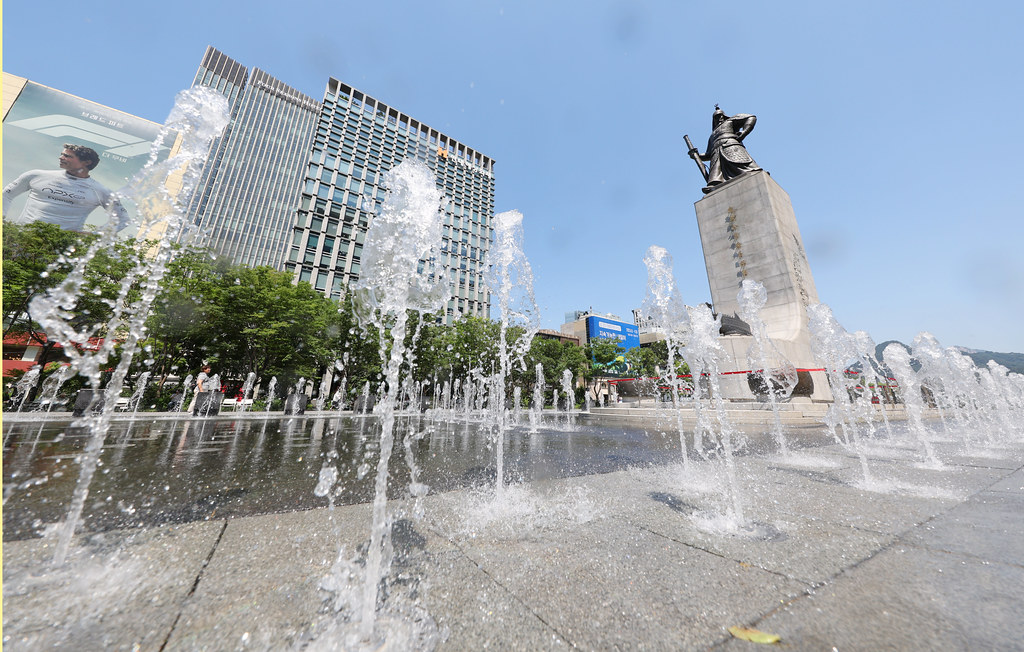
Summer floor fountains dance in front of the towering Admiral Yi Sun-sin statue. Photo: KOREA.NET (Republic of Korea), CC BY-SA 2.0 via Flickr. Source: https://www.flickr.com/photos/42438955@N05/54583975991
The 2022 rebuild and the water 💧
The square you see is new. After a first 2009 version, Seoul rebuilt it and reopened on August 6, 2022. It’s now about 2.1 times larger — roughly 40,300 square meters — and about a quarter greenery, with some 5,000 trees. It feels far more walkable than the old traffic-hemmed strip.
Water is the signature. The “History Waterway” runs the length of the plaza with 630 stone tablets tracing Korean history. A Hangeul fountain forms consonants and vowels. The Myeongnyang fountain plays before the admiral, named for his famous sea battle.
Here’s the thing about the fountains: they’re seasonal. They run April 1 to October 31 and shut off in winter. In July they’re on, roughly 10:00 to 20:50. Kids splash in them all summer, and it’s genuinely charming.
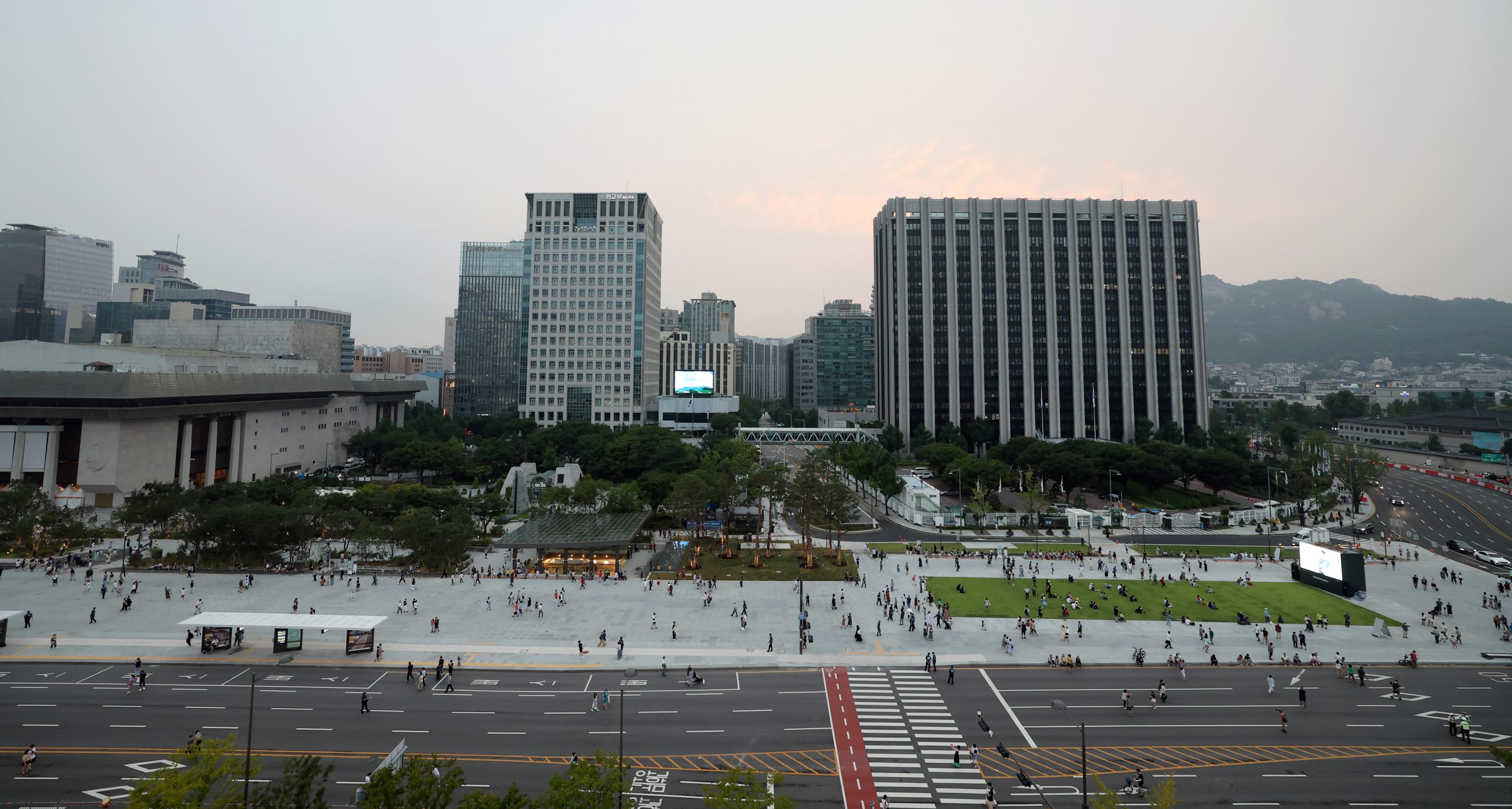
The redesigned Gwanghwamun Square on its 2022 reopening day — wider, greener, and full of people. Photo: Republic of Korea, CC BY-SA 2.0 via Wikimedia Commons. Source: https://commons.wikimedia.org/w/index.php?curid=123853501
The shot everyone comes for 📸
Stand near King Sejong in Gwanghwamun Square and look north. You get the celebrated alignment: square, then Gwanghwamun Gate, then Gyeongbokgung Palace, then Bugaksan mountain behind. It’s one of Seoul’s most photogenic sightlines, and it’s completely free.
This axis is the real draw. The statues make strong foregrounds, the gate frames the middle, and the mountain finishes it. If you only do one thing here, line up that photo and take your time with it.
When Gwanghwamun Square is at its best ⏰
Timing changes this place completely. On a summer weekday morning it stays calm, and the fountains switch on at 10:00. Come at midday in July and the open granite radiates heat with almost no shade. That’s the honest trade-off.
My pick is a summer evening. The lit fountains and statues look their best, the crowds ease off, and the walk finally turns cool. In winter the fountains shut down, so the plaza feels quieter and more austere — still worth the photo, just less playful.
Should you bother with the underground halls?
Behind the King Sejong statue, stairs drop to two free exhibition halls: “The Story of King Sejong” and “The Story of Admiral Yi Sun-sin.” They open 10:00 to 18:30, later on Fridays, and close Mondays. Admission costs nothing.
Honestly, skip them unless it’s raining or brutally hot. They’re a minor, slightly dated add-on. On a nice day your time is far better spent above ground or walking to Gyeongbokgung Palace at the north end.
The honest downsides 🙃
Let’s be fair about what this place is and isn’t.
- Little shade, and nowhere to sit. It’s a big open granite expanse that bakes in summer. Seoul’s own citizen surveys flag the lack of shade, benches and rest space, and visitors notice it in practice — even the bus shelters along the edge have no seating. Chaining Gwanghwamun to Deoksugung and Cheonggyecheon on a hot day is more walking than it looks.
- Thin on things to do. At its core it’s a plaza. Many travelers treat it as a 15-minute photo stop, and that’s a reasonable read.
- Protests and mega-events. This is Korea’s default demonstration ground. Rallies and big paid events can block or overwhelm it. Avoid Saturdays, and check Seoul TOPIS for road closures on rally days.
- Roads and noise. Wide, busy roads surround it, so you’ll cross traffic and hear it while you’re there.
- The statue shots have queues. A clean, dead-centre photo of Sejong or Yi Sun-sin means waiting your turn. Most people give up and shoot from the side, which honestly looks fine.
- Don’t plan on eating here. There is little worth eating right at the square, and the good options in Seochon and Samcheong-dong start closing their kitchens around 20:00. An evening visit can easily end with nowhere to have dinner. Eat first, or head to Jongno.
- Driving is expensive and awkward. Parking around Gwanghwamun Square is scarce and pricey, and the surrounding traffic is heavy. Gwanghwamun Station puts you on the plaza.
- The “privatized square” gripe. Corporate takeovers draw local backlash — one BTS show reportedly tied up the square for about a week, leaving parts fenced.
- A 2026 wrinkle. A controversial “Garden of Gratitude” memorial opened at the north end around May 2026. Expect occasional protests and possible small cordons near that zone — not a full-plaza closure.
Who should go — and who can skip it
Go if you’re already visiting Gyeongbokgung, which you almost certainly are. The square sits right at the palace gate, so it’s a natural warm-up or wind-down. Go if you want that Sejong-to-Bugaksan photo, or if you’re traveling with kids who’ll love the summer fountains.
Skip a dedicated trip if you’re short on days and craving depth over symbolism. There’s no ticket, no interior, no big activity — it’s a stroll and a photo. That’s plenty as part of a bigger loop, and thin as a standalone outing.
How I’d actually do it
If I had one afternoon in this part of Seoul, I’d start at Gyeongbokgung for the changing-of-the-guard, walk south through Gwanghwamun Gate, and land in the square for photos and the fountains. Then I’d drift to Cheonggyecheon Stream or east toward Insadong and Bukchon.
That way Gwanghwamun Square earns its 20–30 minutes without carrying the whole day. For more spots in this vein, browse more Seoul icons & views. It’s a strong, free thread to weave through central Seoul.
Pingback: Seoullo 7017: Seoul's Skygarden Walk Above the Station
Pingback: Lotte World Adventure: Skip the Lines (2026 Guide)