
This guide is for foreign visitors landing in Seoul who want the simplest, cheapest way to ride the subway and buses without fumbling for cash or tickets at every gate. Here is the bottom line. For almost every short-term traveler, a rechargeable T-money card is still the default answer in 2026. Buy one for a few thousand won at any convenience store and load it with cash. Then tap it on every subway turnstile, bus, and most taxis in the country. If you plan to ride heavily inside Seoul, the newer Climate Card unlimited pass can beat it; we compare both below. Fares below reflect mid-2026 rates, with US-dollar figures converted at roughly ₩1,380 to US$1.
What a T-money card actually is
T-money is Korea’s universal prepaid transit card — a stored-value chip card you top up in advance and then tap to pay. It works nationwide: Seoul Metro and regional subways, city and intercity buses, most taxis, and even as small-change payment at convenience stores, vending machines and coin lockers. There is no registration, no passport, and no app required to use the basic card. You are simply spending down a balance you loaded earlier, and the reader deducts the correct fare each time you tap.
The card is anonymous and reusable across trips and years, so if you return to Korea, an old T-money card still works — you just reload it. Cashbee is a near-identical competitor card that behaves the same way; either is fine.
Where to buy one and what it costs
You can pick up a T-money card at almost any convenience store. The big four are CU, GS25, 7-Eleven and Emart24, with Ministop too. And at ticket/top-up machines inside subway stations. Just say “T-money card” at the counter. The blank card itself costs roughly ₩2,500–₩4,000 (about US$2–3) depending on the design, and that price is a non-refundable purchase, not a deposit you get back. Character and special-edition cards cost more but work identically.
Airport arrivals can buy one at convenience stores inside Incheon (ICN) and Gimpo (GMP) before heading into the city. That helps if you want to tap straight onto the AREX train or a bus.
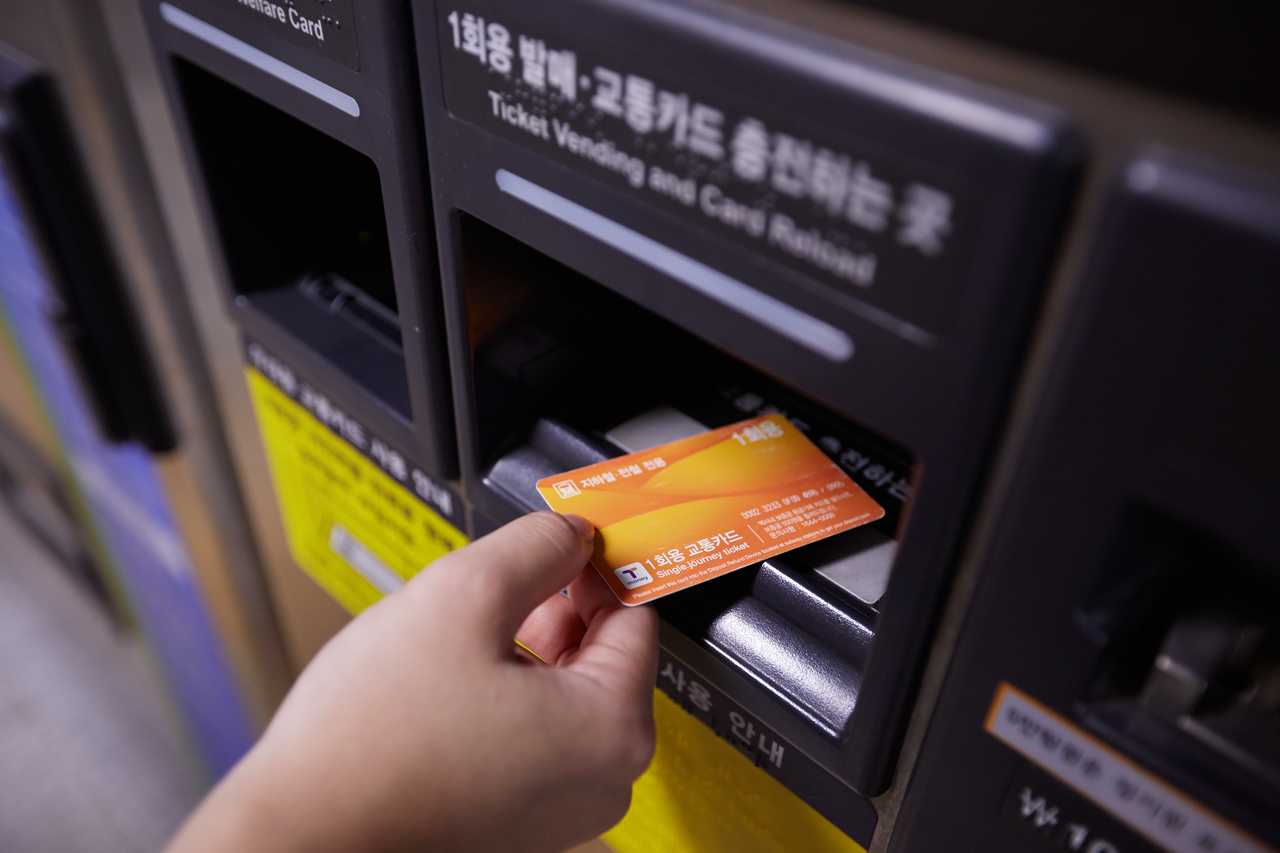
The ticket vending and card reload machines sit inside every subway station, signed in English — Source: Korea Tourism Organization 관광사진갤러리 (KOGL Type 1)
How to charge (reload) it
Reloading is called “charging” in Korea. Two easy options:
- Convenience stores: hand the card to the cashier with cash and say the amount, e.g. “charge ₩20,000.” This is cash-based and works everywhere.
- Station recharge machines: tap the card on the pad, feed in banknotes, and top up. Historically these machines took cash only (₩1,000 notes and up), which caught many tourists out.
- New foreign-card kiosks. Since March 2026, about 440 new kiosks at all Seoul Metro Line 1–8 stations accept overseas Visa, Mastercard, JCB, UnionPay and Amex for single-ride tickets and Climate Card tourist passes. Machines on other lines and outside Seoul are often still cash-only, so keep some won.
A typical 3–4 day Seoul trip runs about ₩30,000–₩50,000 (US$22–36) of transit. Load in chunks rather than all at once. The deposit never comes back, but leftover balance does, so small reloads carry little downside.
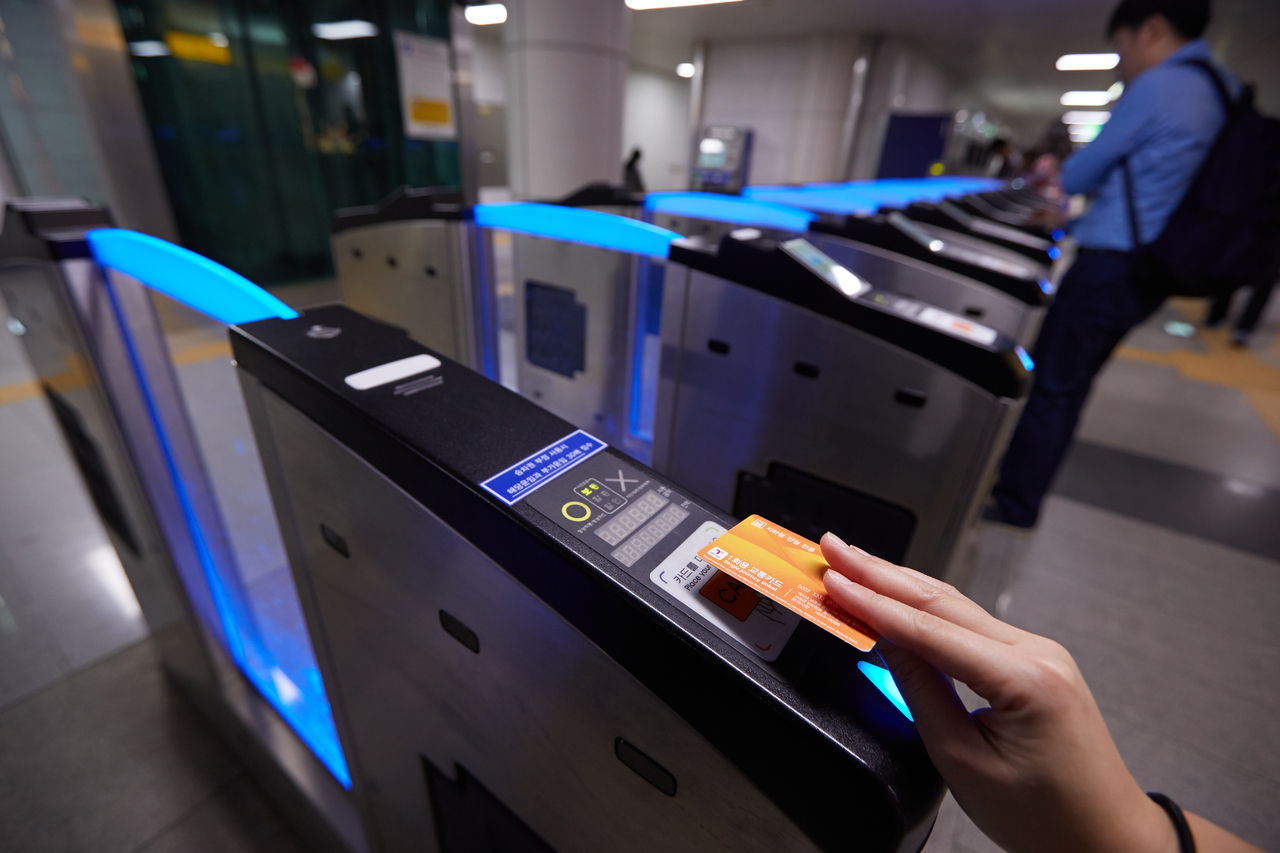
Seoul subway fare gates: tap the card flat on the reader pad and wait for the green O — Source: Korea Tourism Organization 관광사진갤러리 (KOGL Type 1)
How to tap: subway, buses and taxis
On the subway, tap the card flat on the reader pad as you enter the gate, and tap again on the reader as you exit. Both taps matter. Seoul charges by distance, so forgetting to tap out leaves the system unable to calculate your ride. It may then add a penalty on your next entry.
On city buses, tap the reader by the front door as you board. On many routes you should also tap the rear reader as you get off. That keeps you inside the transfer window and avoids an extra base fare. In taxis, tell the driver you’ll pay by card. Then tap the T-money reader at the end of the ride, usually near the meter or back seat. The meter takes the fare straight from your balance.
As of 2026, standard adult base fares with T-money run about ₩1,550 (US$1.12) for the subway and ₩1,500 (US$1.09) for a city bus, with distance surcharges of roughly ₩100 added per extra 5 km beyond the first 10 km. Paying with a single-journey ticket instead costs about ₩100 more per ride.
The transfer discount — the reason locals use T-money
The big money-saver is the free/discounted transfer system, and it only works if you tap in and out with a card. When you switch between subway and bus (or bus to bus) within 30 minutes of tapping out — extended to 60 minutes for late-night rides after 21:00 — you are not charged a second base fare. Instead the system treats your trip as one continuous journey priced by total distance, and you get up to four transfers per trip. Buy a paper single-journey ticket and you lose this entirely, paying full fare each leg. This is why a T-money card almost always beats single tickets for anyone taking more than one or two rides a day.
T-money vs Climate Card vs WOWPASS vs single tickets vs tapping your credit card
Here’s how the options travelers now ask about stack up. Prices are 2026 figures; the card fee for a physical Climate Card is a separate one-time ₩3,000.
| Option | How it works | Cost (2026) | Best for |
|---|---|---|---|
| T-money card | Prepaid tap card; pay per ride, distance-based, free transfers within 30 min. | Card ₩2,500–₩4,000 (US$2–3) + you load what you spend; base fare ~₩1,550 (US$1.12). | Most travelers; flexible trips, taxis, intercity, and rides outside Seoul. |
| Climate Card (Tourist Pass) | Unlimited Seoul subway + city bus for a fixed number of days. | ₩5,000 / ₩8,000 / ₩10,000 / ₩15,000 / ₩20,000 (US$3.60–14.50) for 1/2/3/5/7 days, plus ₩3,000 card. | Heavy riders staying inside Seoul who take 4+ trips a day. |
| Single-journey ticket | Paper/RF ticket bought per ride at a station machine; no transfer discount. | ~₩1,650 (US$1.20) fare + ₩500 refundable deposit (returned at a machine on exit). | One-off riders with no card who won’t transfer. |
| WOWPASS | Prepaid debit card aimed at tourists with a built-in T-money chip; exchange foreign cash at kiosks, then spend or ride. | Card ~₩6,000 (US$4.40) + your loaded balance; T-money portion loaded separately. | Visitors who also want a card for shops/restaurants and easy currency exchange. |
| Contactless foreign credit card tap | Tapping your own overseas Visa/Mastercard at the gate. | n/a — not available at Seoul gates in 2026. | Nobody yet; tap-to-ride with foreign cards is due on Seoul city buses first in 2027, with the subway to follow later. |
Rough math: the Climate Card 3-day pass (₩10,000) beats T-money once you take about seven base-fare rides across three days if you already hold the card, or about nine once you add the ₩3,000 card fee. Take fewer, or plan trips outside Seoul, and pay-as-you-go T-money usually wins.
Honest caveats — what can go wrong
- The card price is gone for good. The ₩2,500–₩4,000 you pay for the blank card is not a deposit — only the loaded balance is refundable.
- You cannot tap your home credit card at the gate. Despite headlines about open-loop payments, in 2026 Seoul turnstiles still accept only transit cards (T-money, Cashbee, Climate Card) and single tickets. Direct foreign-card tap-to-ride is due on Seoul city buses first in 2027, with the subway to follow later.
- The 30-day Climate Card has ended. Seoul discontinued the monthly card in September 2026. Its replacement, the K-Pass-based Climate Pass, needs a Korean bank card, so it doesn’t suit short-term visitors. The 1/2/3/5/7-day tourist passes carry on unchanged.
- The Climate Card is Seoul-only and route-limited. It doesn’t cover some lines (e.g. the Shinbundang Line) or trips that leave the city, and short-term tourist passes exclude bikes and the Hangang boat.
- Reload machines are often cash-only. The new foreign-card kiosks exist but aren’t everywhere yet — always keep some won.
- Refunds have limits. There’s a flat ₩500 fee, and while convenience stores refund balances under ₩20,000, amounts of ₩20,000–₩50,000 need a staffed subway service window and your passport. Balances above ₩50,000 generally require a Korean bank account, which short-term tourists rarely have — so don’t over-load.
Getting your remaining balance back
Before you fly home, drain the card. Hand it to a cashier at any major convenience store (GS25, CU, 7-Eleven, Emart24, Ministop) and ask for a refund (“hwan-bul”). They return your balance in cash minus a ₩500 fee, for balances under ₩20,000. Larger balances up to ₩50,000 are refunded at a subway station customer service window with your passport. You keep the physical card either way — useful for a future trip.
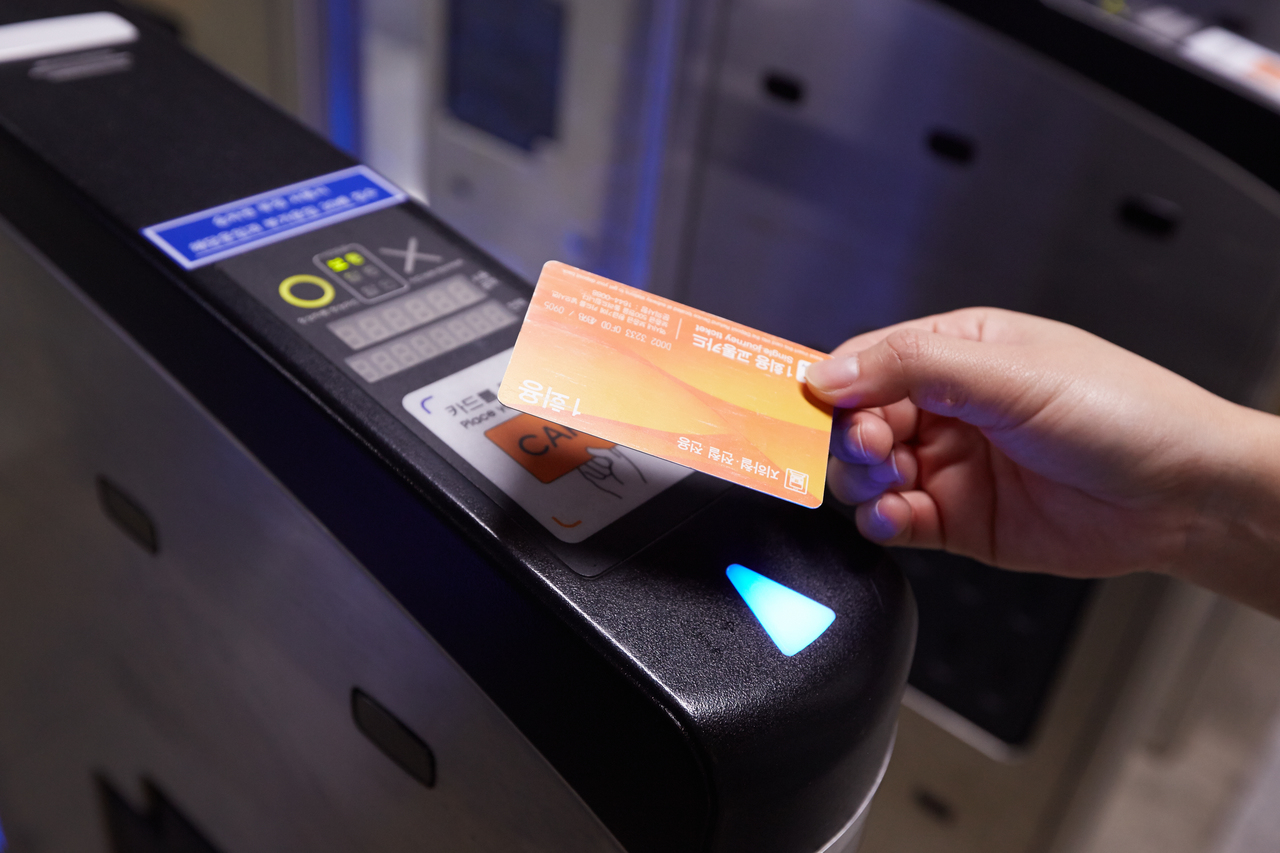
A card on the gate reader — the same tap works on buses and in taxis — Source: Korea Tourism Organization 관광사진갤러리 (KOGL Type 1)
Where a T-money card actually takes you
Once you’re tapping through the gates, the whole city opens up. Our Places guides map out where to go next. Ride Line 3 to Gyeongbokgung for the main palace, hop the bus or Line 4 to Myeongdong for shopping and street food, take Line 2 out to Hongdae for buskers and nightlife, or ride down to Gangnam for the quiet grounds of Bongeunsa Temple. A single tap-and-transfer covers most of these on one distance-based fare.
Verified as of September 2026. Transit fares, card prices and pass tiers change — especially with Seoul’s open-loop payment rollout in progress — so double-check current figures on the Seoul Metropolitan Government or operator site before you travel.