
Mapping a day in downtown Seoul? Cheonggyecheon Stream is one of those stops travelers keep asking about but few guides ever explain. Almost every itinerary name-drops it. This guide lays out what it actually is. In short, it is a free, restored urban stream cutting through the city center, sunk below the traffic. The real question is whether it earns one to two hours of your day or just a quick 30-minute detour. Either way, it is a calming, photogenic walk that costs nothing. It also links the palaces, markets, and shopping you are probably already seeing. Here is how to fit it in.
- Address: 37 Mugyo-ro, Jongno-gu, Seoul (Cheonggye Plaza)
- Hours: Open 24/7, free public walkway (lower path may close in heavy rain)
- Price: Free
- Getting there: Gwanghwamun Station (Line 5), Exit 5 — ~60 m to Cheonggye Plaza
- ⏱ Time needed: 1–2 hours for a partial walk (full 11 km walk ~3 hours)
- 🔗 Nearby: Gwangjang Market, Myeongdong, Gwanghwamun Square & Gyeongbokgung, Dongdaemun/DDP
- ✅ Verified as of June 2026
A highway became a stream: what you are actually walking beside
Cheonggyecheon Stream is a roughly 11-kilometer waterway running west to east through central Seoul. It sits in a sunken promenade below the busy roads. You take stairs or a ramp down, then follow the water toward the Han River, passing under 22 bridges. That is the format — a quiet corridor threaded beneath a loud city.
The backstory is what makes it a landmark. After the Korean War, the city buried the stream under concrete and an elevated expressway. It stayed hidden for decades. Then, from 2003 to 2005, an ambitious project tore the highway down and brought the water back. It reopened in September 2005. Urban planners worldwide now cite it as the model for trading a traffic artery for public green space. That history is why it reads as more than a canal. It is a whole argument about what cities can be.
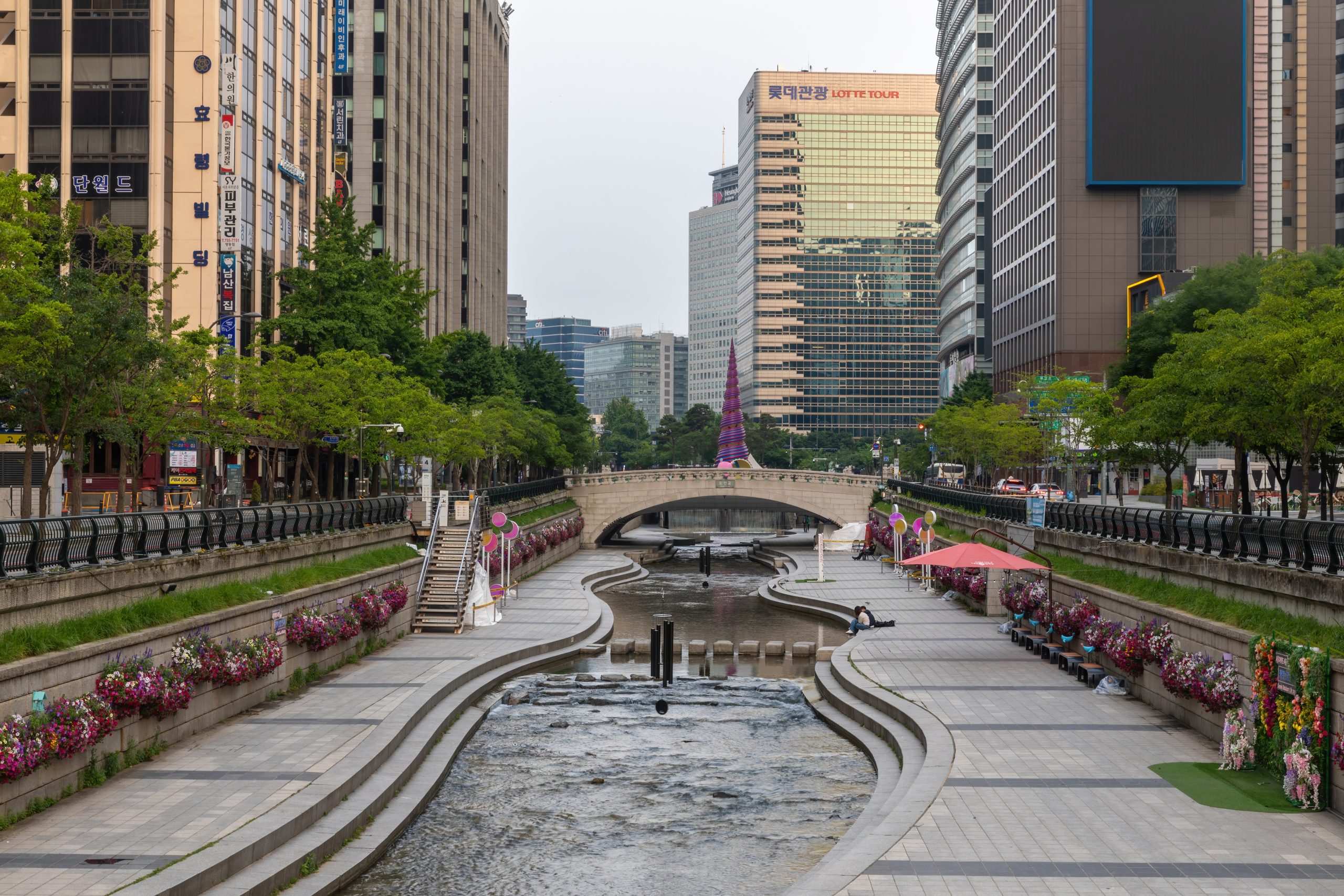
Photo: Cheonggye Plaza, the lively upstream start, with the red-and-blue “Spring” sculpture — CC BY-SA via Wikimedia Commons.
The walk itself is landscaped and deliberate. Expect stepping stones, waterfalls near the western plaza, planted banks, and plenty of seating. There are restrooms and accessible ramps along the way too. The upstream start at Cheonggye Plaza has the tall “Spring” sculpture by Claes Oldenburg, and the stonework nods to bojagi wrapping cloth. This plaza end is the liveliest stretch. It is where most short visits should begin.
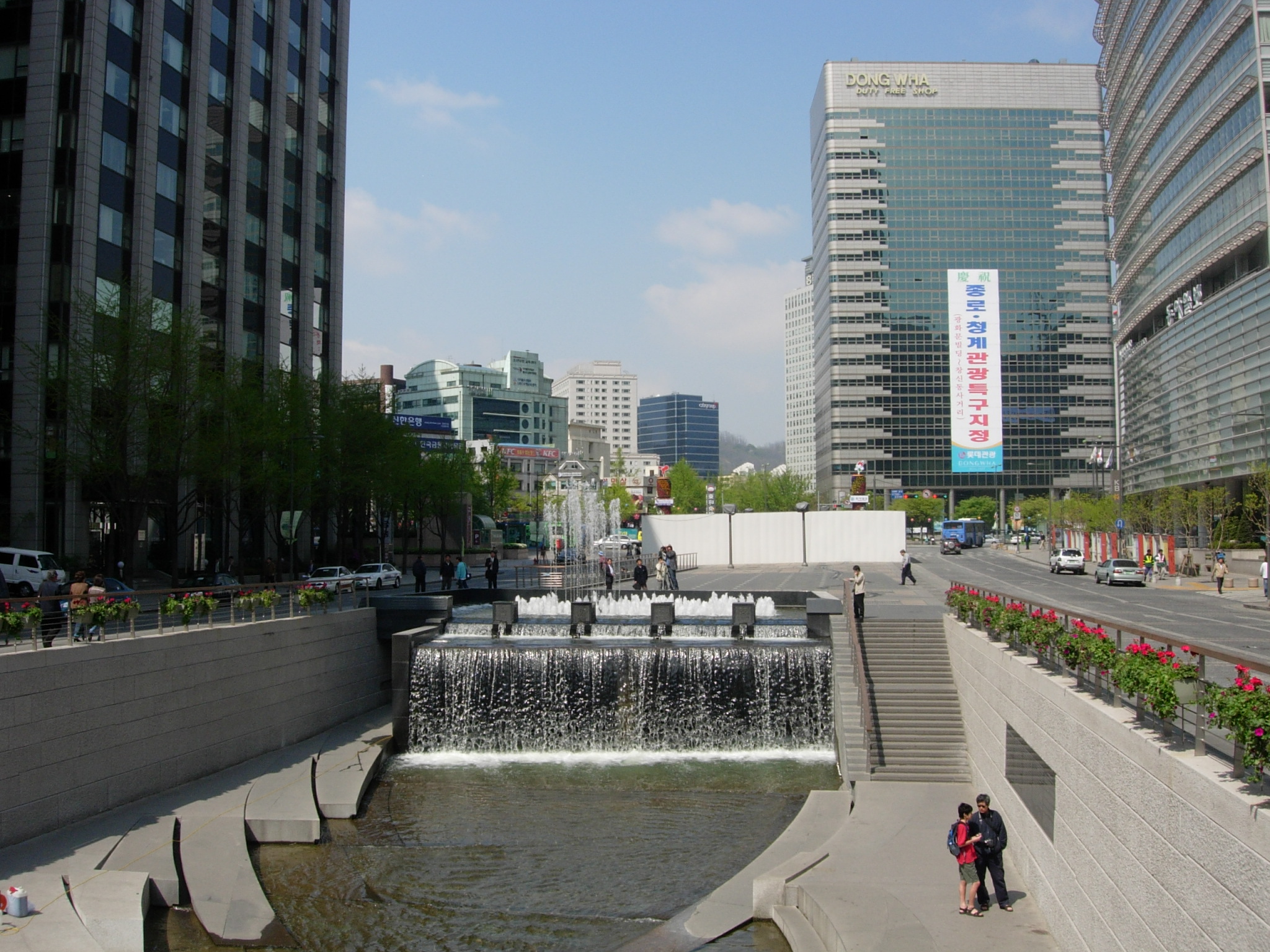
Photo: The restored Cheonggyecheon waterway in central Seoul — Source: Wikimedia Commons.
What makes it worth a slot in a packed day
The appeal of Cheonggyecheon Stream is simple. It is a peaceful escape from downtown traffic. Drop below street level and the car noise fades. The water cools the air, too — measurably several degrees more pleasant on a warm day. That contrast between the busy street above and the calm below is the entire draw.
- Free and dead easy. No ticket, no gate, with entry points at loads of subway stations — it slots into any itinerary.
- Best at night. The LED-lit banks after dark are the standout. Evening is the time to come.
- Photogenic. The stepping stones, the waterfalls, and that bold “Spring” sculpture are the repeat photo stars.
- Real, not touristy. Locals genuinely use it — strolling, resting, meeting after work.
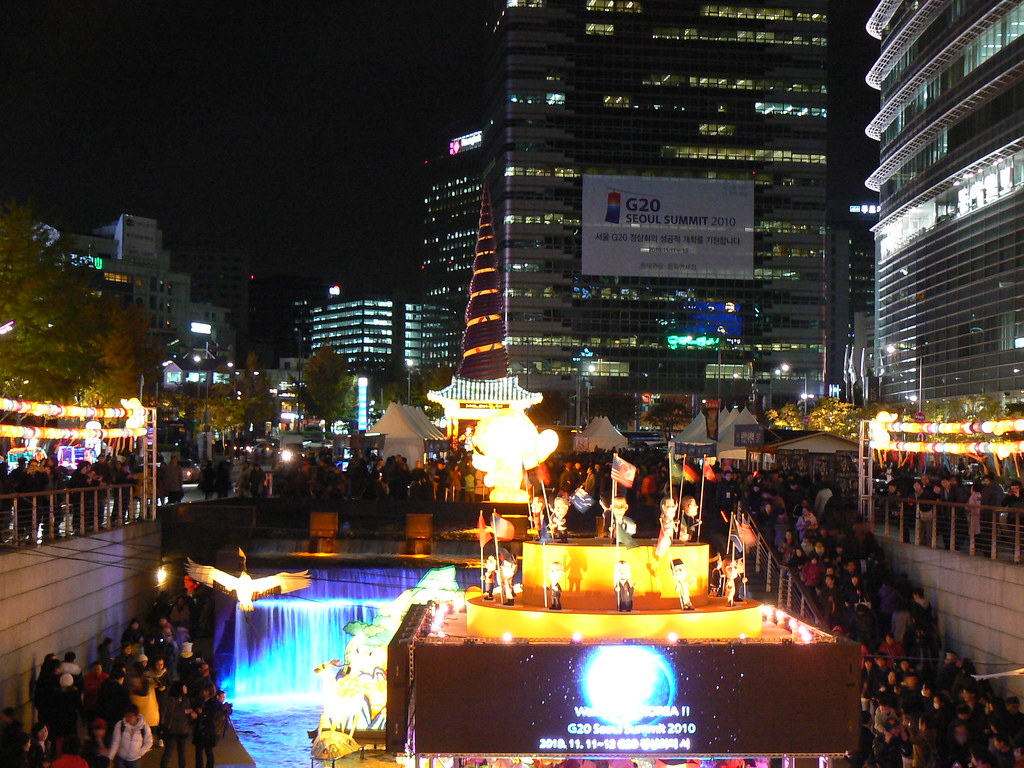
Photo: The Seoul Lantern Festival (서울빛초롱축제) lighting up the stream at night — CC BY 2.0 via Flickr.
Before you go: the honest downsides of Cheonggyecheon Stream
Set expectations first. Cheonggyecheon is an artificial waterway. The city pumps and recirculates water from the Han River and from groundwater. Some visitors feel let down once they realise the “creek” is really a maintained canal. Anyone arriving for wild nature will find this engineered version underwhelming. And no, you cannot wade in it.
The water itself divides people. In warm months the slower stretches turn green and murky, and algae builds up where the flow drops off. Up close, some walkers notice a faintly stagnant smell. It photographs much better than it looks from a metre away.
Weather punishes both ends of the year. The sunken promenade has almost no shade, so midday in summer bakes. In winter that same corridor funnels wind, and it gets too cold to sit for long. Spring and autumn evenings are the sweet spot by a wide margin.
Crowds, noise, and the food trap
Peak-time crowds chip away at the calm that is the whole point. Summer evenings, weekends, and holidays fill the popular western stretches. More people also means more litter left along the banks by closing time.
The quiet is not absolute, either. The stream runs right past the Euljiro and Jongno bar districts. Evening noise spills down from street level in those sections. It is calmer than the road above, not silent.
Then there is the food trap. The restaurants and cafés along the stream are small, and the popular ones run brutal queues. Weekday lunch waits of 40 minutes are routine at the busiest spots. Weekend waits can stretch past two hours. The cause is simple — these places have very few tables. Register on the waiting app the moment you arrive, or just eat a few streets back.
Finally, do not drive here. Traffic around the stream clogs badly, and parking fills up whenever the walkway is busy. The subway drops you right at the water.
- Easy to deprioritize. On a tight schedule it is pleasant, but a palace or a market wins.
- Repetitive scenery. Bridge to bridge starts to look the same, and the eastern stretches thin out. You do not need the full length.
The smart way to walk it: a scenic shortcut, not a mission
Walk Cheonggyecheon Stream partially rather than end to end. Enter at Cheonggye Plaza by Gwanghwamun Station (Line 5, Exit 5). Stroll for one to two hours. Then climb out at whichever of the 11 connected stations sits nearest your next stop — Jonggak, Euljiro, Jongno 3-ga, or Dongdaemun. Treat it as a scenic shortcut between sights rather than a destination, and it works far better. A strong pairing is a short stretch plus a meal at Gwangjang Market, which the stream runs right past. A hop north to the palaces works just as well.
On timing: for the calmest daytime version, arrive roughly 8–9am on a weekday, before office foot traffic and midday heat build up. For the lit-up version, the LED banks read best in the first 30–60 minutes after full dark. In Seoul’s summer that means closer to 9pm than 7pm.
Is Cheonggyecheon Stream your kind of stop?
The stream suits visitors who like easy urban walking, want a calm break between busier sights, or love night photography. The lit evening stretches are where it stands out. It earns its place partly because it threads through parts of the city on most Seoul itineraries anyway.
It is easier to skip if your Seoul time is very tight and palaces come first. Skip it too if you want untouched nature rather than a designed canal. In that case, the city’s mountain trails deliver more — the other Parks & Nature guides point to greener, wilder options. For most travelers, though, Cheonggyecheon Stream is a free, low-effort addition that quietly improves a day in the heart of Seoul.