
Here’s my honest take on Dongmun Market: it’s two markets sharing one roof. By day, Jeju City’s oldest market sells tangerines, rice cakes and silver hairtail to locals. After dark, a single food alley near Gate 8 turns into the island’s busiest night market. Most visitors only see the second one, and that’s where the frustration starts.
The fix is timing. Come in the late afternoon, shop the day stalls first, then walk into the night market right as it opens. You get both markets, shorter queues and a real dinner. This guide shows you how.
- 📍 Address: 20 Gwandeok-ro 14-gil, Jeju-si, Jeju-do (제주특별자치도 제주시 관덕로14길 20) — in Jeju City’s old downtown
- 🕗 Hours: Day market about 8am–9pm, open daily year-round, but each shop sets its own hours. Night market at Gate 8: 19:00–24:00 (May–Oct) and 18:00–24:00 (Nov–Apr). Stalls shut early once they sell out
- 💰 Price: Free to enter. Night-market snacks run roughly ₩4,000–10,000 each, and most hot dishes sit around ₩10,000
- 🚌 Getting there: From Jeju Airport, a bus takes about 20–25 min to the Dongmun Rotary / Dongmun Market stop (e.g. lines 316, 325 or express 1111 — confirm the route in Naver Map or Kakao Map on the day). Jeju buses are cashless, so tap a T-money card or transit-enabled card, or use the QR payment for foreign visitors. A taxi takes about 10–15 min and costs roughly ₩6,000–10,000
- 🅿️ Parking: Two public lots serve the market, on Dongmun-ro 4-gil and Jungang-ro 13-gil. The first 30 min is free, then a small hourly fee applies, capped at ₩10,000 a day. Both fill up on weekend evenings
- ⏱ Time needed: 30–60 min to browse; 1.5–2 hours if you eat
- 🔗 Nearby pairing: Sanjicheon Stream (2–5 min walk), Gwandeokjeong Pavilion (about 8–10 min), Tapdong seaside plaza (about 10–12 min)
- Verified as of September 2026 — stall hours and prices change often, so treat them as a guide
Find Dongmun Market in Jeju City
The pin is the market’s official map marker, next to the Gate 8 food street where the night market sets up.
Two markets, one address: day vs night
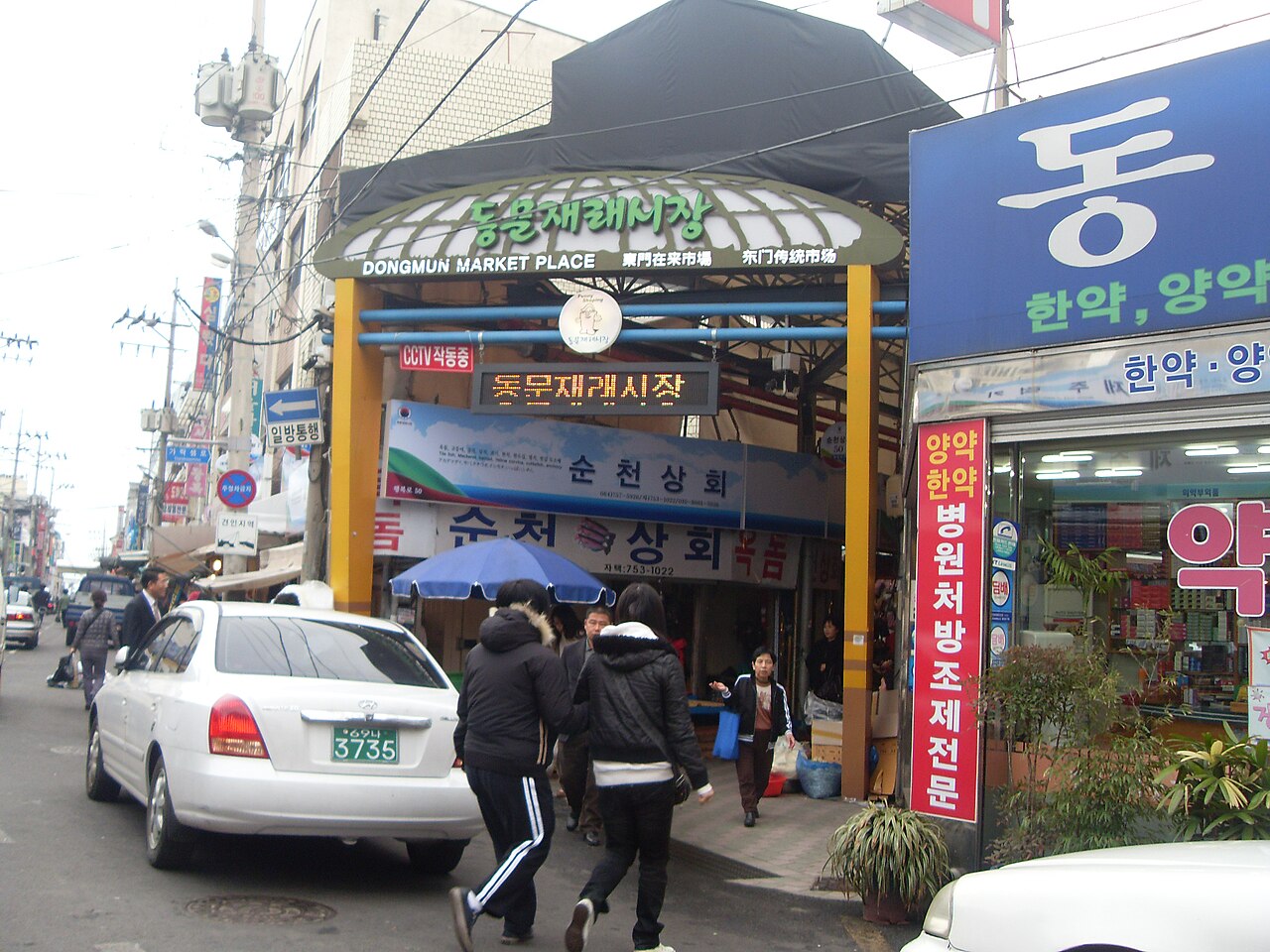
One of Dongmun Market’s street entrances, with the market name in Korean and English. Photo: thddbwnd, CC BY 3.0 / Source: Wikimedia Commons
The day market dates back to 1945, which makes it one of Jeju’s oldest markets. It spreads across a grid of covered alleys with twelve numbered gates. You’ll find fruit stands, dried fish, rice-cake shops and souvenir counters, all packed tight.
This side of Dongmun Market is where you actually shop. It’s quieter and full of things you can take home. Many produce and seafood shops start closing in the early evening, though. Plenty of alleys look shuttered by 8pm.
The Dongmun Market night market is a different animal. Around 32 food stalls line the alley near Gate 8, and they cook to order on open grills. Some vendors put on a show with flames and dancing. It’s loud, smoky and fun, but it covers only a small slice of the whole market.
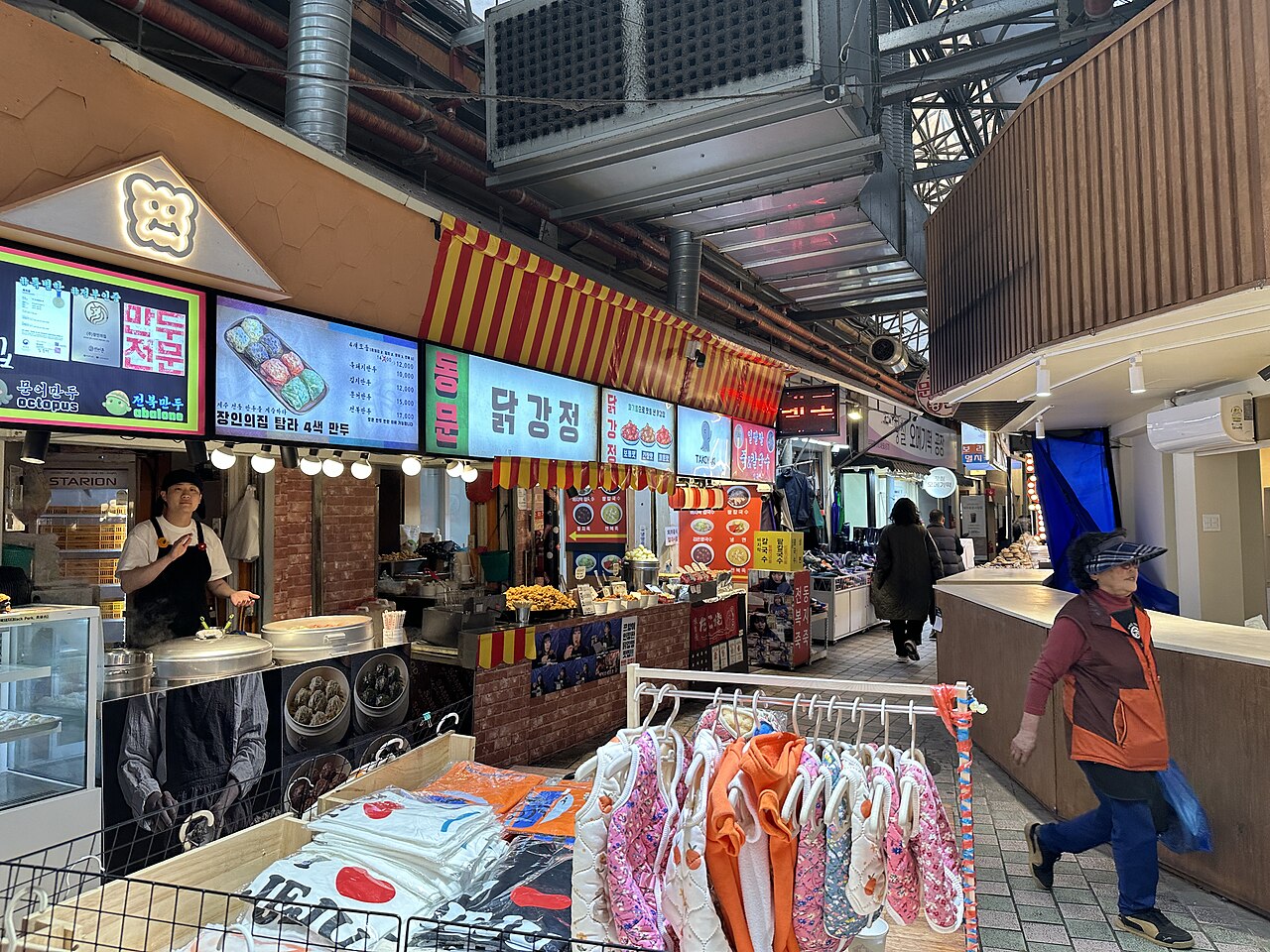
The food-stall row by day. After dark, the Gate 8 night-market stalls set up nearby. Photo: Grapesurgeon, CC BY-SA 4.0 / Source: Wikimedia Commons
What to eat at the Gate 8 night market 🍢
Real talk: you can’t eat everything, and you shouldn’t try. Pick three or four things, share them, and save room for dessert from the day side. These are rough prices from recent 2025–2026 reports. They vary by stall and change often.
| Dish | Rough price | My take |
|---|---|---|
| Abalone gimbap | around ₩7,000–9,000 | The easiest Jeju-flavoured win |
| Black pork skewer | around ₩4,000–7,000 | Jeju’s famous pork, grab-and-go |
| Grilled lobster (garlic or cheese) | around ₩9,000 per half | The showpiece, and the longest lines |
| Kimchi-rolled pork belly and similar hot plates | around ₩10,000 | Filling, but pricey for street food |
| Omegi-tteok (Jeju millet rice cake) | about ₩1,100 a piece at Obok Tteokjip (open since 1967) | Buy it by day; it sells out |
| Hallabong juice | around ₩3,000–6,000 | A cheap citrus hit |
Want something cooler? Takeaway sashimi counters by Gate 8 pack small platters with ice, often from around ₩20,000. It’s a great hotel-room dinner. Just compare two or three counters before you buy.
Here’s a newer detail worth knowing. Since July 23, 2026, all the night-market stalls serve dine-in food in reusable containers. Tell the vendor whether you’re eating there or taking it away. If you eat on the spot, return the container to the washing point when you’re done. Takeaway still comes in disposables.
Shopping the day market: tangerines, rice cakes and fish
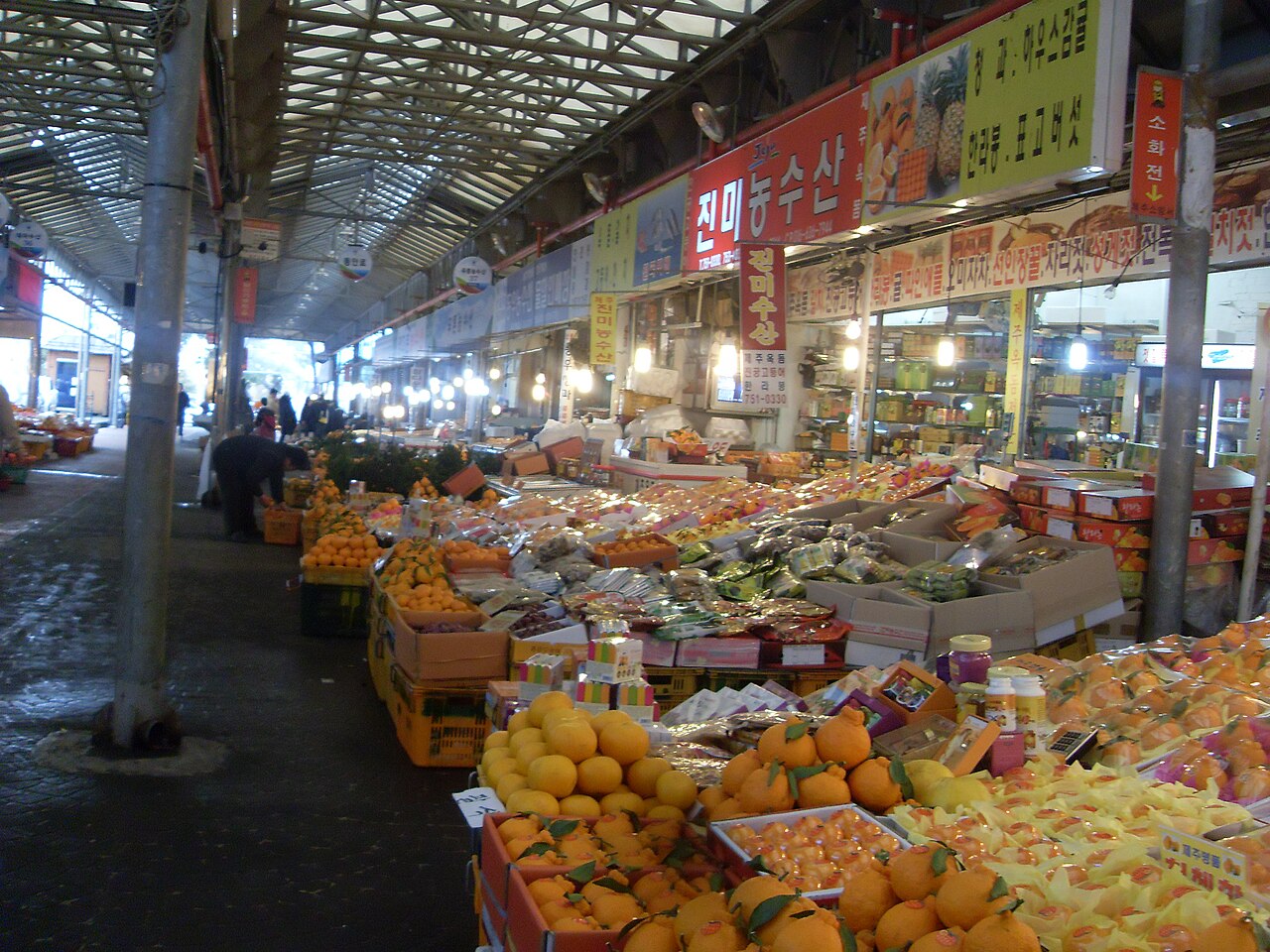
Citrus stalls stack tangerines and hallabong by grade, so ask the box price before you buy. Photo: thddbwnd, CC BY 3.0 / Source: Wikimedia Commons
Citrus is the headline. Tangerines (gamgyul) peak roughly from October or November to January, and hallabong runs from about December to February. Outside those months, you’ll still see other Jeju varieties on the stands.
Prices swing a lot by grade, size and season, so there’s no fixed number to quote. Ask for the price per box or per kg before you pick. Stalls right by the entrances can cost more than the ones deeper inside, so walk a little first.
Many fruit and seafood stalls ship boxes anywhere in Korea, packed with ice where needed. That’s handy if you’re flying home via Seoul. Be careful with international trips, though. Fresh citrus usually can’t enter the US, the EU or Australia.
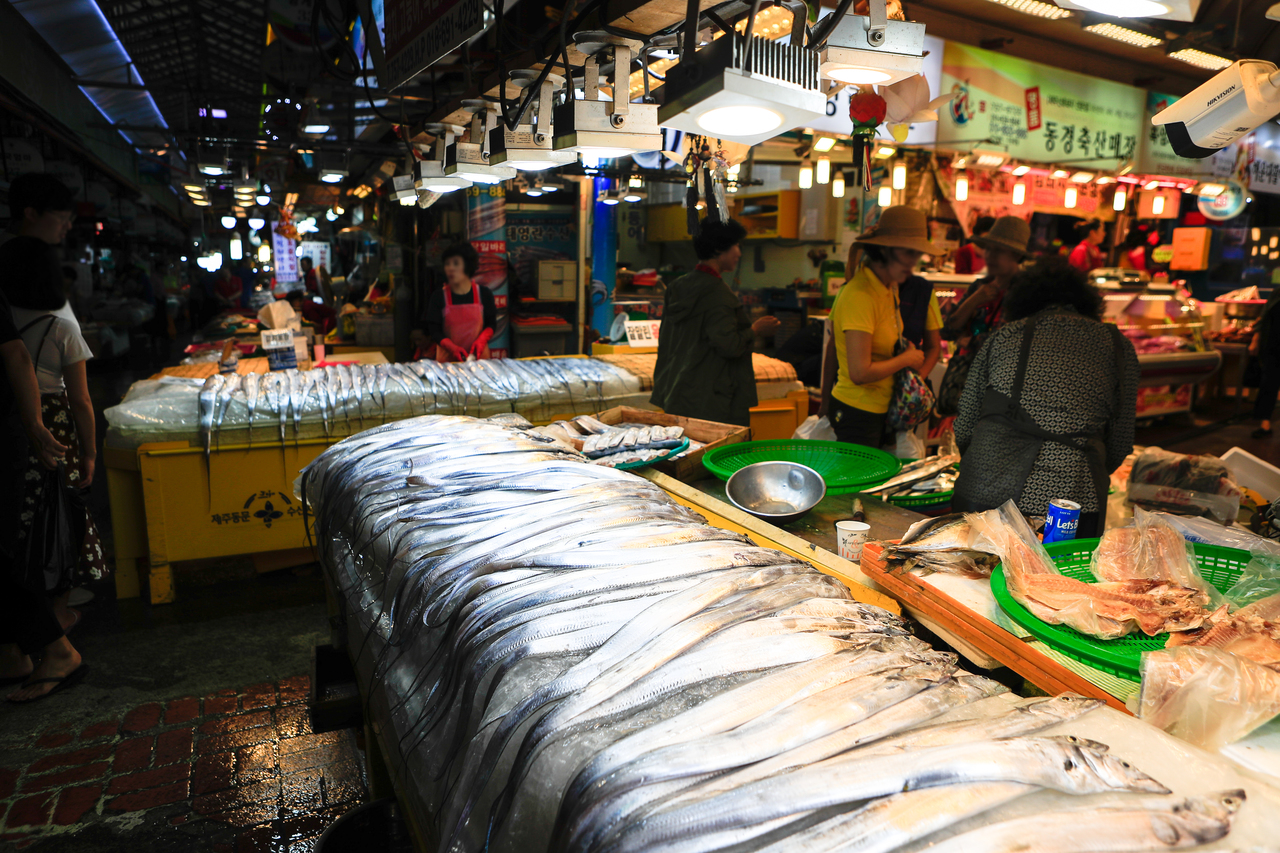
Silver hairtail (galchi), Jeju’s signature catch, laid out at a seafood stall. Photo: Dongmun Market / Source: Korea Tourism Organization photo gallery (KOGL Type 1)
The seafood aisles are the other big draw at Dongmun Market. Look for long, silver hairtail (galchi) and mackerel, both Jeju staples. These sell at market price by size, so ask for the per-fish price and weight first. Many seafood shops will vacuum-seal and ice-pack your order for domestic shipping.
The honest downsides of Dongmun Market
The crowds peak hard. Between roughly 7pm and 9pm, the night-market alley gets so packed that you shuffle rather than walk. Weekends and holidays are the worst. If you don’t plan to eat, you may find this stretch isn’t worth fighting through.
Queues eat your evening. The fire-show stalls, the lobster grills and the famous bakeries all draw long lines. The busiest stalls can mean a long wait for a single dish.
There’s almost nowhere to sit. Most people eat standing by railings or near the bins. Wear clothes you don’t mind splashing, or take food back to your room. It will cool down on the way, though.
It’s not cheap street food. Many hot dishes cost around ₩10,000, and portions are small. A few items can add up to a restaurant-sized bill. Some of the food also looks better than it tastes.
Good stuff sells out. Popular rice cakes, doughnuts and cream-filled treats can vanish by the afternoon. On the flip side, many day shops close by evening, so arriving late means missing half the market.
Parking and traffic get messy. Roads around Dongmun Market jam up at night, and the lots fill on busy evenings. The bus or a taxi is less stress.
It’s smaller than the hype. The night market is really one or two food alleys. In summer, the grill heat plus the crowds makes it hot and sweaty too.
Should you give it an evening?
Go if you’re a first-time Jeju visitor, you love grazing on street food, or you want citrus and snacks to take home. It’s also a perfect arrival or departure stop, since the airport is so close.
Skip it if you hate crowds, you want a sit-down meal, or you’re after rock-bottom prices. In that case, come for the daytime shopping only and eat dinner elsewhere. If you want a bigger, rowdier seafood market, our Jagalchi Market guide covers Busan’s best.
What I’d actually do with one evening in Jeju City
If I had one evening here, I’d arrive around 5pm. First, I’d hit the rice-cake shops for omegi-tteok, before the popular ones run out. Next, I’d pick a citrus box and have it shipped, so I’m not carrying it all night.
Then I’d stand at Gate 8 right as the night market opens. That’s 7pm from May to October, or 6pm in winter. You get your first two or three dishes before the crowd peaks around 7:30. Take any leftovers to go.
Afterwards, walk a few minutes to Sanjicheon Stream for a quiet stroll toward the port. Or head about 8–10 minutes west to Gwandeokjeong Pavilion and the old Jeju government office grounds. Planning an early start the next day? Pair this with a sunrise hike at Seongsan Ilchulbong on the island’s east coast.
Looking for more places like Dongmun Market? Browse our Korean market and shopping guides for your next stop.
Pingback: Mangwon Market: Seoul's Local Food-Alley Feast
Pingback: Tongin Market Lunchbox Guide: Brass-Coin Dosirak