
Seoul has five grand Joseon palaces, and among first-time visitors one name comes up more than any other: Changdeokgung. It is a UNESCO World Heritage Site, and it holds the city’s most beloved royal garden. Unlike the broad, flat Gyeongbokgung, it was built to follow the hills behind it rather than flatten them. This guide lays out whether Changdeokgung is worth a half-day of your Seoul itinerary. Just as important, it shows you how to lock in the Secret Garden tour before it sells out.
- 📍 Address: 99 Yulgok-ro, Jongno-gu, Seoul 03072 (창덕궁)
- 🕘 Hours: 09:00–18:00 (Feb–May, Sep–Oct), 09:00–18:30 (Jun–Aug), 09:00–17:30 (Nov–Jan); last admission 1 hour before close. Closed Mondays.
- 💳 Price: Palace 3,000 won (adult) / 1,500 won (youth). Secret Garden tour is a separate 5,000 won (adult) / 2,500 won (youth) on top — about 8,000 won total. Hanbok wearers enter the palace free. A 10,000-won integrated ticket covers four palaces + Jongmyo for 3 months (the Huwon tour still needs its own reservation).
- 🚇 Getting there: Anguk Station (Line 3), Exit 3 — about a 5–6 minute walk to Donhwamun Gate.
- ⏱ Time needed: 3–4 hours for the palace plus the 90-minute Secret Garden tour.
- 🎟 Booking the Huwon: Reserve the English tour online via the official Royal Palaces reservation system; online slots open up to 6 days ahead and sell out in peak season — book as early as you can.
- 🔗 Nearby pairing: Changgyeonggung (adjacent), Jongmyo Shrine, Bukchon Hanok Village, and Insadong are all a short walk away.
- ✅ Verified as of June 2026 — palace prices and tour times change periodically; reconfirm on the official site before you go.
A palace shaped by its hillside
King Taejong founded Changdeokgung in 1405 as a secondary palace. Over time it became the dynasty’s most-used royal residence. Today the complex sprawls across roughly 57.9 hectares in northern Seoul’s historic core. UNESCO inscribed it in 1997 as a prime example of Far Eastern palace architecture. The citation singled out how its buildings harmonize with the natural topography instead of forcing a rigid grid onto it.
Two structures anchor the front. Donhwamun Gate is the oldest surviving gate of any Joseon palace, rebuilt in 1607–08. Beyond it stands Injeongjeon Hall, the main throne hall and a National Treasure. This is where the court held enthronements and affairs of state. The current hall dates to 1804, after fires and the 1592 Imjin War forced repeated rebuilds.
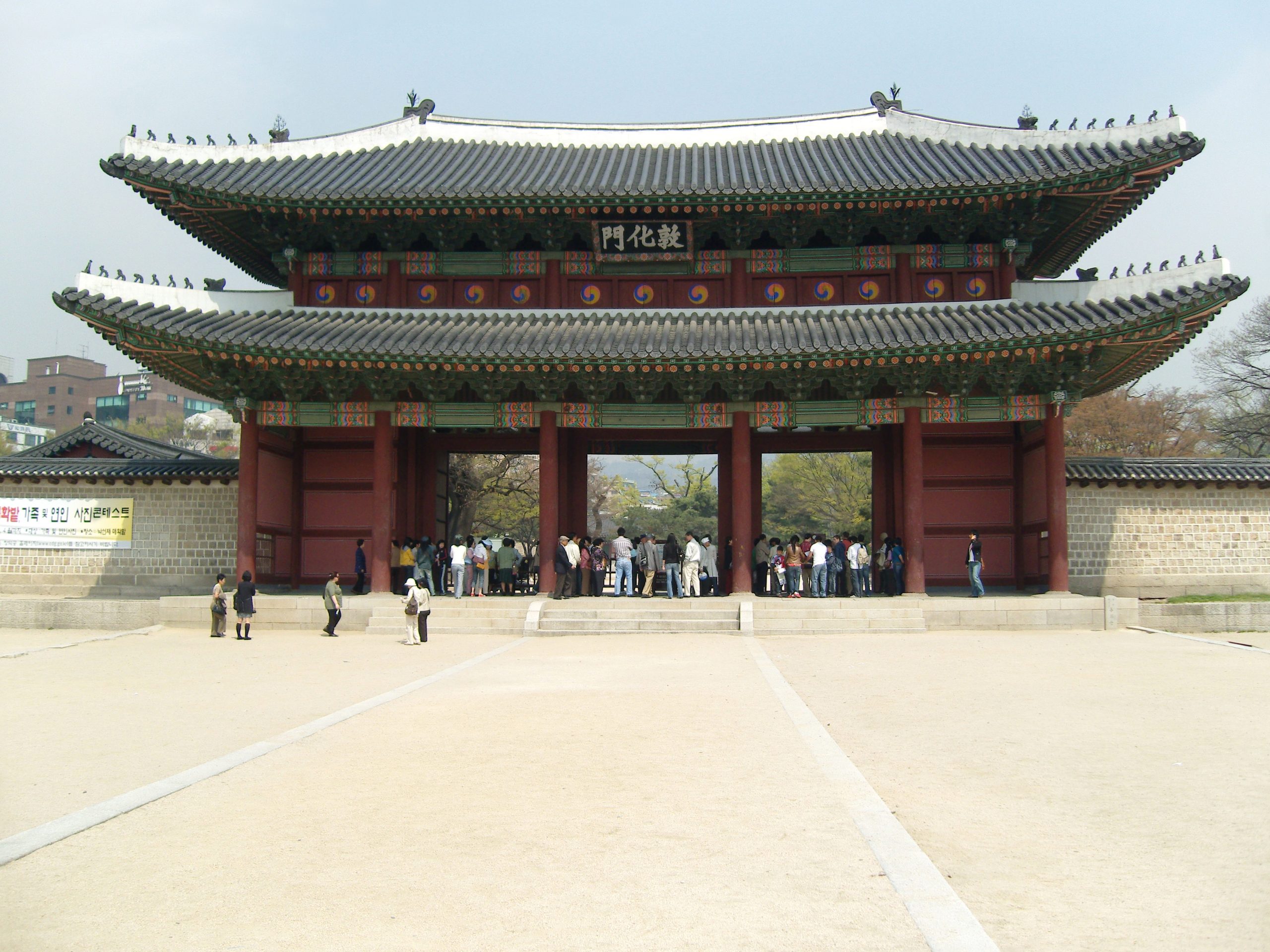
Photo: Donhwamun, the oldest surviving palace gate of the Joseon era — Alain Seguin, CC BY-SA 3.0 via Wikimedia Commons.
Inside the Secret Garden (Huwon)
The palace front is the formal face. But the Huwon — the “rear garden,” known in English as the Secret Garden — is its soul. It covers around 32 hectares, nearly half the complex. The layout follows a principle called “borrowed scenery”: pavilions, ponds, and paths that follow the land rather than reshape it. More than 160 tree species grow here, dozens of them over 300 years old. The centerpiece is the Buyongji lotus pond (1707), framed by the Buyongjeong pavilion and the two-story Juhamnu library above.
Now the catch that defines a visit. You cannot wander the Huwon on your own. Access is by guided tour on a fixed timetable, about 90 minutes, capped at 100 people per language. Fifty spots sell online in advance and 50 go on-site same-day. The walk from the main gate to the garden entrance takes about 15 minutes. Arrive late to your slot and you get no entry and no refund.
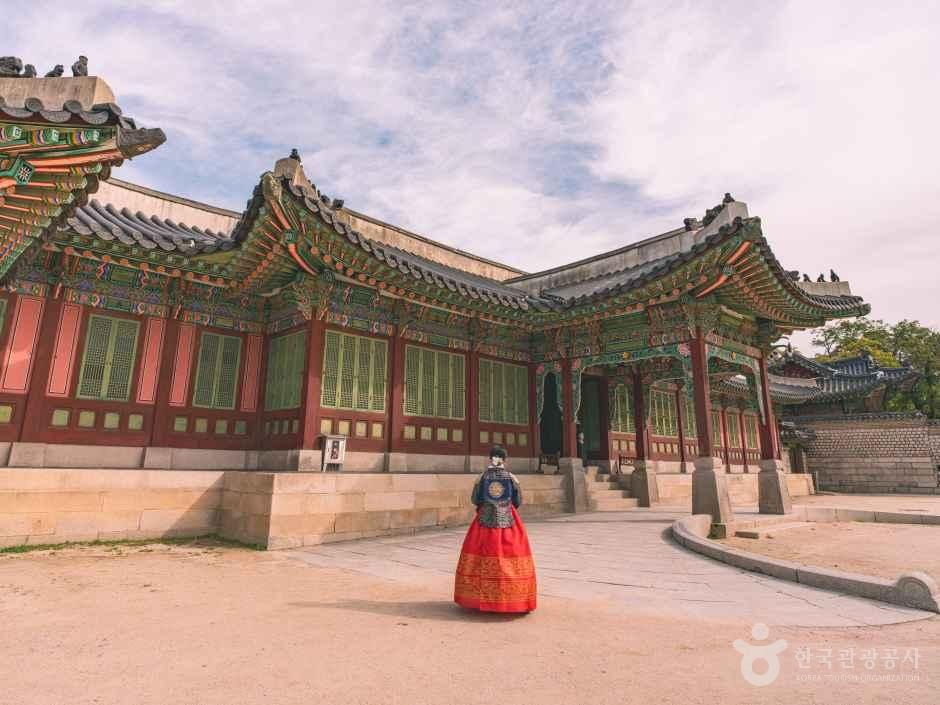
Photo: A hanbok-clad visitor before one of Changdeokgung’s painted halls — Source: Korea Tourism Organization (KOGL Type 1).
What keeps drawing people back
The Huwon is the most beautiful and most peaceful royal garden in Seoul. That 100-person cap earns real credit. The shaded, largely downhill paths feel immersive rather than herded. The lotus pond and the centuries-old trees are the highlight worth planning around. The palace itself earns steady praise too, especially from travelers who have already done Gyeongbokgung and want something quieter.
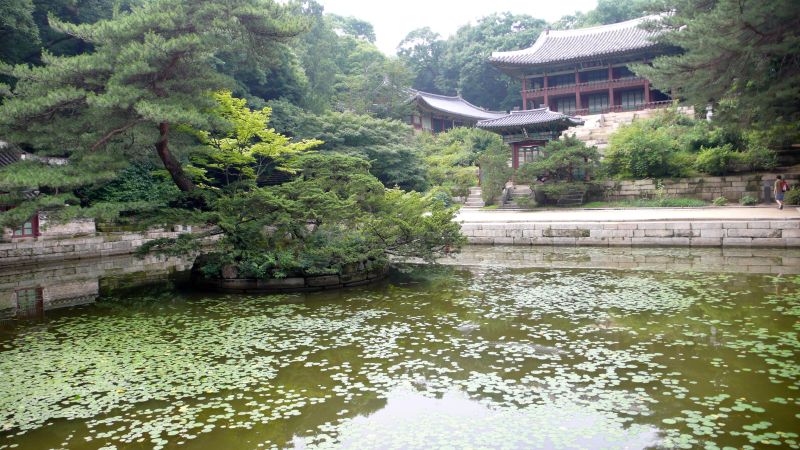
Photo: The Buyongji lotus pond in the Secret Garden (Huwon) — manray3, CC BY-SA 2.0 via Wikimedia Commons.
Reading the ticket math and the calendar
Do a quick cost check before you arrive. If your Seoul trip already includes Gyeongbokgung, Deoksugung, and Jongmyo, the 10,000-won integrated pass beats buying each separately. It also stays valid for three months. But it does not include the 5,000-won Huwon tour, which is always a standalone reservation. Note too that the Huwon ticket carries no group discount and no senior rate — it is one flat price. Tickets and the on-site reservation desk take card, though a little cash smooths the smaller vendors around Bukchon afterward.
Timing is the single biggest lever here. The garden centers on water, lotus, and old-growth trees, so it peaks twice a year. Cherry blossoms land in late March to early April. Autumn colour runs from late September into October. Those are also when the English tour sells out first — the best views come with the hardest tickets. For the thinnest crowds in any season, aim for a weekday and arrive at the 09:00 opening. Changdeokgung sits in the dense historic cluster of northern Seoul, so it pairs naturally into a longer day with adjacent Changgyeonggung, nearby Jongmyo Shrine, and Bukchon.
What to know about Changdeokgung: the honest caveats
The biggest gripe isn’t the place. It’s booking friction. English Huwon tours run just three to four times a day, and they vanish fast in blossom and foliage season.
The same-day queue can cost you the trip. Those 50 on-site spots are a hard cap, and in peak months they are gone by midday. Turning up hoping to walk in is how people end up making a wasted journey. Book online if there is any way to do it.
Your slot decides your experience. This is the detail nobody mentions. A sold-out 100-person slot means moving through the garden as a large herd, shuffling behind a guide. Earlier slots often run with barely a dozen people and feel completely different. If you have a choice, take the first tour of the day — same garden, far better visit.
Expect to queue in the open. The line from the ticket office to the entrance has little cover. On a hot afternoon you wait in full sun, and the crowd at the gate on the way out can be startling. Barring genuinely bad weather, this palace is busy.
On your feet, in the weather
It’s a real walk, mostly outdoors. The full palace-and-garden circuit runs three to four hours with some slopes. Shade exists in patches, but most of the visit is exposed. Summer heat makes it genuinely hard going. Wear proper shoes, bring water, and don’t attempt it dragging luggage — there is nowhere convenient to put it.
Strongly seasonal. Spring and autumn are the clear winners. A bare deep-winter garden loses much of the magic.
Thin English signage. Commentary and signs are limited, so most people lean on the QR-code audio guide.
Is Changdeokgung your palace?
Changdeokgung is the right choice for anyone who wants one palace that rewards slowing down. Think travelers who care about gardens and design. Think anyone who has already done Gyeongbokgung and wants somewhere quieter and more atmospheric. In spring and autumn, it is an easy yes.
It is a weaker fit if you won’t commit to a fixed tour time. It’s also wrong for anyone who finds a three-plus-hour walk with slopes a problem. Deep-winter visits underwhelm, too. In that case, the palace grounds alone may serve better — or another of Seoul’s royal palaces. But booked ahead and caught in blossom or foliage season, Changdeokgung is the most quietly magical palace in the city.