
Most people treat Jagalchi Market as a photo stop. They walk the tanks, film a wriggling octopus, and leave. That’s a mistake, because the real point of Busan’s famous fish market is lunch. You pick a fish downstairs, somebody cuts it for you, and you eat it upstairs twenty minutes later.
So here’s what I’d actually do. Come on a weekday morning, buy one in-season fish by the kilo, eat it at a second-floor table with a harbour view, then climb to the free rooftop. That’s the whole plan, and this guide shows you how to do it without overpaying.
- 📍 Address: 52 Jagalchihaean-ro, Jung-gu, Busan (부산 중구 자갈치해안로 52) — the modern building with the seagull-wing roof
- 🕘 Hours: Market listed 05:00–22:00. Posted floor hours: 1F live fish roughly 06:00–21:00, 2F restaurants roughly 09:00–21:00. Stalls vary. Closed the 1st, 3rd and (when there is one) 5th Tuesday of each month — check before you go
- 💰 Price: Free to browse. Upstairs setting fee ≈₩5,000 per person, plus your fish. Budget roughly ₩60,000–100,000 for two, all in
- 🚇 Getting there: Busan Metro Line 1 to Jagalchi (Exit 10) or Nampo (Exit 2), then a 5–6 min walk. From Busan Station it’s a short 6–10 min ride on Line 1
- ⏱ Time needed: 45 min to browse and see the rooftop; 1.5–2.5 hours with a seafood meal
- 🔗 Nearby pairing: BIFF Square (4–5 min walk), Gukje Market (~8 min), Yongdusan Park and Busan Tower (~10 min)
- Verified as of September 2026 — prices move daily, and the market may close for a day or two around Chuseok
Where it is
The pin marks the main seagull-roofed Jagalchi building on the harbour front.
How Jagalchi Market really works: buy downstairs, eat upstairs 🐟
This is the part most first-timers get wrong. The ground floor isn’t a restaurant. It’s a wet market, and the second floor is where you eat what you bought. Here’s the flow, step by step.
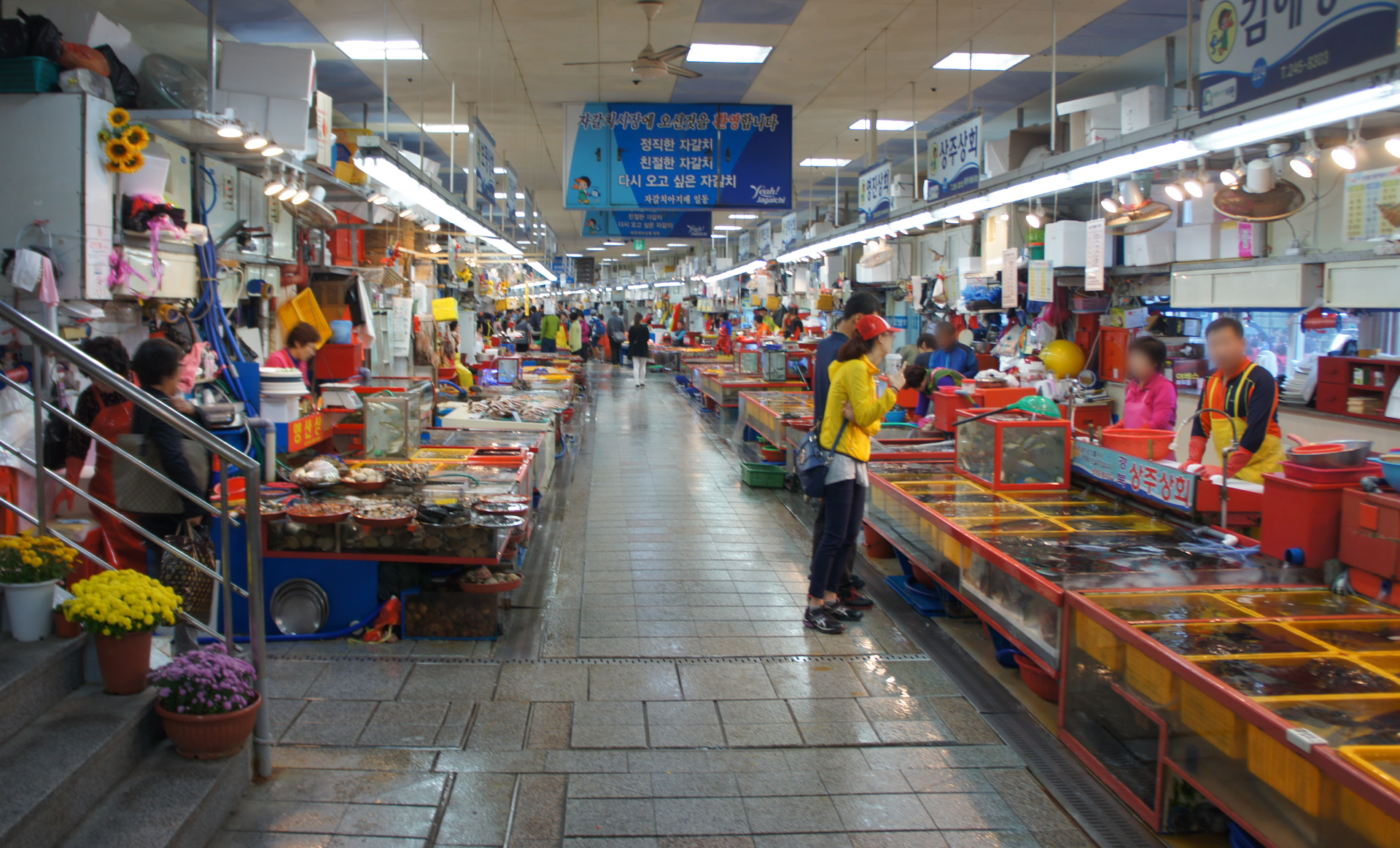
The ground-floor aisles, where every tank is a menu you can point at. Photo: Inside Jagalchi Market in Busan — Tracy Hunter, CC BY 2.0 via Wikimedia Commons
1. Pick your fish at a 1F stall. Vendors sell by the kilo or by the piece at the daily market price. Choose a stall with a price board, and watch the scale.
2. Confirm the number before the knife comes out. Ask the price per kg, the weight, and the total. A translation app works fine here. Once they cut, the deal is done.
3. Follow the vendor’s pointer upstairs. The stall fillets your fish and sends you to a partner table on 2F, often by number. These little upstairs places serve the fish with dipping sauces.
4. Pay the setting fee upstairs. Expect about ₩5,000 per person. That covers lettuce and perilla wraps, sauces and a few small side dishes. Spicy fish stew (maeuntang) and steaming crab or shellfish cost extra.
Don’t want the upstairs step? Takeaway carries no setting fee, and a purchase gets drivers a one-hour parking voucher. Or skip the system entirely and order from a sit-down restaurant menu. You get fixed platters and more side dishes, but less fish for your money.
What to order on your first visit
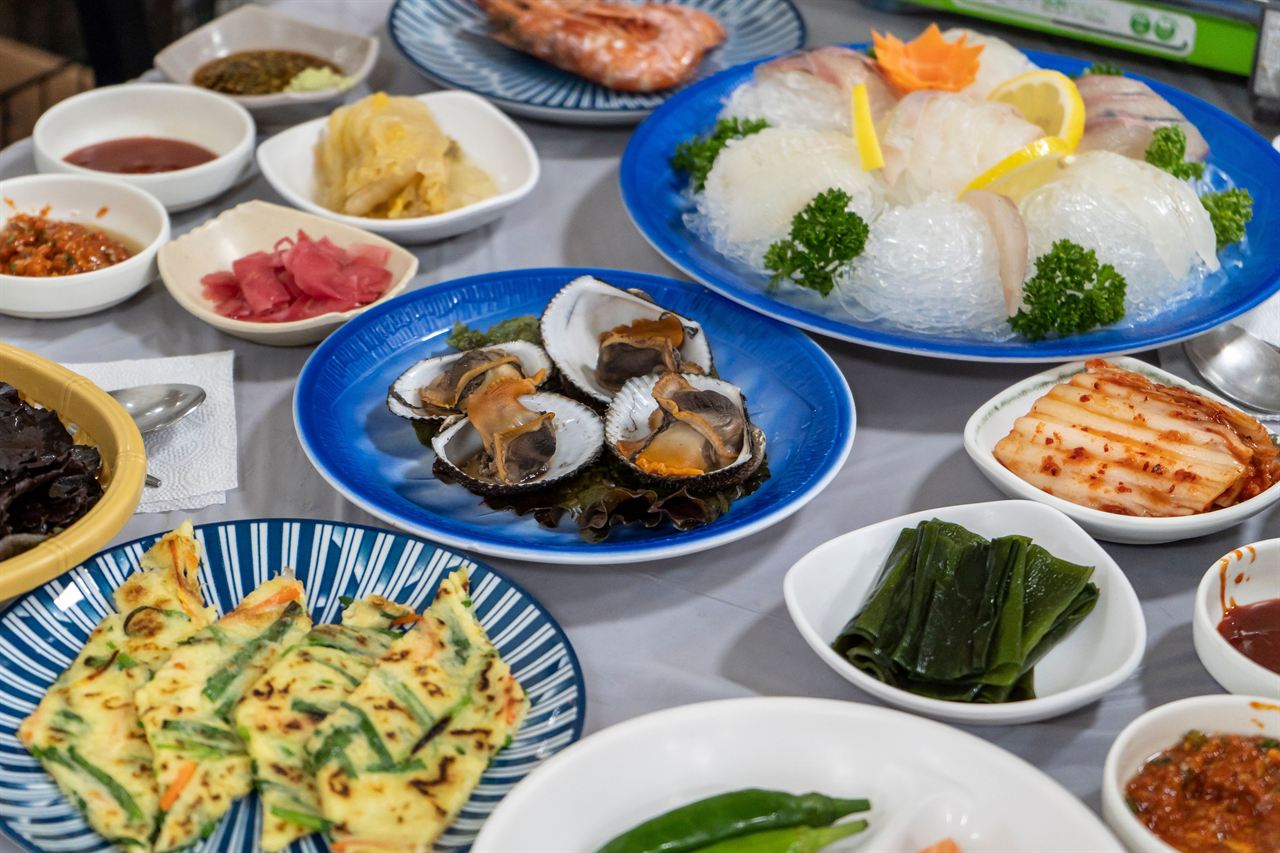
A proper upstairs spread — sliced raw fish, shellfish and the small plates that come with the setting fee. Photo: Jagalchi Market (자갈치시장) / Source: Korea Tourism Organization photo gallery (KOGL Type 1)
Keep it simple. One fish, sliced as hoe (Korean sashimi), plus stew made from the bones, will feed two people well. The cuts here run thick and fresh, which is the whole reason to come.
These are example prices visitors reported at individual stalls and restaurants in 2026. They’re a rough guide only, because prices change daily and vary from stall to stall.
| Option | Approximate 2026 price | Good for |
|---|---|---|
| Gizzard shad (jeon-eo), autumn | ≈₩30,000–35,000 per kg | The classic autumn pick |
| Pike eel (hamo) | ≈₩30,000 per kg | Something different |
| Cuttlefish | ≈₩20,000 each | A cheap add-on |
| Live small octopus (sannakji) | ≈₩10,000 per portion | The adventurous bite |
| Mixed hoe platter (one restaurant’s menu) | ≈₩60,000 / ₩90,000 / ₩120,000 (S/M/L) | No-fuss, no stall visit |
| Chef’s course | ≈₩30,000–50,000 per person | Groups who want variety |
| Grilled-fish set meal | ≈₩10,000–15,000 per person | Anyone avoiding raw fish |
King crab tempts plenty of visitors. Recent guides put it at roughly ₩80,000–90,000 per kg (check the board), and one crab often weighs 2.5–3.5 kg. So do that maths before you point. For snow crab, check the board on the day.
Across the road, Shindonga Seafood Market runs set courses at about ₩40,000–50,000 per person (sometimes negotiable). It bills itself as fixed-price, which suits nervous first-timers.
The charcoal eel strip outside 🔥
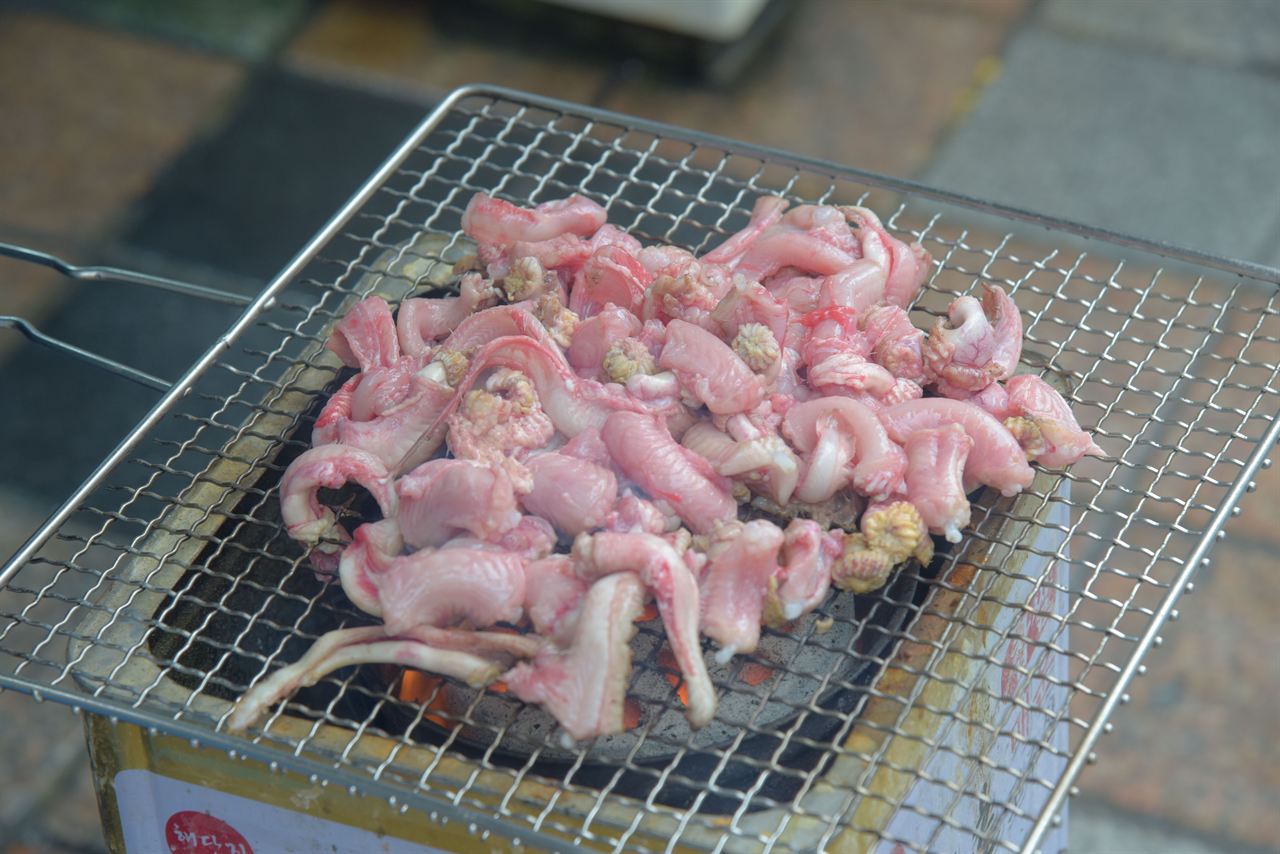
Spicy kkomjangeo sizzling on foil — smoky, chewy and very Busan. Photo: Jagalchi Market (자갈치시장) / Source: Korea Tourism Organization photo gallery (KOGL Type 1)
Step outside and walk the stretch of road between Shindonga and the main building. That’s the kkomjangeo strip. Locals call it eel, but it’s actually hagfish, grilled over charcoal.
You order by size: small, medium or large. Then you choose spicy sauce or plain salt. The texture is springy and the smoke is half the fun. Prices aren’t consistent, so read the posted menu first.
When to go (and when not to)
Weekday mornings, roughly 7 to 10, give you the working-market buzz and the freshest stock. A weekday late afternoon suits a calmer meal upstairs. Weekends, especially Saturday lunch, bring crowds and long waits.
One thing to clear up: Busan’s big pre-dawn wholesale fish auction is held at Busan Cooperative Fish Market, about 1 km west, not in the main Jagalchi building. So don’t set a 4 a.m. alarm expecting an auction at Jagalchi itself.
The Busan Jagalchi Festival usually runs in October. Organisers hadn’t announced the 2026 dates as of September 2026, so watch for the official announcement before you plan around it.
The honest downsides of Jagalchi Market
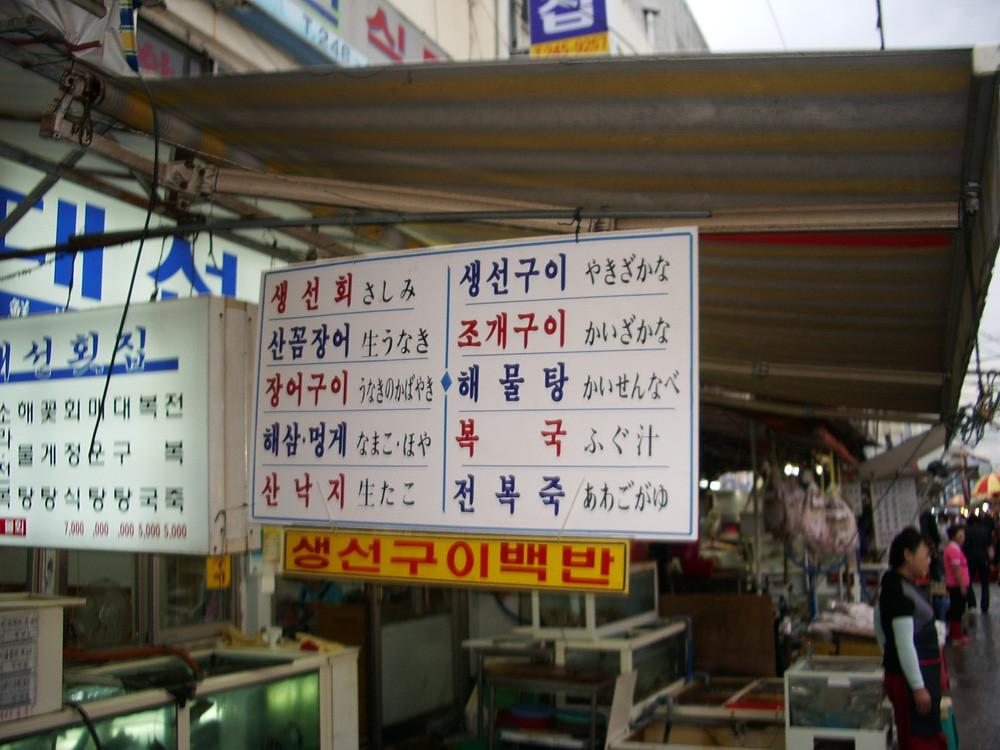
Menus like this help, but always confirm the final number before anyone starts cooking. Photo: 자갈치시장 Jagalchi Market, Busan — InSapphoWeTrust, CC BY-SA 2.0 via Flickr
The overcharging case is real. In late summer 2025, a restaurant near the market charged ₩70,000 for two or three sea cucumbers that had no posted price. Jung-gu district fined it and ordered a fix. Market merchants then signed an anti-overcharging pledge, and Busan city told sellers to display daily reference prices for ‘market-price’ items. Most visitors report fair treatment, especially at stalls with clear price boards. The fix is simple: ask the price per kg and the total before they cut.
It isn’t a bargain. Restaurant sets and courses often give you no more fish per won than a neighbourhood fish shop. Buying by the kilo at a stall gives the best value. Come for freshness and atmosphere, not a discount.
Add-ons creep up. The setting fee, the stew and the steaming charge all land on top of your fish. The side dishes are also sparse compared with a restaurant menu. Ask for the all-in total upfront.
Weekend waits get long. Cutting alone can take 30–40 minutes on busy days, and takeaway queues drag too. A weekday visit solves most of this.
Touts work the eel strip. Some shops outside call you in hard, and service can feel curt. Just walk on until a menu looks clear.
Prices could change. Merchants in the main building start paying rent to the city in December 2026. The city expects modest rents, but it’s too early to say whether prices will change. Also, driving isn’t cheap — parking costs ₩700 per 10 minutes.
Is this fish market your kind of place?
Go if you love seafood, you enjoy a noisy, working market, or you want the most Busan meal in Busan. It also works well for couples and small groups who can share one big fish.
Skip it if you expect rock-bottom prices, or live seafood makes you uneasy. Tanks full of creatures you’ll eat soon are the whole show here. If you want Seoul’s version instead, read our Noryangjin Fish Market guide.
How I’d slot it into a Nampo-dong day
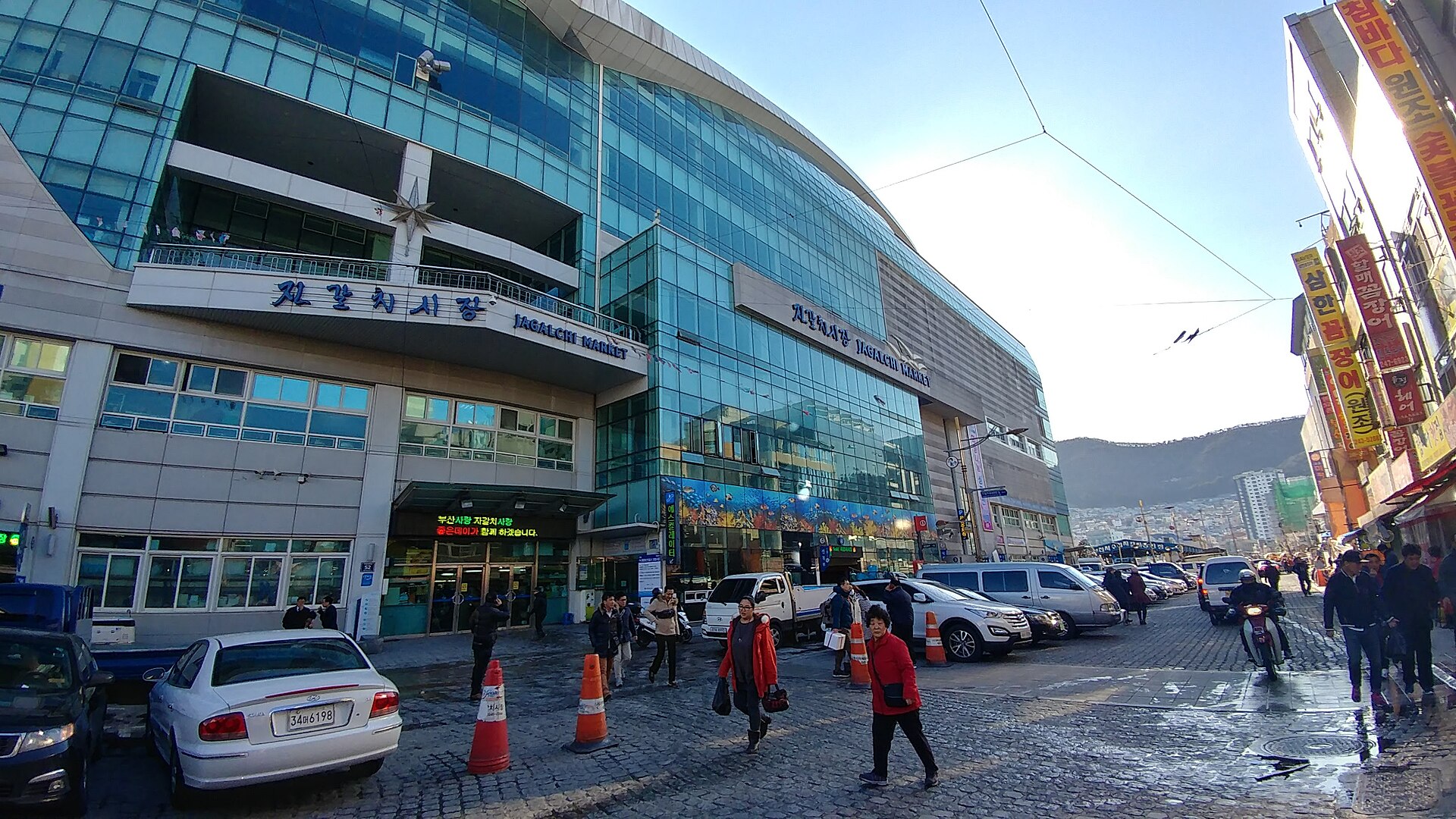
The glass-fronted main building — your landmark for the rooftop and the harbour walk. Photo: Busan Jagalchi Market — Altostratus, CC BY-SA 4.0 via Wikimedia Commons
Start with a weekday morning at Jagalchi, then eat upstairs around 10 or 11. Next, walk 4–5 minutes north to BIFF Square for a sweet seed hotteok. From there, Gukje Market sits about 8 minutes away, and Yongdusan Park with Busan Tower takes around 10 minutes on foot.
Prefer an afternoon plan? Walk about 10 minutes east to Yeongdo Bridge for its daily 2 p.m. drawbridge lift. Or ride a short bus to Gamcheon Culture Village, about 15–20 minutes away. Then finish at Bupyeong Kkangtong night market after dark.
Want more places like this? Browse our more Korean market guides for the next stop on your list.
Pingback: Tongin Market Lunchbox Guide: Brass-Coin Dosirak
Pingback: Incheon Airport to Seoul: Every Way In (2026)