
The War Memorial of Korea is free, and it is enormous. Plan a quick hour and you will likely stay closer to three. This is not a palace or a pretty hanok lane. It is a serious, beautifully built museum about the war that split the country in two. And a real B-52 bomber sits parked out front. For anyone who wants to actually understand the Korea they are travelling through, it earns a slot on the itinerary.
One tip travellers pass along often: if a DMZ tour is on your plan for later in the trip, visit here first. The museum turns the border from an abstract line on a map into something you feel on the ground.
- 📍 Address: 29 Itaewon-ro, Yongsan-gu, Seoul (전쟁기념관)
- 🕘 Hours: 09:30–18:00, last entry ~17:00 — closed Mondays (open the next day if Monday is a holiday)
- 💵 Price: Free (indoor halls + outdoor exhibits); only special temporary shows charge
- 🚇 Getting there: Samgakji Station (Line 4 & Line 6), Exit 12, ~5–10 min walk
- ⏱ Time needed: 2–3 hours (you won’t see it all — and that’s normal)
- 🔗 Nearby: Itaewon (right next door), National Museum of Korea, Namsan & N Seoul Tower
- ✅ Verified as of June 2026
What the War Memorial of Korea actually is
The museum opened in 1994 on the former Korean Army headquarters site in Yongsan, and it does two jobs at once. The War Memorial of Korea honours those who died defending the country. The Korean War above all, but also the Vietnam War and later overseas deployments. It is also a genuinely deep history museum, displaying roughly 10,000 artifacts drawn from a collection that tops 33,000.
In practical terms it splits into two worlds. Outside sits a wide plaza packed with real military hardware you can walk right up to. Inside are six thematic galleries across several floors, running from ancient Korean warfare to the modern ROK military. Visitors can do the outdoor section alone in about 30 minutes for free, or spend half a day working through the whole thing.
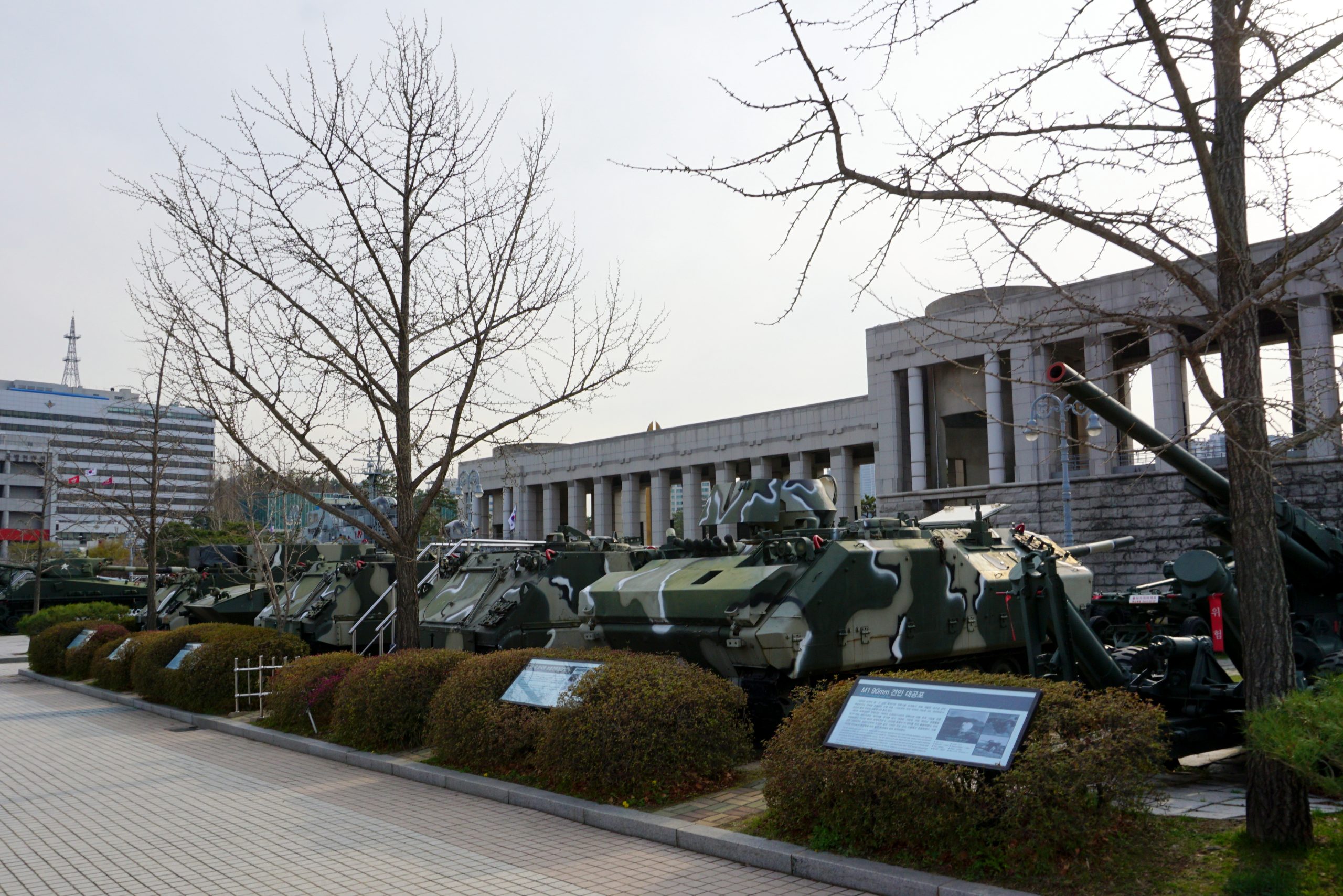
Outdoor armor lined up in front of the museum’s colonnade. Photo: Matt Kieffer, CC BY-SA 2.0 via Wikimedia Commons.
The open-air hardware plaza
Even for visitors who do not usually seek out museums, the outdoor exhibition tends to land. More than a hundred large pieces sit in the War Memorial of Korea’s open-air plaza, no ticket required. You can walk right up to nearly all of them.
The headliner is a Boeing B-52D Stratofortress — one of only a handful displayed anywhere outside the United States. It is enormous, and standing beneath that wingspan resets your sense of scale. Around it are an F-4 Phantom, an F-86 Sabre, a captured MiG-15, There is also a field of Cold War armor. A Soviet T-34/85, an American Sherman, Patton tanks, and a small navy patrol boat that still carries its bullet holes. Children climb the ones that permit it, military enthusiasts linger for ages, and almost everyone photographs the B-52.
The Statue of Brothers, and why it lingers
Of everything on the grounds, one monument tends to stay with people. The Statue of Brothers shows an older South Korean soldier embracing a younger North Korean soldier. Siblings who fought on opposite sides, meeting on the battlefield. They stand on a cracked stone dome that splits down the middle. It is not subtle, and it does not need to be. For a divided country, this single sculpture carries the whole story.
Nearby, black marble colonnades bear the engraved names of the fallen. Korean soldiers stand alongside the UN and allied forces who came to fight. This is the emotional heart of the site, and it is the part visitors most often wish they had lingered over longer.
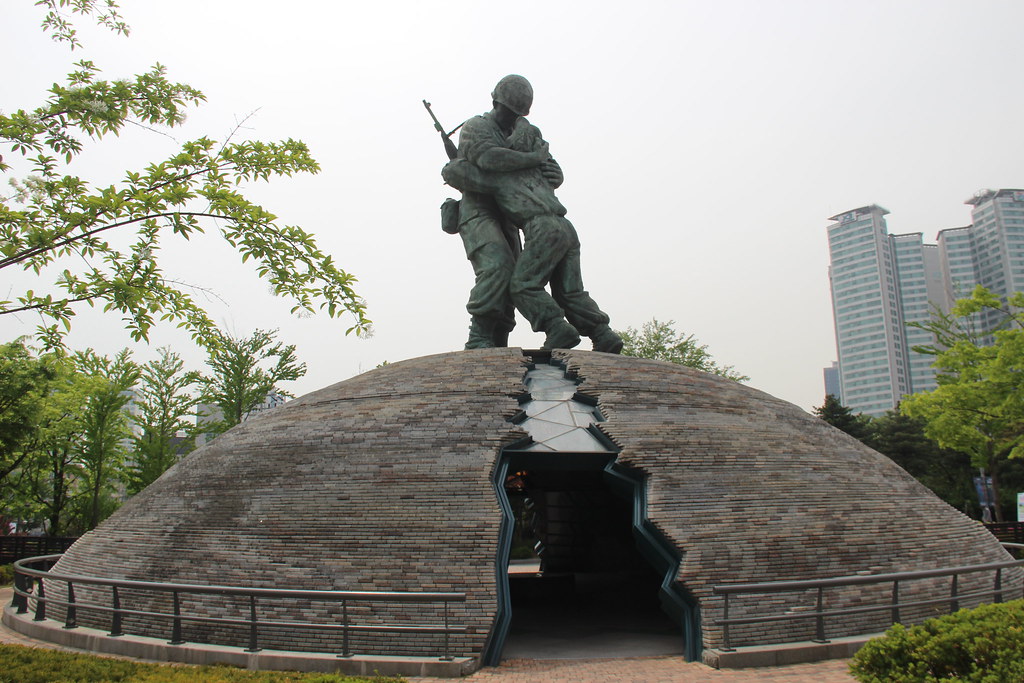
The Statue of Brothers, standing on its split stone dome. Photo: Gary Lee Todd, CC0 1.0 via Flickr.
Inside the galleries, where the history lives
The indoor galleries are where casual visitors tend to get pleasantly surprised. The English labeling is genuinely solid, far better than most first-timers expect. No squinting at Korean-only panels and guessing.
The flow runs roughly chronological. The War History Room covers Korean military history from ancient times. It includes a full-size replica of a geobukseon, the famous “turtle ship,” worth the detour on its own. Then come the Korean War Rooms, the core of the museum. Causes, major battles, dioramas, short films, and the weapons of 1950–53. This is the section that primes a DMZ visit. Beyond it sits an Overseas Dispatch room covering Korea’s role in Vietnam and later, plus a modern ROK Armed Forces hall. Then there is the indoor Large Equipment Hall, with oddities like Syngman Rhee’s Cadillac and a Kim Il-sung limousine.
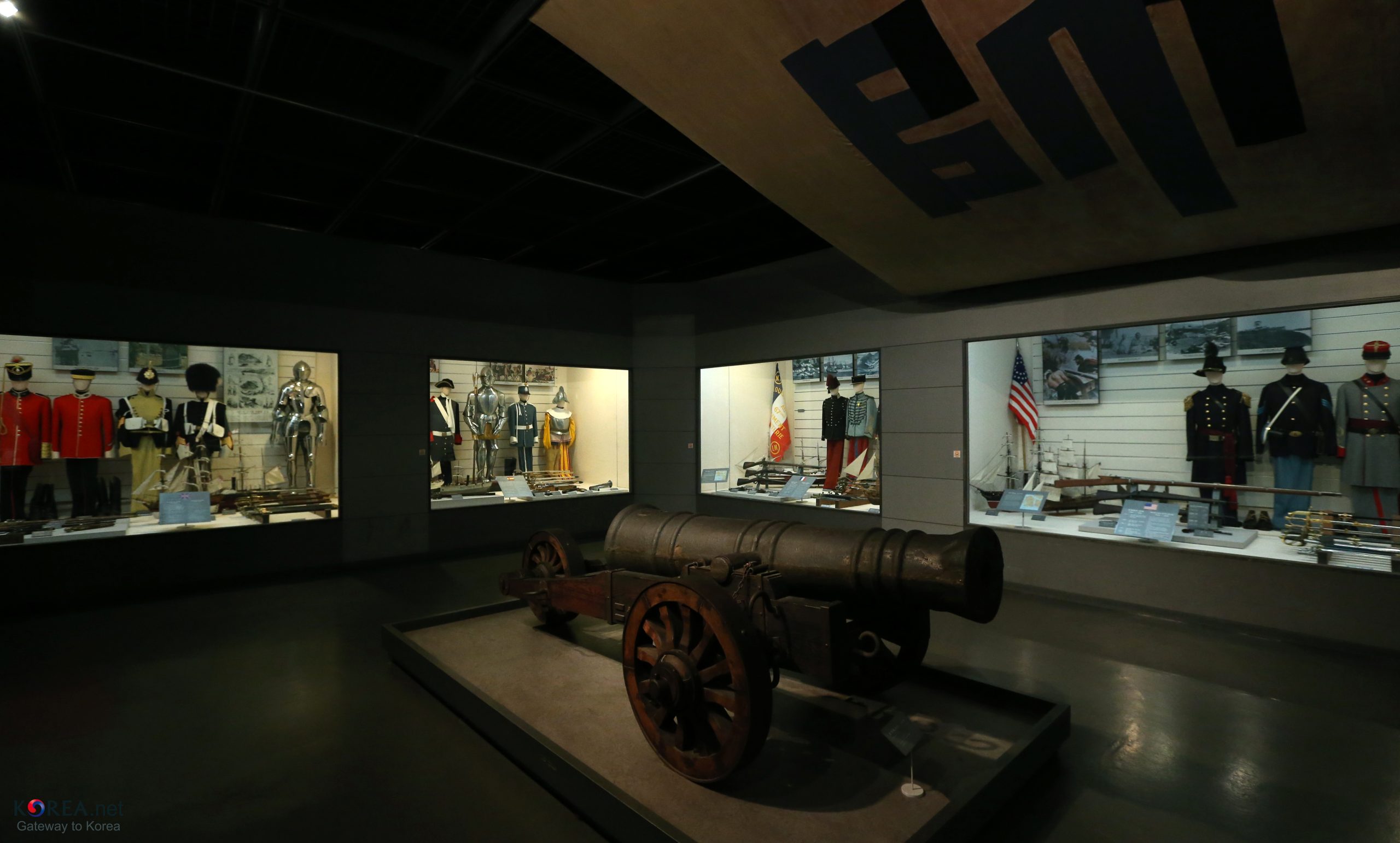
Inside the War History Room. Photo: Korea.net / KOCIS (Jeon Han), CC BY-SA 2.0 via Wikimedia Commons.
Visiting with children
The site is not only a grown-up history lesson. A dedicated Children’s Museum offers interactive games, simplified storytelling, and a small “training ground” play area. Book it, though, rather than assuming you can walk in. It runs in timed sessions with a capped number of visitors each, most places released as advance online reservations and only a small allocation held back for same-day walk-ups. On a busy weekend or during school holidays that allocation goes early and families do get turned away. There is a comfortable air-conditioned waiting area once you are in the queue, which helps. Pair that with climbing around real tanks and planes outside, and the afternoon becomes genuinely kid-friendly. Heavy themes, handled at a level young visitors can absorb.
Timing your visit and getting oriented
A few logistics reward a little planning. The museum is quietest right at the 09:30 opening, and again after about 15:00. Mid-morning on weekends and public holidays brings the heaviest crowds and the busiest school groups. Arriving within the first half hour buys you the outdoor plaza and Memorial Hall in relative calm before tour groups arrive. Entry is genuinely free with no ticket line for the permanent halls, The only budgeting question is the optional special exhibitions, and they vary far more than people expect. A small in-house show may be a few thousand won, while a headline touring exhibition can run ₩30,000 or more a head. Card is fine at the counter either way. Anything sold as a timed session, special shows and the Children’s Museum alike, asks you to be at the ticket desk about ten minutes before your slot, because there is wristband or equipment fitting to get through first. Coming from Samgakji Station, follow signs for Exit 12. The route is step-friendly and takes roughly five to ten minutes on foot, past the museum’s front lawn. There is a car park, but it is not the easy option. It fills fast and queues on weekends, and worst of all on the commemorative dates — Memorial Day on 6 June and the Korean War anniversary on 25 June — which is exactly when people come here. Rates run on the steep side too, though the museum offers a visitor parking discount, so ask at the information desk before you drive out.
War Memorial of Korea’s drawbacks, and how to plan around them
It is too big. That is the most common criticism, and a fair one. Plenty of people cover only a quarter of the museum in three hours and leave a little frazzled. The workable approach at the War Memorial of Korea is to skip reading every panel. Choose the Korean War Rooms plus the outdoor plaza, and let the rest go.
It is also heavy. This is war, death, and a still-divided peninsula, not a light outing. Those after something cheerful may want to save it for a day they are in the right headspace.
There is a substantive caveat too: the perspective leans patriotic. The emphasis falls on soldiers and the official national narrative, with relatively little on what ordinary civilians endured. It is best read as one very well-made point of view rather than the full human story.
Smaller notes. The walk from Samgakji confuses some first-timers, so aim for Exit 12 and follow the signs. The outdoor exhibits bake in summer and freeze in winter. The on-site cafe is modest, which is exactly why pairing the visit with a proper meal in Itaewon makes so much sense.
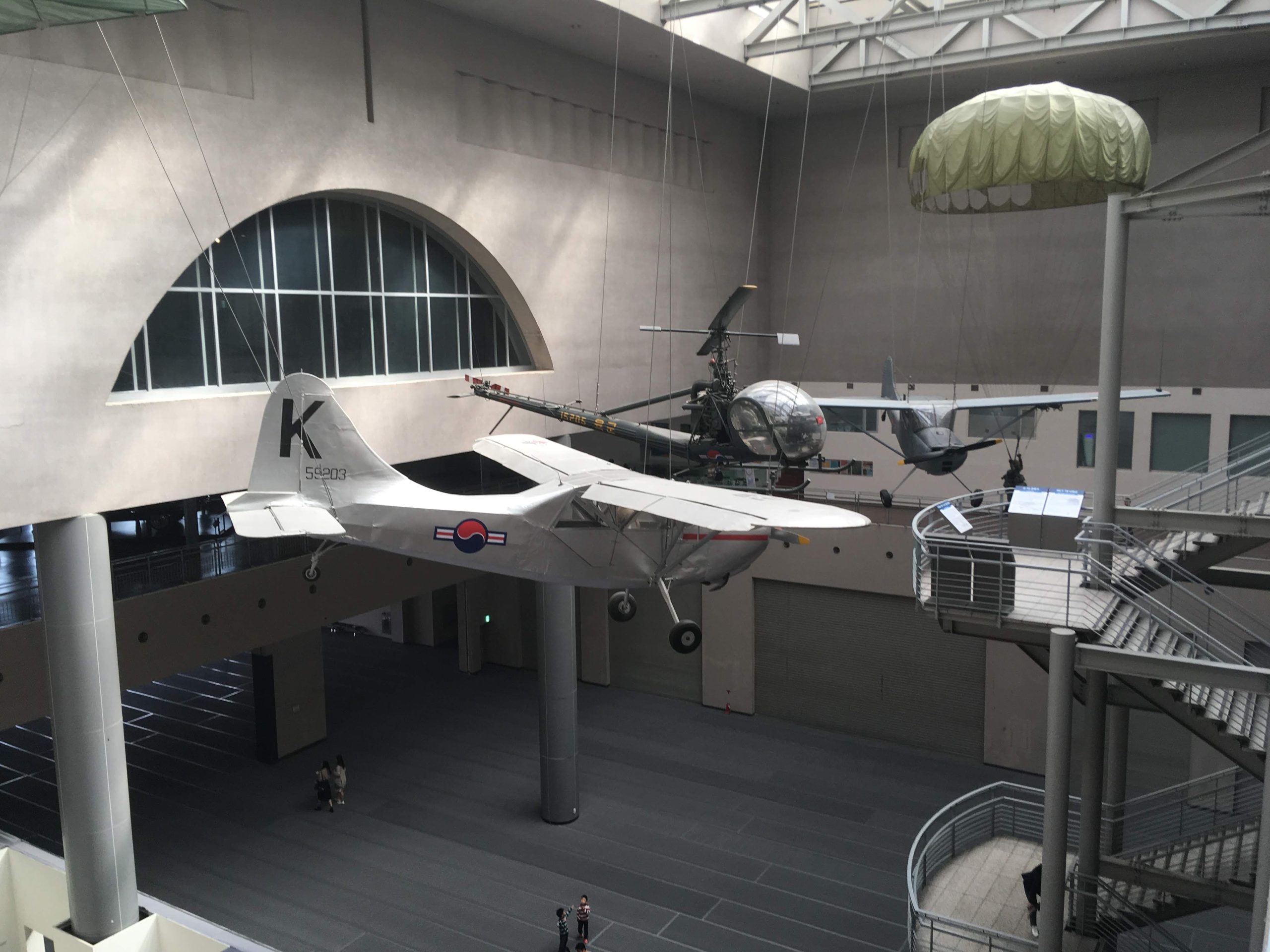
Aircraft suspended in the indoor large-equipment hall. Photo: Christophe95, CC BY-SA 4.0 via Wikimedia Commons.
Is it worth your Yongsan afternoon?
The War Memorial of Korea suits anyone even mildly interested in history, and anyone doing a DMZ tour. It also works for families with children who love big machines, or travellers simply after a substantial free thing to do in Yongsan. The War Memorial of Korea is easier to skip on a tight, pure-fun trip, or if you are already museumed-out. Three big Seoul museums in three days is a lot to absorb.
Here is the half-day version of the War Memorial of Korea. Take in the outdoor hardware and Statue of Brothers first, then spend a focused hour in the Korean War Rooms. Walk into Itaewon for dinner afterwards. It makes for a near-perfect afternoon that costs nothing but the meal.
Want more big Seoul sights like this? Browse our Icons & Views guides for towers, museums, and the city’s standout landmarks.