
Step out of a subway exit in Gangnam and the glass towers hit you first. Then the COEX traffic, and the hum of Seoul’s wealthiest district. Two minutes later a temple gate closes the noise off behind you. Wooden halls, drifting incense, monks in grey robes, and a 23-meter stone Buddha gazing back at the skyline. That is Bongeunsa Temple, and the whiplash is precisely the appeal.
Entry is free, and the grounds open from before dawn until late at night. Bongeunsa Temple sits directly across the street from the COEX mall. That makes it the natural calm counterpoint to a Gangnam shopping afternoon. Weighing whether it earns a slot in a packed Seoul day? Here is a clear-eyed account of what to expect.
- Address: 531 Bongeunsa-ro, Gangnam-gu, Seoul (서울특별시 강남구 봉은사로 531)
- Hours: Roughly 05:00–22:00 daily (times can shift around services and ceremonies)
- Price: Free to enter. Paid programs only (see Temple Life below)
- Getting there: Line 9 → Bongeunsa Station, Exit 1, ~2-minute straight walk. Or Line 2 → Samseong Station, Exit 5/6, ~10 minutes past COEX
- ⏱ Time needed: 1–2 hours
- 🔗 Pair it with: COEX Mall, Starfield Library, and the COEX Aquarium — all directly across the street
- Verified as of June 2026
A temple that refuses to yield to the skyline
Many Seoul guides oversell the “ancient meets modern” line. Bongeunsa is one of the rare places that delivers it without effort. Curved wooden roofs and lotus lanterns fill the foreground, while a wall of Gangnam high-rises stands directly behind them. The contrast reads as a cliché on paper. In person it genuinely lands. It is the most-photographed scene on the grounds for good reason.
The site climbs a gentle slope, so flat ground is rare. Most first-timers enter at the front gate, wind past the main courtyard, and keep heading uphill. Crowds thin with the elevation and the city noise recedes with each step. Near the top, it is hard to believe one of Asia’s largest malls sits a stone’s throw away. The lower path is the most level route for a stroller or mobility concerns. The upper terraces involve stone steps and no lift.
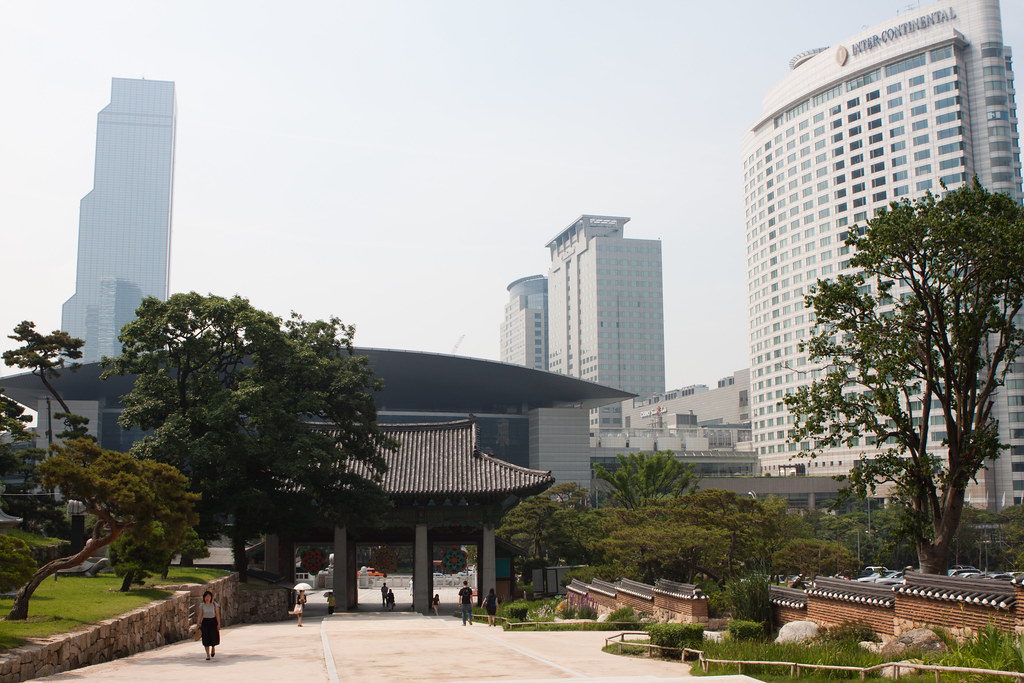
A temple gate framed by Gangnam’s high-rises — the contrast that defines Bongeunsa. Photo: Bongeunsa Temple (봉은사), Seoul, South Korea — Jirka Matousek, CC BY 2.0 via flickr (Source: https://www.flickr.com/photos/28415633@N00/8386644661)
The statues, halls, and quiet treasures on the grounds
The headliner is the Maitreya Buddha (Mireuk Daebul), a stone statue of the “Future Buddha.” It stands roughly 23 meters tall — among the tallest of its kind in Korea. Carved over a decade and finished in 1996, it drew contributions from thousands of lay Buddhists. Seen from its base, it is genuinely imposing, and it frames cleanly against the towers behind it.
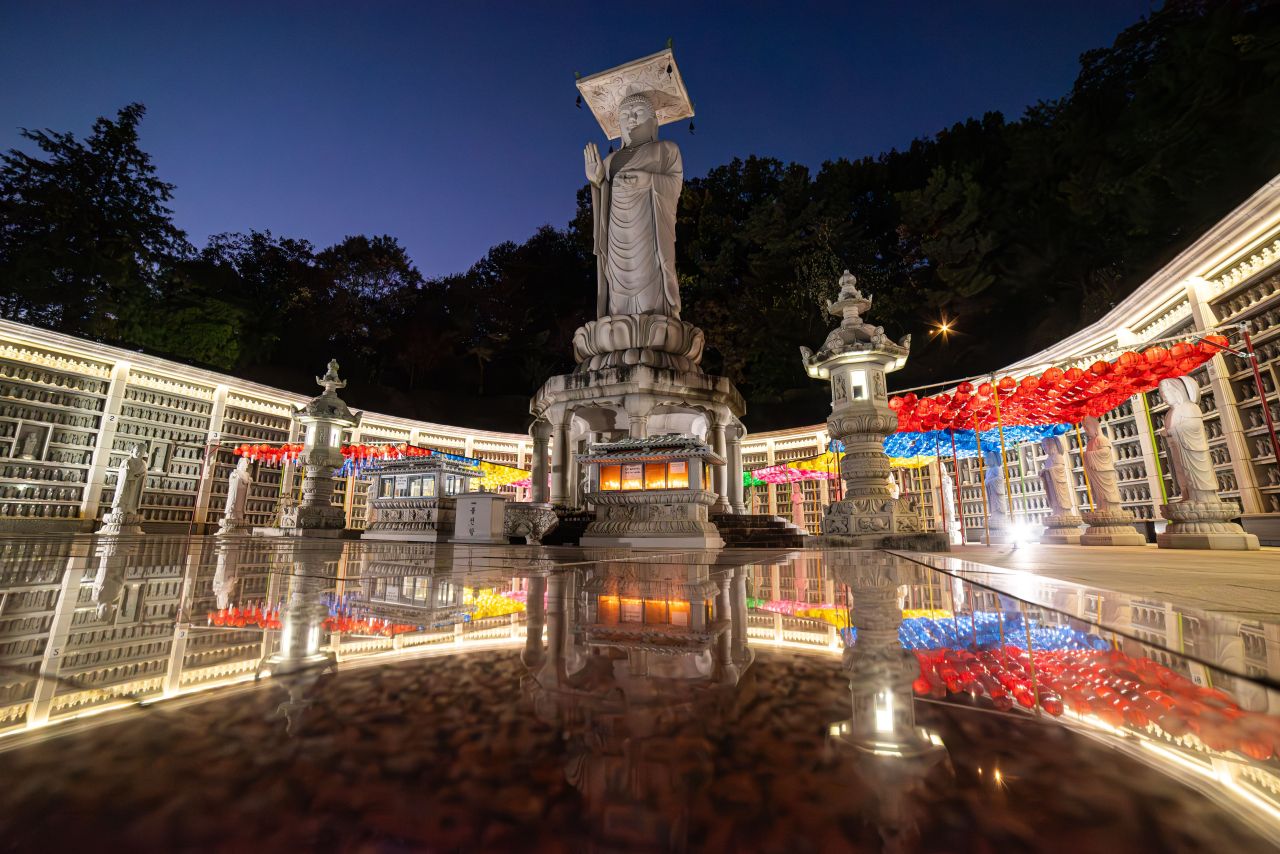
The Maitreya Buddha lit up at dusk, ringed by lotus lanterns and a mirror-still reflecting pool. Photo: 봉은사 / Source: Korea Tourism Organization 관광사진갤러리 (KOGL Type 1)
The smaller treasures reward attention too. The Panjeon scripture hall, built in 1855, is the temple’s oldest surviving building. Inside it holds nearly 3,500 carved woodblocks of Buddhist scripture, including the Avatamsaka (Flower Garland) Sutra. Kim Jeong-hee, one of Korea’s most revered calligraphers, brushed its wooden signboard. Both the board and the woodblocks carry protection as Seoul cultural properties. Many visitors walk right past it, which is a genuine miss.
If you would rather do something than just look, the wish candles are the easy way in. A self-service stall at Bongeunsa Temple sells them sorted by the twelve zodiac animals, each with its own design, so you find the year you were born, write a wish and offer the candle. It costs very little, nobody minds a non-Buddhist taking part, and it gives the visit a shape beyond photographing the Buddha. One footnote while you are wandering: there is a spring water point on the grounds, but it is signed as not for drinking.
Founded in 794, but rebuilt in living memory
Bongeunsa dates to 794 AD, founded during the Silla dynasty under King Wonseong. For centuries it carried real institutional weight — from 1551 to 1936 it served as the head temple of Korean Seon (Zen) Buddhism. The roots run deep.
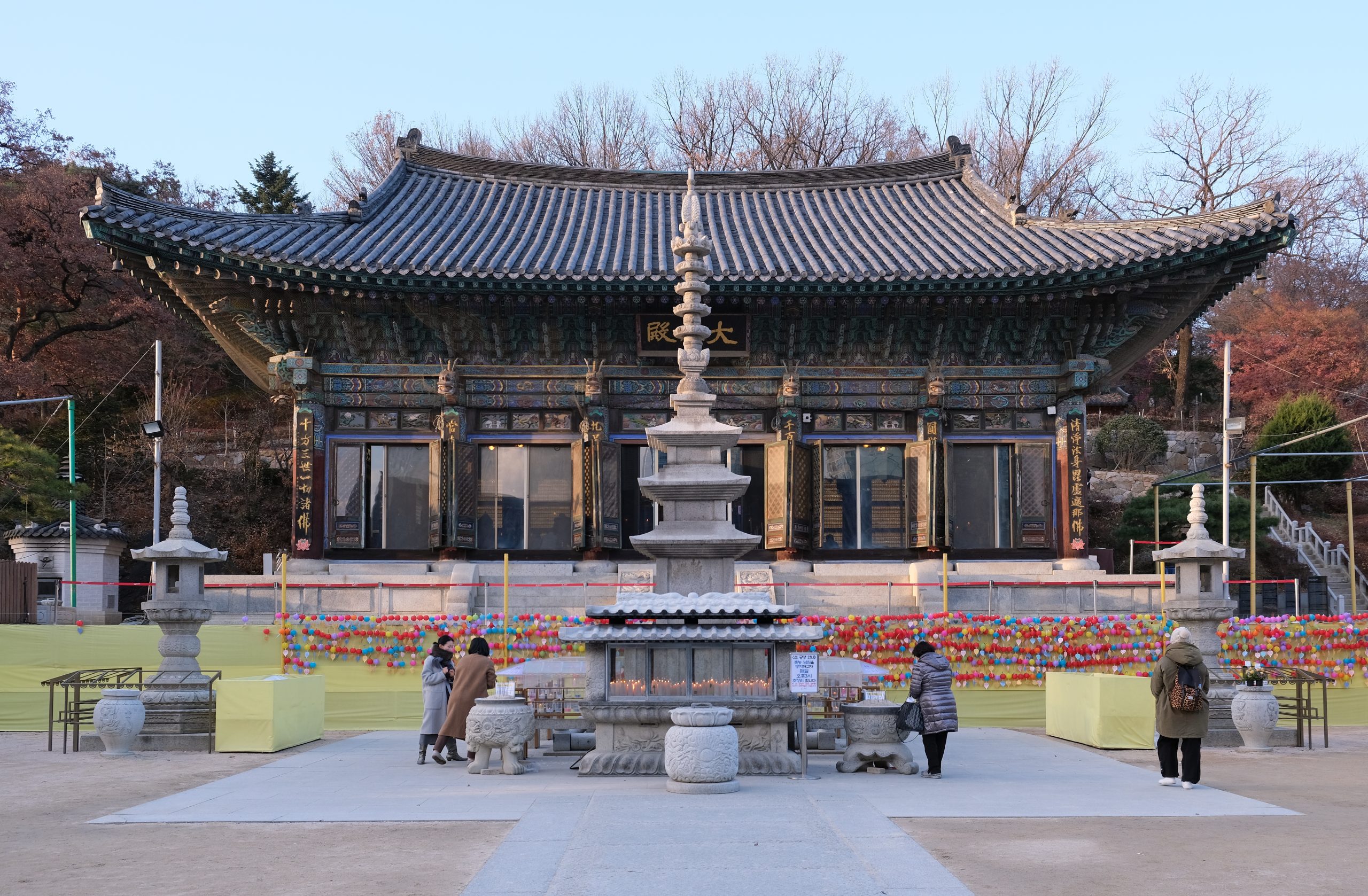
The Daeungjeon main hall and its stone pagoda, with autumn color creeping in behind. Photo: Bongeunsa Seoul 8 — kallerna, CC BY-SA 4.0 via wikimedia (Source: https://commons.wikimedia.org/w/index.php?curid=128414492)
One piece of context about Bongeunsa Temple is worth carrying in. A 1939 fire destroyed most of the temple, and the Korean War damaged it further. Many of the buildings on the grounds today are 20th-century reconstructions rather than 1,200-year-old originals. That does not make them inauthentic, since Korean temples have always been rebuilt after fires and wars. But if you are hunting ancient, weathered timber, seek out the Panjeon hall. It is effectively the one older survivor.
Joining the English Temple Life program
For those who want more than a walk-through, Bongeunsa runs one of Seoul’s most accessible English-language temple experiences. The Temple Life day program runs on Thursday afternoons and is designed for foreign visitors. It covers a guided tour, a meditative tea ceremony, sutra copying, lotus-lantern making, and a short meditation. Everything is in English, and no Buddhism background is needed.
Put another way, the day program costs less than a mid-range Gangnam lunch. The overnight sits in the range of a budget hotel night, but bundles food, lodging, and instruction. You pay for temple programs at booking through the official site, so no cash is needed for the experience itself. The grounds cost nothing to enter.
Picking the right season and hour
Any clear day works, but two windows stand out. In May, around Buddha’s Birthday, thousands of hanging lotus lanterns fill the grounds for the Lotus Lantern Festival. Spectacular, and also the busiest the temple ever gets. Go in knowing it is a festival rather than a quiet temple that day. There are queues for the toilets, the gift shop and even the candle stall, and the grounds pack shoulder to shoulder under the lanterns. The odd thing visitors keep reporting is that it still works. Even inside that crowd the noise drops away in patches, and the place feels like a temple again. In autumn (late October into November), the foliage on the slope turns gold and red, and the photographs almost compose themselves.
As for time of day, late afternoon is the sweet spot. Softer light, the 4:10 drum ceremony, and a thinner crowd than midday. Arrive by about 3:30 PM. That leaves time to climb to the Maitreya Buddha before the drum ceremony begins. Evenings hold their own appeal too, once the halls and lanterns glow against the dark towers.
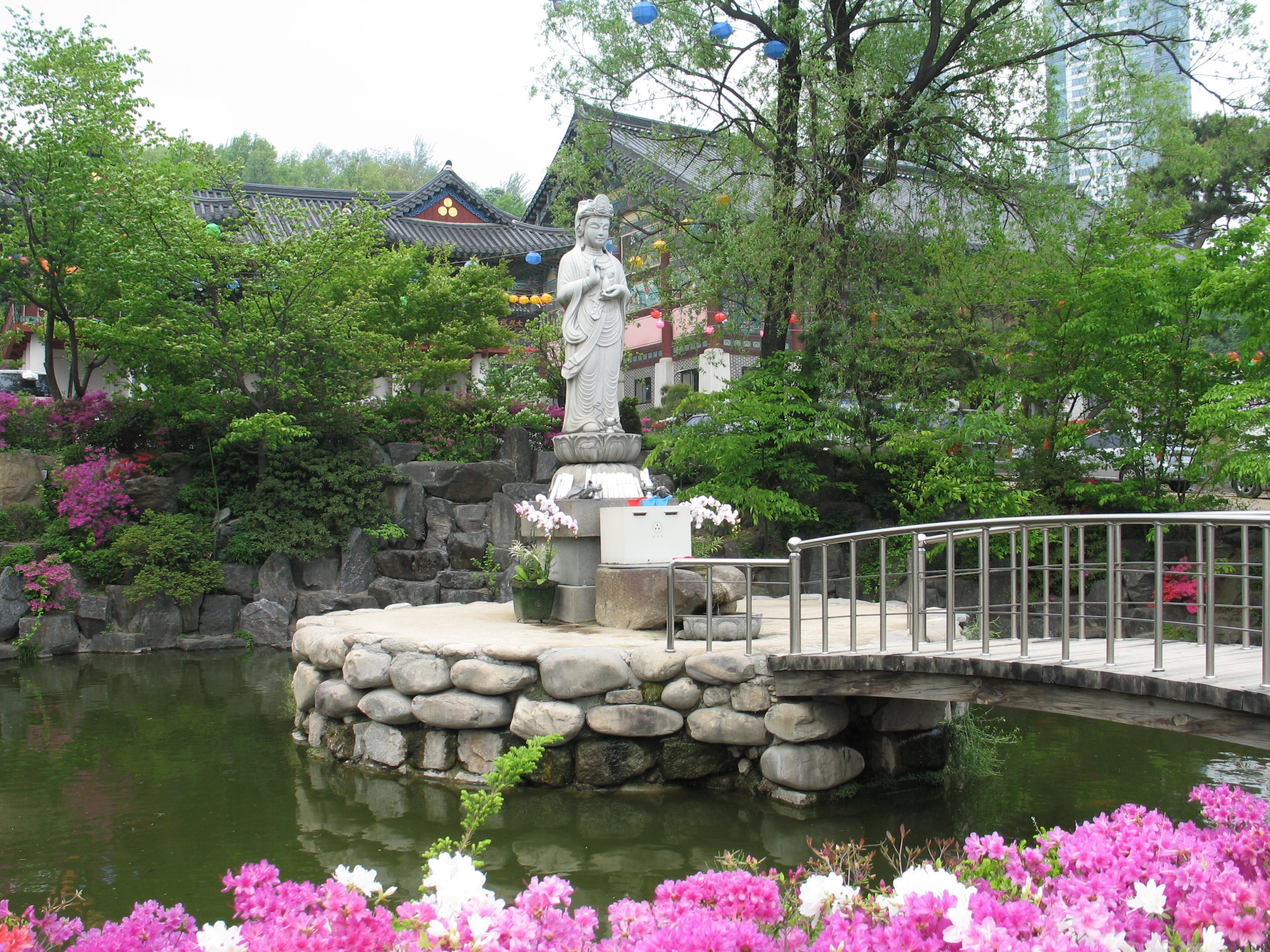
A Bodhisattva statue set in a quiet garden pond, framed by spring azaleas. Photo: Korea-Seoul-Bongeunsa-27 — Gaël Chardon, CC BY-SA 2.0 via wikimedia (Source: https://commons.wikimedia.org/w/index.php?curid=3999062)
A few caveats worth knowing at Bongeunsa Temple
Bongeunsa is a rewarding stop, but it is not flawless, and a few things catch travelers off guard. The entrance fronts a busy road, so the first thirty seconds feel anything but serene. The payoff comes only after the gate and the climb. Some visitors also find it a touch commercial. An ATM and a gift area sit near the front, which can undercut the mood if you came for total tranquility.
History expectations deserve tempering as well. Because so much was rebuilt last century, Bongeunsa does not feel as weathered or intact as an old mountain temple. Travelers who have already seen grand sites like Haeinsa or Bulguksa may find this urban one modest by comparison. Bongeunsa Temple also grows genuinely crowded on weekends and during the May festival. A weekday morning is the surest route to the calm most people come for.
And do not drive to Bongeunsa Temple. This is the one complaint that comes up consistently, and it is close to the only real one. Gangnam parking rates are steep, the temple’s own lot queues on busy days, and the surface is unpaved enough that passing cars raise dust over everyone behind them. If you do bring a car, settle the fee at the payment kiosk before walking back rather than at the barrier. Bongeunsa Station Exit 1 puts you at the gate in two minutes, which makes the whole question moot.
Whether it belongs in your Seoul plan
Bongeunsa Temple makes sense if you are in Gangnam and want a free, atmospheric break from shopping and skyscrapers. It pairs especially well with COEX across the street. It also suits travelers curious about Korean Buddhism who want a low-commitment English program. May and autumn show it at its best.
Skip Bongeunsa Temple if your trip is already heavy on temples. Skip it too if you want deep, untouched history rather than a living urban temple. In that case a mountain temple outside the city is the better use of a slot.
What earns Bongeunsa its place is exactly where it stands. A 1,200-year-old temple holding its ground in the middle of Korea’s flashiest district is a story that can only be told here. For more Seoul sights in this vein, browse our Seoul heritage sites.
Pingback: Jogyesa Temple: Seoul's Free Downtown Lantern Temple