
You’ve done Seoul. The palaces, the night markets, the neon. Now go coastal — to Gamcheon Culture Village, Busan’s pastel hillside icon. 🌊
Busan’s answer to a postcard is a hillside stacked with pastel houses, and it has a name: Gamcheon Culture Village. People call it “Korea’s Santorini” and the “Machu Picchu of Busan.” Cute nicknames. Here’s the honest deal, though. It’s gorgeous, it’s genuinely fun to wander, and it’s also a very real neighborhood that a lot of tour buses discovered years ago.
So this isn’t an untouched secret. It’s a curated, painted, absolutely-worth-it stop — if you go in with the right plan. If I had one Busan morning, I’d spend it here. Let me tell you how to do it well.
The quick facts you actually need 📋
- Address: 203 Gamnae 2-ro, Saha-gu, Busan (부산광역시 사하구 감내2로 203). Info line +82-51-204-1444.
- Hours: The village is an open residential neighborhood, so the lanes are walkable 24/7. Shops, galleries, and the info center run roughly 09:00–18:00 (Mar–Oct) and 09:00–17:00 (Nov–Feb), year-round.
- Price: Free entry. The optional stamp-tour map is ₩2,000 (about US$1.50) at the Haneul Maru info center.
- Getting there: Busan Metro Line 1 to Toseong Station (토성역), Exit 6, then a small green Saha-gu village bus (Saha 1-1) up the hill. Or grab a taxi from Nampo — easiest by far.
- ⏱ Time needed: 2–3 hours to do it right. You can rush the core in about 90 minutes.
- 🔗 Nearby pairing: Jagalchi Fish Market, Nampo-dong, and the coastal Huinnyeoul Culture Village.
- Verified as of July 2026.
How Gamcheon Culture Village went from slum to icon
Okay — the backstory matters here, because it changes how the place feels. This wasn’t built for tourists. The roots trace to relocations in the 1920s and 30s. But the village really formed after the Korean War, around 1955.
Roughly 800 refugee families climbed this hillside and stayed. Among them was the Taegukdo religious community. They built homes in staggered tiers so that no house blocks another’s view or sunlight. That tidy stacking? It’s not a design gimmick. It’s a hard-won courtesy between neighbors who had almost nothing.
By the 2000s the village had emptied out. Younger residents left for the flatlands, and homes fell vacant. It was close to an abandoned slum. Then in 2009 a government-and-artist project — nicknamed “Dreaming of Busan’s Machu Picchu” — turned those empty houses into galleries and cafes and filled the lanes with murals and sculpture. Now about 1.4 million people visit every year.
That’s the whole arc, and you can feel both halves of it as you walk. The polished, painted main lane is the 2009 project. The steep, worn side stairs and the laundry drying on a rail? That’s the older village, still lived in. Both are true at once, and that tension is exactly what makes the place interesting.
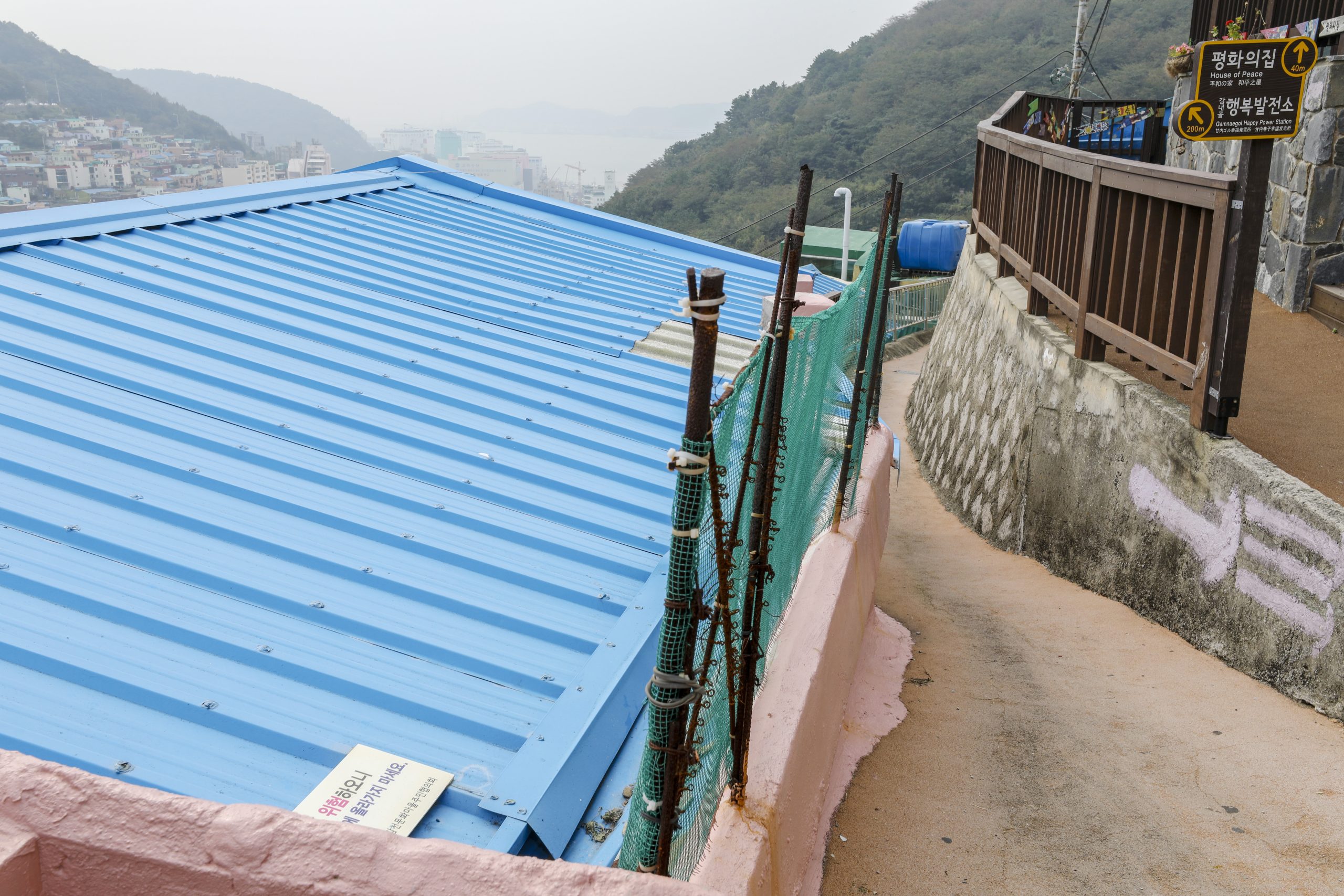
Photo: A hillside lane in Gamcheon Culture Village looking out over Busan toward the sea. CC BY-SA 2.0 via Wikimedia Commons.
The spots worth hunting down 🎨
The village is a maze, and that’s the point. Don’t grip the map too tightly. But a few landmarks are worth aiming for.
The Little Prince & Fox statue
This is the shot. A small statue of the Little Prince and his fox sits on a wall, gazing out over the tiered rooftops behind them. It’s the image you’ve seen on every Busan travel post. Expect a queue — it’s polite here, but it’s real. There’s also a new Little Prince House exhibition that opened in March 2026, billed as Asia’s only officially recognized one. It’s brand new, so check hours and tickets on-site.
The stamp tour and Fish Alley
Buy the ₩2,000 stamp map at the Haneul Maru info center. It routes you to designated art spots where you collect stamps, and you trade a full sheet for postcards. Real talk? It’s a little touristy. It’s also a genuinely clever way to make sure you find the good corners instead of just the main drag. Look for Fish Alley (물고기 골목), a lane of painted wooden fish that double as directional arrows.
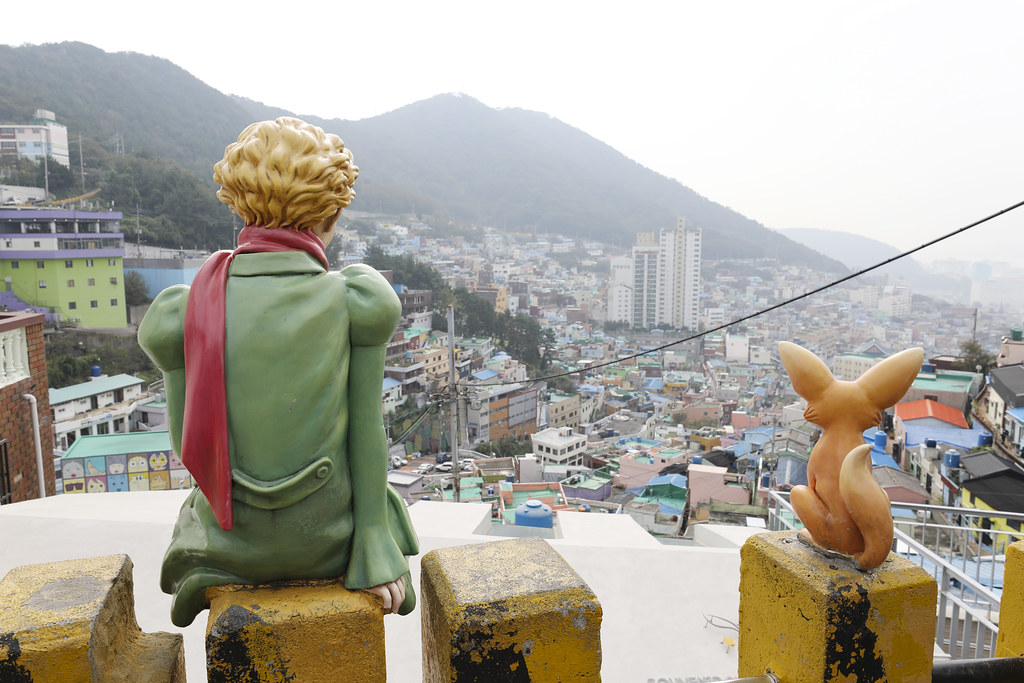
Photo: The Little Prince and fox statue gazing over Gamcheon Culture Village, Busan. CC BY-SA 2.0 via Flickr.
The stairs and the views
The “Stairway to See Stars” (별 보러 가는 계단) is a long, steep staircase — a landmark and a workout in one. The name is romantic. Your legs will disagree. The Haneul Maru Sky Terrace by the main entrance gives you the classic panorama: rooftops tumbling down toward the sea in a wash of mint, coral, and cream.
Honestly, though, the best views come when you wander past the entrance into the quiet upper lanes. Fewer people, same pastel magic. Duck down a random alley and you’ll find a mural nobody’s photographing, or a tiny cafe with a rooftop that opens onto the whole hillside. That’s the version of Gamcheon worth remembering.
The honest downsides — read this before you go
I’d rather you know the rough edges now than curse me on the hill later.
It is steep. Very steep. Stairs and inclines, everywhere. Do the village properly and you’ll clear 10,000 steps without trying. Here’s the catch nobody warns you about. Every tempting little lane runs downhill, and you have to climb back out of it. It’s tiring for anyone, and genuinely tough for elderly travelers, anyone with mobility issues, and families pushing strollers. Wheelchairs will struggle. Wear real shoes — leave the heels at the hotel.
Summer is the wrong season. There’s almost no shade. The pastel walls throw the heat straight back at you, and the climbing never stops. Visitors who came in midsummer keep landing on the same verdict: don’t. If you’re locked into a July or August date, go at opening and duck into a cafe when you flag.
Crowds, cars, and expectations
The Little Prince queue is a real queue. That statue is the shot everyone wants, so people line up to take it one at a time. It moves. But on a busy afternoon tempers fray, and squabbles over cutting in are not unheard of. Come early or accept the wait.
Driving here is a mistake. This is the loudest complaint from anyone who tried it. The village sits high up on narrow lanes, cars park along the shoulders, and the gradient is severe. Parking is scarce enough that some visitors spend their morning fielding calls to go shuffle the car. Take the village bus or a taxi instead. Watch for vehicles squeezing through the alleys while you walk, too.
Not everyone leaves Gamcheon Culture Village impressed. A recurring verdict runs like this: smaller than expected, and busier than it is interesting. Some walk away feeling there were more people than things to see. Plenty wouldn’t make time to come back. Souvenirs and cafe prices also run above what you’d pay down in central Busan. Come for the wander and the views, not for a checklist of attractions.
People live here. This is a working residential neighborhood, not a theme park. Signs ask you to keep your voice down and respect privacy. Drones are prohibited. Please don’t peer into windows for a photo.
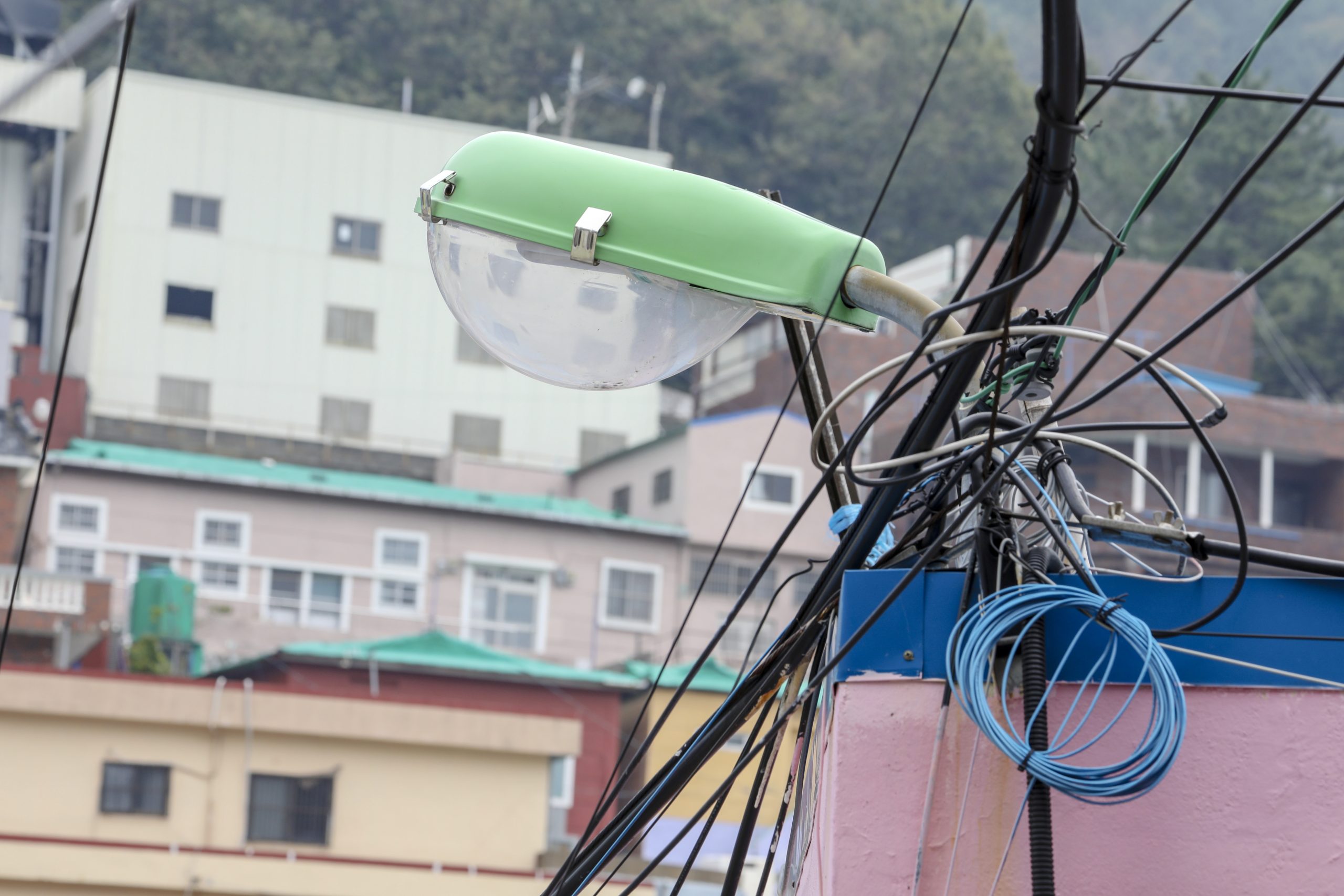
Photo: A real, lived-in street in Gamcheon Culture Village — tangled wires and all. CC BY-SA 2.0 via Wikimedia Commons.
Should you go? A straight answer
Go if you love photography, murals, and public art. Go if you enjoy getting pleasantly lost in alleys. Go if you’re doing a Busan day and want one signature stop that’s free and easy to slot in. This place delivers on all of that.
Adjust your plan if stairs are a problem. Here’s the move: take a taxi to the top near the Haneul Maru entrance, then walk down through the village. Gravity does the hard part.
Maybe skip if you’re deeply crowd-averse and can’t make an early start, or if you’re chasing an “untouched authentic village.” This one is popular and curated by design. That’s not a flaw — it’s just what it is.
Building it into your Busan day
Gamcheon rewards a smart pairing. Do it in the morning while the light and the calm are on your side. Then roll downhill into the rest of the city.
My favorite loop: Gamcheon Culture Village at opening, then a taxi or the bus-plus-metro back to Nampo-dong for lunch at Jagalchi Fish Market. Grab live seafood, then browse the stalls of Gukje Market and BIFF Square next door. In the afternoon, head to Huinnyeoul Culture Village — a coastal cliff-side counterpart with sea views — or unwind at Songdo Beach. That’s a full, satisfying Busan day without backtracking.
A note on the bus ride up, since it trips people up. From Toseong Station Exit 6, look for the small green Saha-gu village bus (Saha 1-1 is the reliable one; Saha 1, Seo-gu 2, or Seo-gu 2-2 also work). It winds up the hill for 10 to 15 minutes. Get off near Gamjeong Elementary School — that drops you right at the main entrance. If stairs or mobility are a concern, skip all of that and take a taxi from Nampo or Busan Station. It’s only 15 to 20 minutes and worth every won.
If you’re collecting the country’s signature stops, Gamcheon absolutely earns its slot. Want more like it? Browse our guide to more Korea icons & views to map out the rest of your trip.
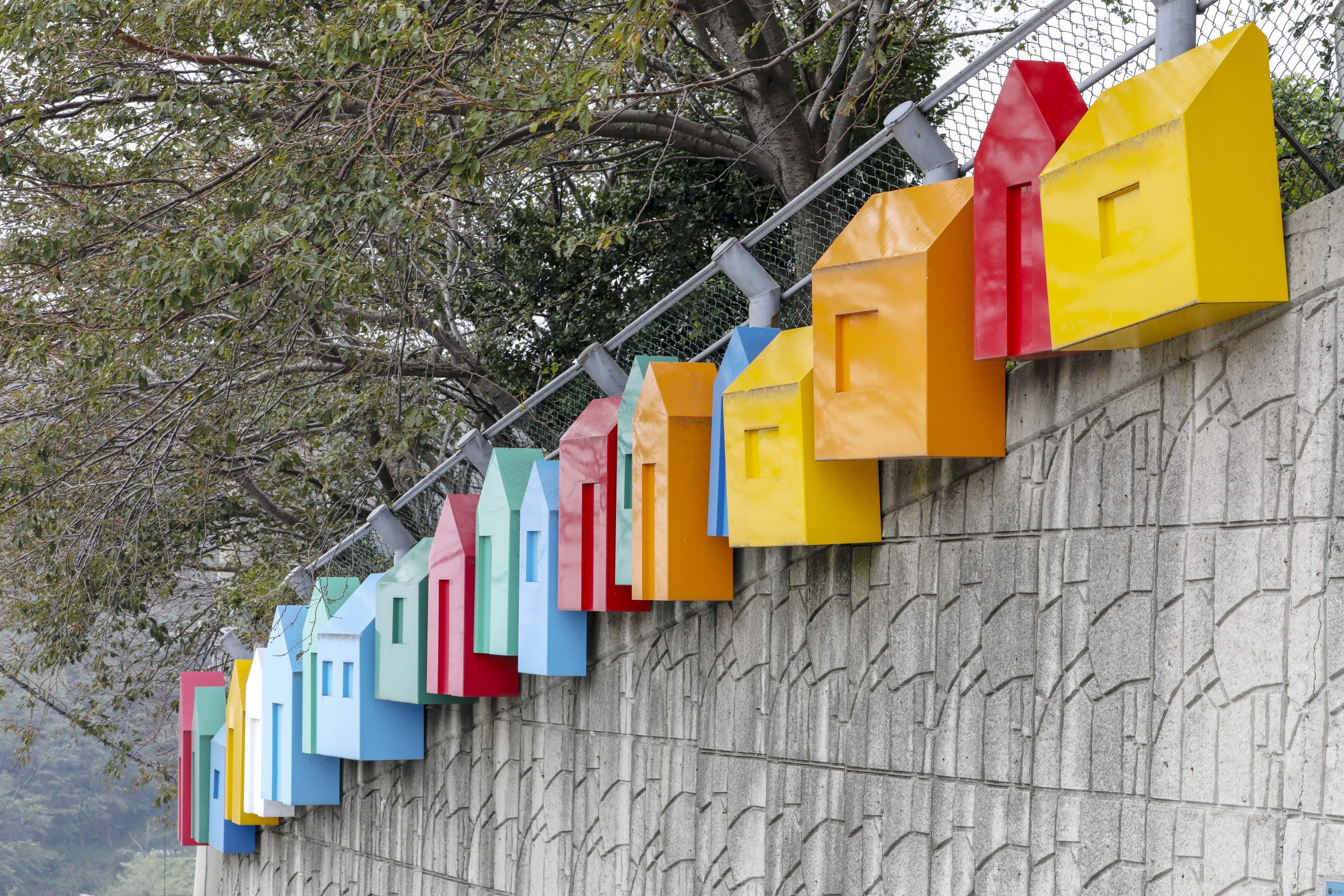
Photo: Colorful painted-house art brightening a wall in Gamcheon Culture Village, Busan. CC BY-SA 2.0 via Wikimedia Commons.
Trust me on the early start. Get there when the lanes are quiet, wander past the crowds, and let yourself get lost. That’s when Gamcheon stops being a photo op and becomes a place. 🇰🇷
Pingback: Leeum Museum of Art: Seoul's World-Class Art Museum