
Room for exactly one cultural stop in your Seoul itinerary? The National Museum of Korea is the one most guides put at the top of the list. It is the most complete overview of what the country is — roughly five thousand years of it, under one roof, and free to enter. This is not a quirky detour or an insider secret. It is the national collection, housed in a building the size of a small airport, on a parkland campus in Yongsan. The detail that surprises most visitors: the entire permanent collection costs nothing to walk into.
The scale is the whole story, and it cuts both ways. Approached badly, it becomes a forced march through dim galleries until the feet give out. Approached with a short hit-list and an unhurried pace, it turns into one of the most rewarding two-to-three-hour stretches in the city.
- 📍 Address: 137 Seobinggo-ro, Yongsan-gu, Seoul (서울특별시 용산구 서빙고로 137)
- 🕘 Hours: 9:30 AM–5:30 PM (Mon, Tue, Thu, Fri, Sun); 9:30 AM–9:00 PM (Wed & Sat); last entry 30 min before close. Closed Jan 1, Seollal & Chuseok.
- 💵 Price: Permanent exhibition FREE. Special exhibitions are paid (roughly ₩5,000–₩20,000; popular shows need a timed online reservation).
- 🚇 Getting there: Ichon Station (이촌역), Subway Line 4 or the Gyeongui–Jungang Line, Exit 2 → follow the covered “Museum Underpass” walkway (~5 min).
- ⏱ Time needed: 2–3 hours for the highlights; a half- to full day if you go deep.
- 🔗 Nearby: Yongsan Family Park (right next door) and the War Memorial of Korea (a short hop) — see the pairing notes below.
- ✅ Verified as of June 2026.
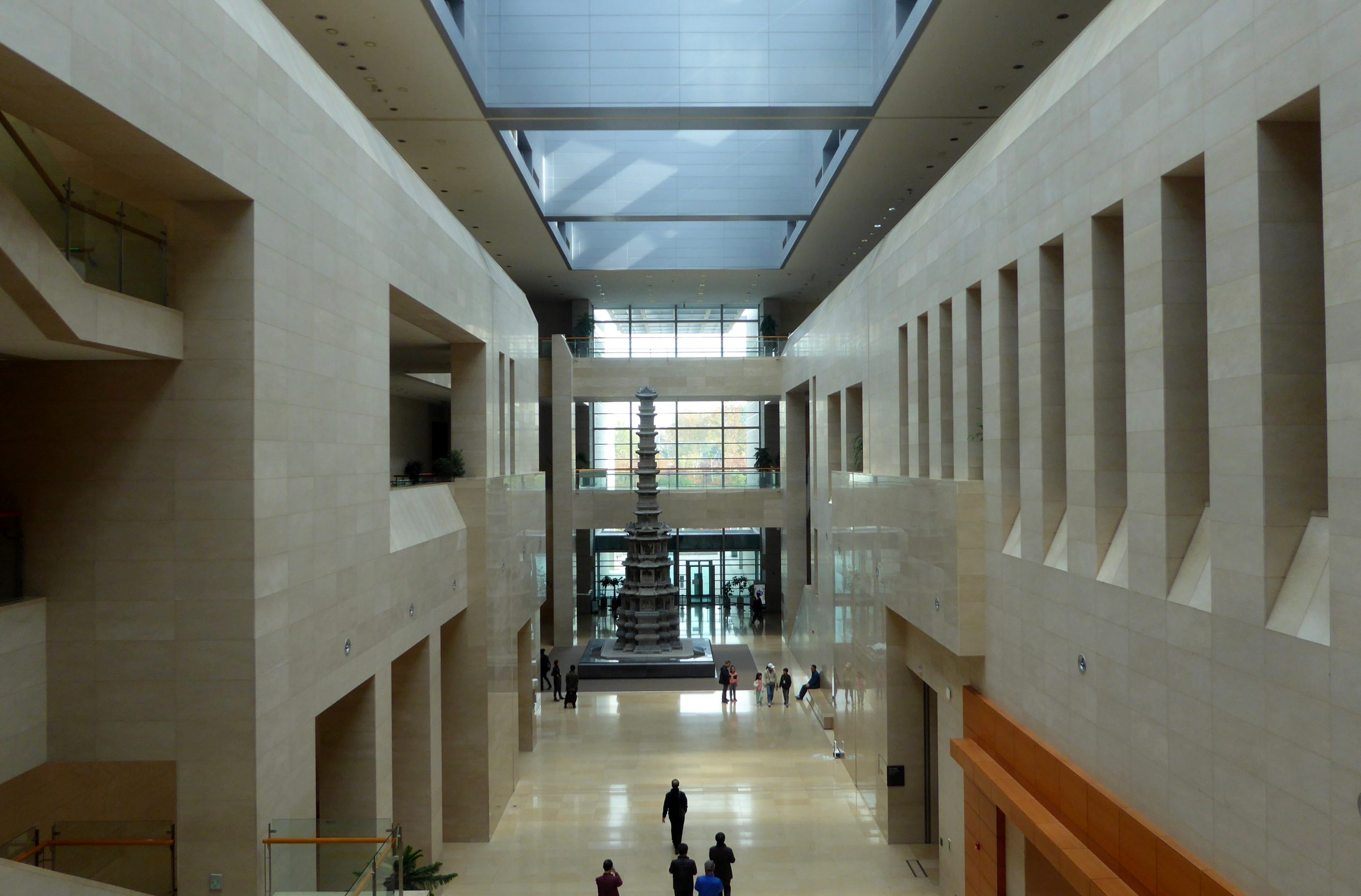
Photo: Interior View of the National Museum of Korea — Ethan Doyle White, CC BY-SA 4.0 via Wikimedia Commons.
A country telling its own story
The short version: this is Korea narrating its own history, and it does the job exceptionally well. The permanent galleries run from Paleolithic hand-axes through Silla gold, Goryeo celadon, and Joseon scholarship into the modern era. The holdings exceed 310,000 objects, with a curated fraction on display across six galleries and three floors.
What separates it from any other large museum is the building itself. The collection is arranged around a soaring central spine called the Path to History. This glass-roofed hall runs the full length of the structure, with a sightline carrying straight through to Namsan in the distance. On a rainy or brutally hot Seoul day, this free, air-conditioned space ranks among the smartest places in the city to be.
Four galleries worth building the visit around
The Ten-Story Pagoda in the Great Hall
This one is impossible to miss — a 13.5-metre marble pagoda standing inside the central hall, visible from several floors as visitors climb. It is the Ten-Story Pagoda from Gyeongcheonsa Temple, carved in 1348 during the Goryeo dynasty. Its rarity comes from the material: most Korean pagodas are granite, while this one is marble. The tiers reward a close look, carved with winding scenes of Buddhas and dragons. Bringing it indoors, lit and protected, was a shrewd move, and it has become the museum’s unofficial mascot.
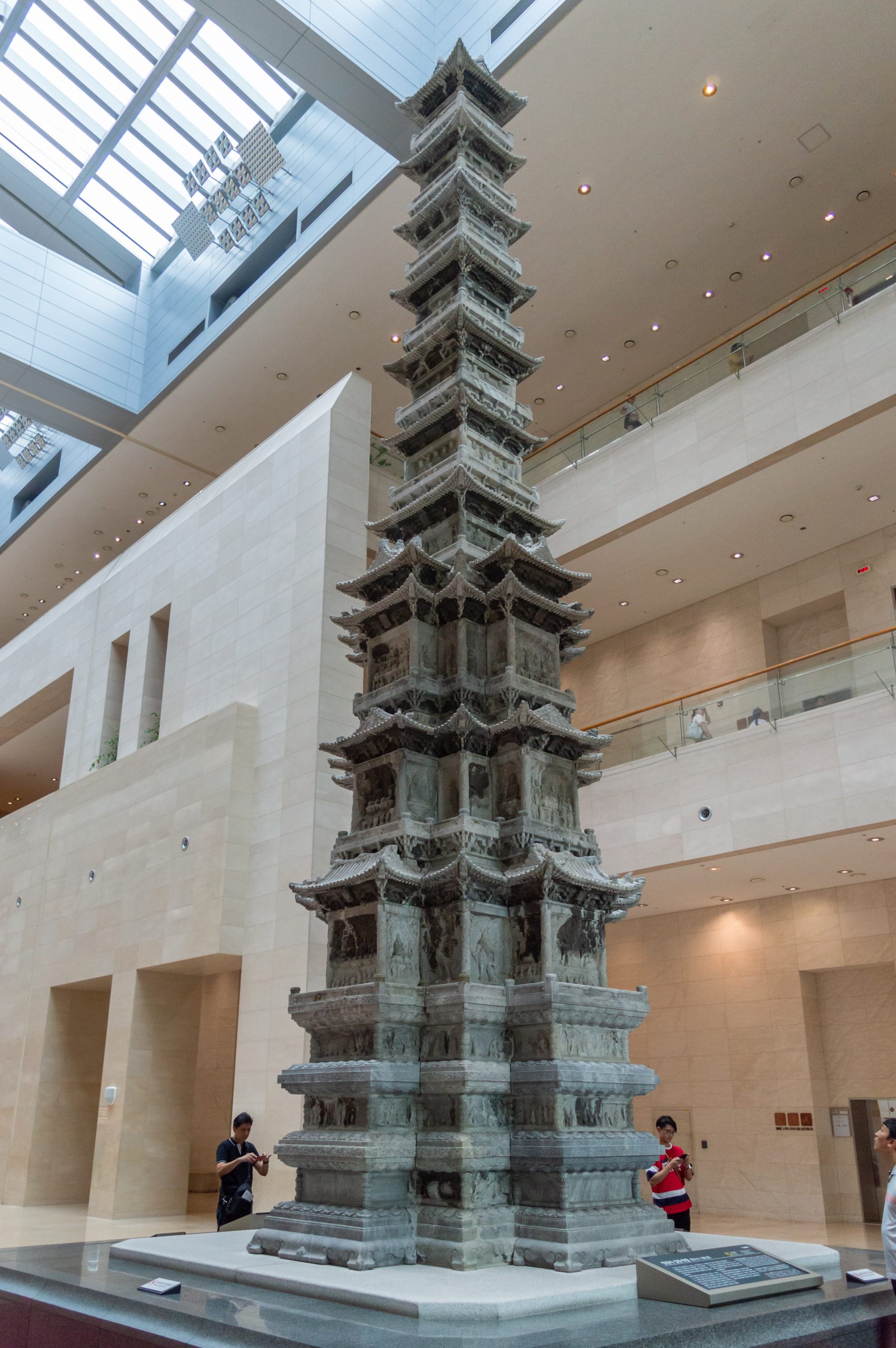
Photo: Ten-Story Pagoda from Gyeongcheonsa Temple, in the museum’s Great Hall — Tristan Surtel, CC BY-SA 4.0 via Wikimedia Commons.
The Room of Quiet Contemplation
If a single space defines the museum, this is it. The Room of Quiet Contemplation (사유의 방) is a dedicated, dimly lit gallery built around two gilt-bronze Pensive Bodhisattva statues (National Treasures No. 78 and No. 83), shown side by side in a room designed for them alone. A ceiling of thousands of suspended rods glows like a slow starfield, and the floor tilts gently underfoot. The lighting is pitched to make everyone slow down and simply look. It opened in 2021 and quickly became the most discussed space in the building. Ten unhurried minutes is the standard advice from repeat visitors.
The Silla gold crowns
Up on the prehistory and ancient-history floor, the gold from the Silla kingdom is the showstopper. The delicate, tree-and-antler-shaped gold crowns were recovered from the great royal tombs in Gyeongju. They are strung with comma-shaped jade gogok and tiny gold spangles that would have shimmered with every movement. Fifteen centuries old, they somehow look as if they were finished last week. This is the material that makes the “five thousand years of history” line feel earned rather than like marketing copy.
Goryeo celadon
The celadon collection explains why Korean ceramics were once the envy of Asia. The jade-green glaze, the impossibly fine inlay work, the restrained shapes — this is quiet, confident craftsmanship. If your eyes are starting to glaze over by this point, it makes a good gallery to finish on. It rewards slow looking rather than reading every label.
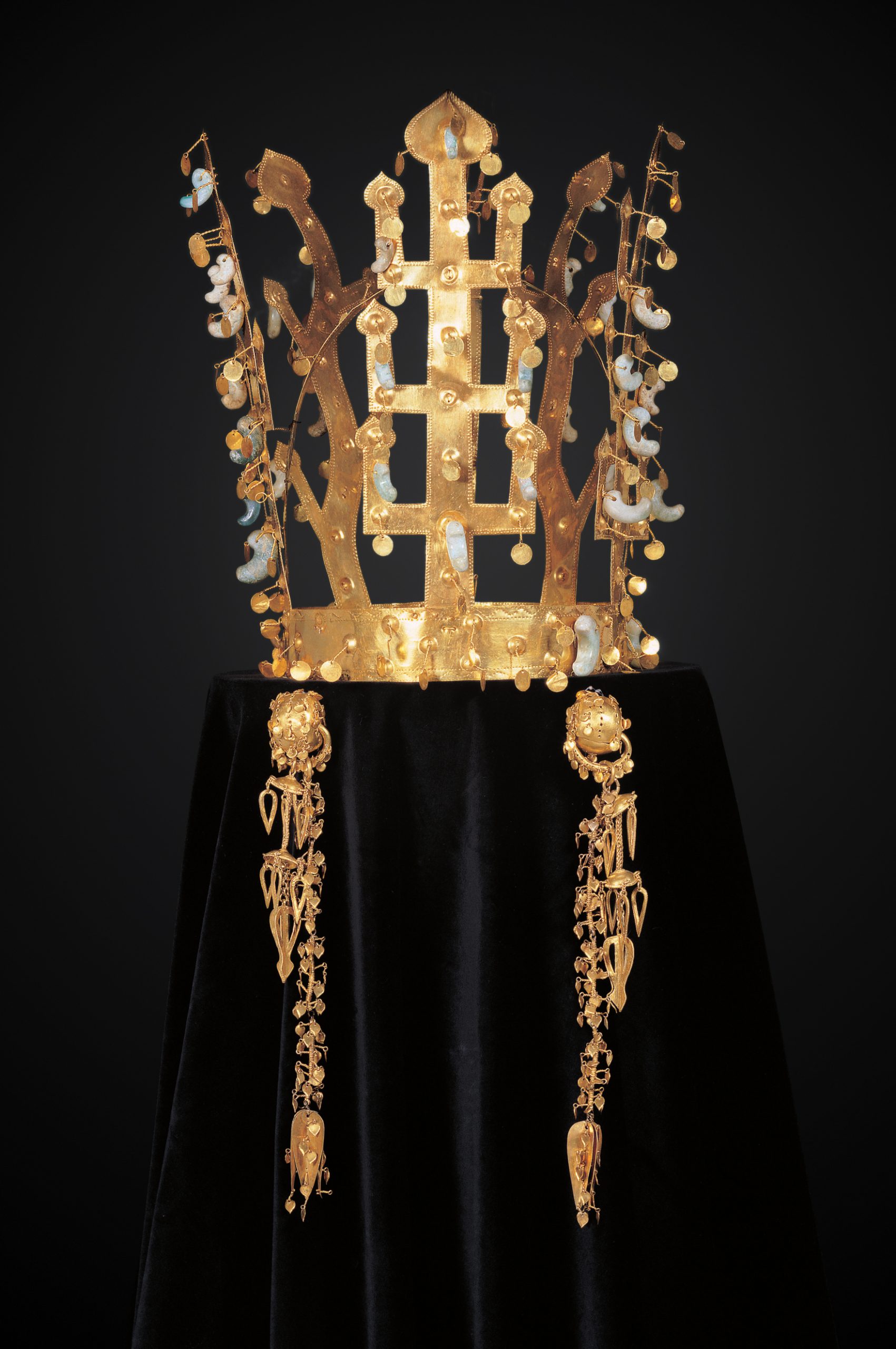
Photo: Silla gold crown, National Museum of Korea — Ismoon, CC BY-SA 4.0 via Wikimedia Commons.
The grounds are half the experience
There is no reason to bolt for the exit on the way out. The museum sits in a large landscaped park with an oval Mirror Pond out front that reflects the building. An outdoor garden is dotted with stone pagodas, steles and small waterfalls. Many of them are genuine relocated artifacts. It is free, stays open well into the evening, and is where the building looks its best. Lit up at dusk and mirrored in the pond, it is one of the better photo spots in Yongsan. Yet almost nobody treats it as a destination in its own right.
Families should note the separate, free Children’s Museum on the campus, which is hands-on and well done (reservations are often advised). It can buy the focused gallery time the adults are after.
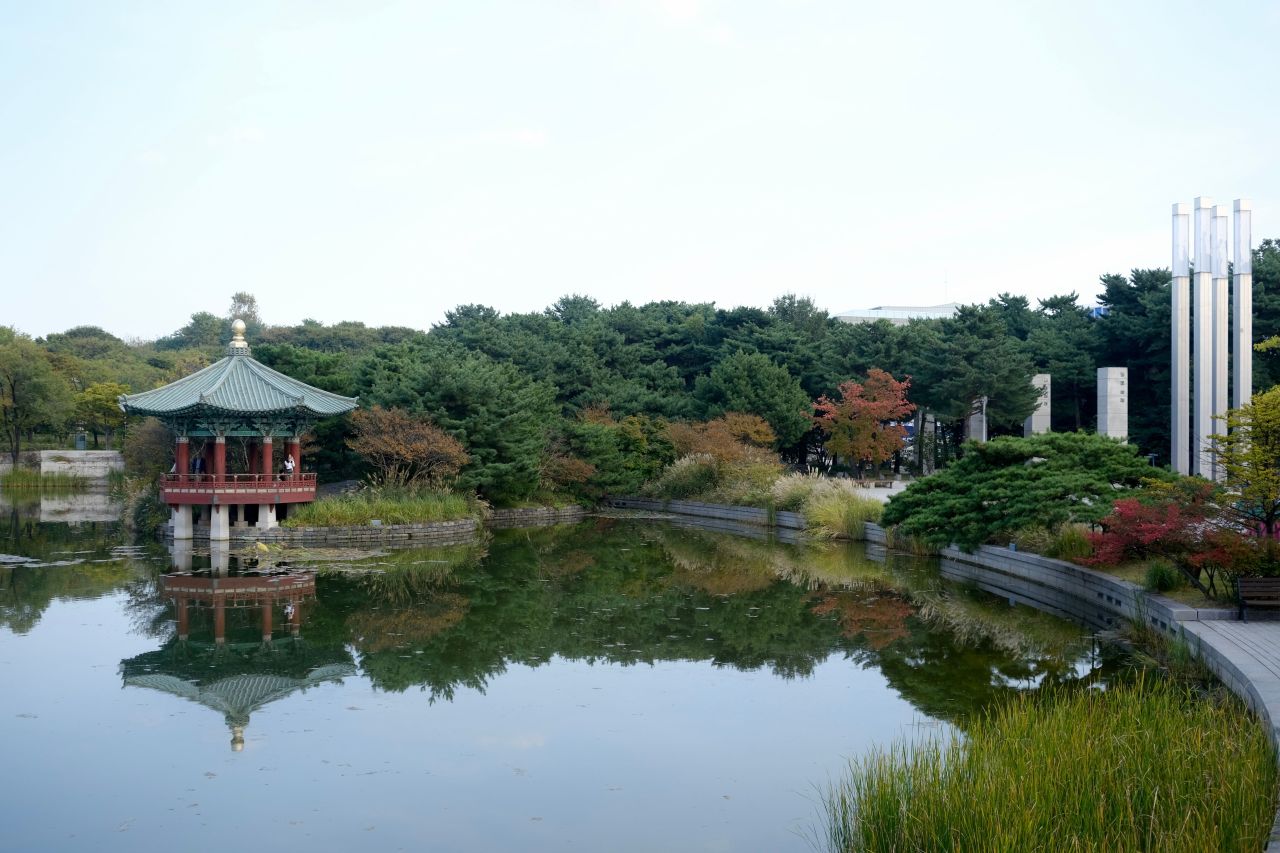
Photo: National Museum of Korea grounds and reflecting pond / Source: Korea Tourism Organization (KOGL Type 1).
National Museum of Korea’s drawbacks, and how to plan around them
One planning note first: the two late-close evenings, Wednesday and Saturday until 9:00 PM, are the sweet spot. Arriving around 3:30–4:00 PM catches the quieter late-afternoon galleries. Then step outside for the illuminated building over the pond after dark, without fighting the midday school groups. With that in mind, the fair-warning list:
- It is genuinely huge — and tiring. This is one of the largest museums in the world by floor area, and “we got exhausted and gave up halfway” is the most common complaint. Pace the visit and use the seating (there is plenty of it, mercifully).
- It’s a bit out of the way. Yongsan isn’t where most first-timers are based. Even after reaching Ichon Station there is a covered walk to the entrance, then more walking across the grounds. Build in the transit time.
- Never drive here. This is the complaint that dwarfs the rest. The car park backs up onto the approach road, and one visitor logged 55 minutes queuing to reach the barrier — on a weekday morning, not a weekend. Ichon Station takes the whole problem away.
- Two queues before you see anything. At peak times the entry line runs around 30 minutes. Then, if you are carrying a bag of any size, you join a second line for the X-ray check. Travel light and you skip half of it.
- Busiest 12:00 to 15:00, and busy regardless. Weekday afternoons draw real crowds now, not just weekends. Early morning or the late-close evenings are the only reliably calm windows.
- Some sections are dry. The early ancient-history rooms are heavy on cases of pottery shards and light on interactivity. Visitors who don’t warm to that can walk briskly through to the gold and the celadon.
- English labeling thins out. The main galleries are well captioned in English, but coverage gets patchier in places, and the experience is richer with the museum’s app or an audio guide.
- Crowds and noise. Weekends and school-trip days can be loud, and popular special exhibitions get packed (and may require a timed reservation).
- The gift shop sells out. It is genuinely good, and the popular items disappear. If something catches your eye, buy it on the way past rather than on the way out.
Is it the right stop for your trip?
The National Museum of Korea earns its slot if you want the definitive overview of Korean history and art. It suits confirmed museum-goers, and it works as a free, climate-controlled refuge for a few hours. Families are a more mixed picture than most guides admit. Older children who like history do fine, but younger ones tend to flag well before the halfway mark — parents regularly report giving up after the first floor. Plan a short, targeted visit if you have small kids in tow. It makes less sense on a two- or three-day Seoul trip if you aren’t a museum person. That time may go further on a palace, a market, or the streets themselves. Korea’s living culture is out there too.
Make a day of it in Yongsan
The museum pairs well with everything around it. The easiest combination is a short walk into Yongsan Family Park next door for a green-space decompress after all that gallery time. For a heavier, all-history day, the nearby War Memorial of Korea adds a complementary layer. The Ichon Hangang Park riverfront is also close for anyone who wants to end the day by the water.
Want more Seoul landmarks to build an itinerary around? Browse the rest of our Seoul icons & views for ideas.
The case for going
The National Museum of Korea is the rare must-see that is also free, indoors, and impossible to outgrow. The key is to treat the National Museum of Korea as a greatest-hits set rather than a marathon. The Ten-Story Pagoda, the Room of Quiet Contemplation, the Silla gold, the celadon, then out to the pond. Handled that way, it leaves visitors with a real feel for Korea and enough energy left for the rest of the day.
Map & location:
Pingback: 3 Days in Seoul: First-Timer's Itinerary (2026)